

A service desk, in contrast, is strategic. It’s a holistic function designed to manage the entire lifecycle of IT services to make sure they’re aligned with bigger business goals.
Defining The Core Difference Between Service Desk and Help Desk
It’s common for organizations to use "service desk" and "help desk" as if they mean the same thing, but that overlooks a massive distinction in their purpose and how they connect to the business. Getting this right is absolutely essential for leaders who want to build support structures that can scale and deliver real, measurable value.
The help desk is where most IT support functions start. Its mission is simple: give end-users a single place to go when they run into technical trouble. Think of it as the IT firefighter, rushing to put out fires as they pop up. This model is entirely user-centric, and success is all about how fast you can close individual tickets.
The service desk is the evolution of that concept. It still handles the break-fix work of a help desk, but it wraps it in a much broader, business-first framework. A service desk doesn't just manage incidents; it also handles service requests (like setting up a new hire), change management, and even problem management to stop recurring issues.
The simplest analogy I've found is this: a help desk is the emergency room doctor treating an acute injury. The service desk is the primary care physician managing the overall health and well-being of the organization.
This strategic approach is usually guided by a formal framework, most often the Information Technology Infrastructure Library (ITIL). This ensures IT services are delivered consistently, efficiently, and in a way that actually supports what the company is trying to achieve. A service desk doesn’t just fix what’s broken—it actively works to prevent problems and improve how services are delivered across the board.
Help Desk vs Service Desk At a Glance
To make these distinctions crystal clear, let's break down how each model operates at a high level. This table really highlights the fundamental gap between a tactical help desk and a strategic service desk, giving you a quick reference for their core purposes and focus.
| Attribute | Help Desk (Tactical) | Service Desk (Strategic) |
|---|---|---|
| Primary Focus | Incident resolution (break-fix) | Business process integration |
| Approach | Reactive | Proactive and reactive |
| Scope | Narrow, focused on end-user issues | Broad, covers the entire service lifecycle |
| Framework | Often informal or process-light | Aligned with ITIL or other ITSM frameworks |
| Business Goal | Restore normal service quickly | Deliver and improve IT services for business goals |
As you can see, while both are essential support functions, their contributions to the business are worlds apart. One keeps the lights on day-to-day, while the other helps design a more reliable and efficient power grid for the future.
Comparing Scope, Workflows, And Business Alignment
Once you get past the basic definitions, you realize a help desk and a service desk operate in completely different orbits. Their day-to-day functions, process maturity, and connection to the bigger business strategy are worlds apart. Nailing these operational differences is key to choosing a model that doesn’t just put out fires but actually drives business value.
A help desk is all about a narrow, tactical scope. It exists to handle break-fix incidents—when something that was working suddenly isn't. This laser focus makes it incredibly efficient at resolving individual user problems like password resets, software glitches, or a printer that just won't connect.
On the flip side, a service desk has a much broader mandate. It acts as the central hub for all IT service interactions, managing everything from break-fix incidents to new service requests. This means it handles not just problems but also proactive tasks like getting new hires set up with the right gear and software access, managing software licenses, and guiding planned system changes.
Contrasting Operational Workflows
The workflow of a help desk is pretty linear and reactive. A user submits a ticket, an agent grabs it, fixes the issue, and closes it out. The whole process is self-contained, with the main goal being to restore service for that one person as quickly as possible.
A service desk, however, runs on integrated, ITIL-aligned workflows. When a ticket comes in, it's not just an isolated incident; it’s a data point. The service desk analyst immediately starts connecting it to broader business functions, asking strategic questions:
- Is this a recurring issue? If so, it gets escalated to problem management to find a permanent fix.
- Does this fix require a system change? If it does, the change management process kicks in to assess risk and coordinate the deployment.
- Is this tied to a specific asset? The ticket is linked to the Configuration Management Database (CMDB) to track the asset’s full history.
This process-driven approach turns reactive fixes into proactive improvements, which directly boosts service quality for the entire organization.
A help desk asks, "How can I fix this user's problem right now?" A service desk asks, "How can I fix this user's problem, and what can we learn from it to prevent it from happening to anyone else?"
Analysing Business Alignment And Strategic Impact
This is where you see the biggest split. A help desk is fundamentally user-centric. Its success is measured by how well it satisfies individual users by closing their tickets quickly. While that's vital for keeping people productive, the focus is inherently tactical and has a limited direct impact on overall business strategy.
In contrast, a service desk is explicitly business-centric. Its main goal is to make sure IT services are delivered in a way that supports and enables the organization's goals. Success isn't just about closing tickets; it's about maintaining service availability, ensuring system changes go smoothly, and improving the quality of IT services over time.
For instance, a key part of optimizing operations is learning how to go about automating customer service with proven workflows. This business-centric view seeks efficiency gains that benefit the whole company, not just how fast one ticket gets resolved.
This strategic alignment is becoming more important in a growing market. The broader MEA IT services market, which includes these critical functions, is projected to hit USD 232.10 billion in 2025 and grow to USD 364.33 billion by 2030. This growth is fueled by trends like government digitization, where a strategic service desk is essential for managing complex, large-scale service delivery.
Real-World Scenarios
Let's walk through a practical example to see how each model would handle the same event: a recurring software bug.
Help Desk Response
- Ticket Received: An employee reports their CRM software crashes when running a specific report.
- Resolution: The help desk agent gives them a known workaround, like clearing the cache or restarting the app.
- Ticket Closed: The user can now run the report. The ticket is marked as resolved.
- Outcome: The immediate problem is fixed for one person, but the underlying bug is still there, waiting to trip up the next user.
Service Desk Response
- Incident Recorded: The same CRM software crash is logged as an incident.
- Problem Identification: The analyst sees that multiple similar incidents have been logged and creates a "problem" record, linking them all together.
- Root Cause Analysis: The problem management team investigates and finds the root cause—a bug in the latest software update.
- Change Request: A change request is created to deploy a patch from the vendor. This is assessed for risk and scheduled carefully.
- Resolution: The patch is deployed, permanently fixing the bug for everyone. The problem record is officially closed.
This scenario shows exactly how the service desk's integrated workflow delivers a more permanent, strategic solution that prevents future headaches and ultimately provides far greater business value. Many companies are taking this even further by giving users more power through self-service, and our guide on https://www.customer-service.cx/the-modern-self-service-portal-playbook/ explores how to do this right.
Evaluating Metrics, SLAs, And Technology Stacks
The real operational gap between a service desk and a help desk snaps into focus when you look at what they measure, what they promise, and the tools they use. These aren't just minor details; they define the strategic value each model brings to the table. Once you get past scope and workflows, this is where the rubber truly meets the road.
A help desk is all about tactical efficiency. Its key performance indicators (KPIs) are purely operational, zeroing in on speed and resolution for each individual ticket. The main goal? Get a single user back up and running as fast as possible.
A service desk, in contrast, is judged on its strategic business impact. Its metrics are built to measure the health and availability of IT services across the entire organization, tying support activities directly to business outcomes.
Key Metrics That Define Each Model
For a help desk, success is often a numbers game focused on agent productivity and immediate problem-solving. These metrics tell that story:
- First Call Resolution (FCR): This measures the percentage of issues solved during the first contact, a clear sign of efficiency.
- Average Handle Time (AHT): This tracks the average length of a support interaction, from the first "hello" to the final click.
- Ticket Volume: A simple but crucial count that helps with staffing and highlights common, repeatable problems.
While a service desk keeps an eye on these operational numbers, it prioritizes KPIs that show the bigger picture of service quality and business alignment. These higher-level indicators include:
- Service Availability: This measures the uptime of critical business services, like your CRM or ERP system, making sure they’re ready when the business needs them.
- Change Success Rate: This tracks the percentage of system changes rolled out without causing new incidents—a vital metric for maintaining stability.
- Customer Satisfaction (CSAT): Help desks use this too, but for a service desk, CSAT gauges satisfaction with the entire service experience, not just how one ticket was handled.
To really get a handle on your support function and make it better, you have to understand these KPIs. Digging into resources on call center reporting software can give you a much deeper view of your operations.
Distinguishing SLAs From Help Desk to Service Desk
Service Level Agreements (SLAs) throw the philosophical divide into sharp relief. A help desk SLA is usually pretty straightforward, tied to ticket-level response and resolution times. A classic example would be an SLA guaranteeing a one-hour response for high-priority incidents.
A service desk SLA is a whole different beast—far more comprehensive. It moves beyond single tickets to set performance guarantees for the entire service from end to end. This could mean promising 99.9% uptime for a critical application or defining specific performance benchmarks for service delivery. These are agreements made with the business, not just with individual users. You can find more context on this in our guide on the differences between a call centre and contact centre, as the principles of managing service levels often overlap. https://www.customer-service.cx/call-center-call-centre/
A help desk SLA promises to answer your call quickly. A service desk SLA promises that the service you're calling about will rarely fail in the first place.
Contrasting The Technology Stacks
The tools each model relies on are a direct reflection of their core mission. A help desk can run just fine with a simple, standalone ticketing system. Its job is to log, track, and manage individual incidents until they’re closed out.
A service desk, however, needs a much more integrated technology stack, usually built around a comprehensive IT Service Management (ITSM) platform. This platform acts as a central nervous system, connecting all the different IT processes. Key pieces of this puzzle often include:
- A Configuration Management Database (CMDB) to map out all IT assets and how they relate to one another.
- Problem Management modules to dig in and resolve the root cause of those annoying recurring incidents.
- Change Control features to manage and de-risk system updates and deployments.
- A robust Knowledge Base that empowers both agents and users through self-service.
This integrated setup lets the service desk see the whole picture, connecting a single incident to the asset it affects, the business service it supports, and any related changes or known problems. The technology is what enables its strategic, business-first mission.
Amid the MEA region’s ICT boom, which is valued at USD 227.75 billion, help desk and ticketing software is foundational for any company looking to scale. For BPO decision-makers, this means picking platforms that play nicely with CRM systems, which support a massive 19.37% share in outsourcing end-use services.
How to Choose The Right Model For Your Business Needs
So, we've broken down the differences between a service desk and a help desk. Now comes the hard part: picking the right one. This isn't a one-size-fits-all decision. The best choice really boils down to your company's maturity, how complex your operations are, and what you're trying to achieve strategically.
A startup with a small team and a single product is probably best served by a lean, tactical help desk. Their main goal is putting out fires—solving immediate customer or employee issues to keep things moving. The bureaucracy and overhead of a full-blown service desk would just slow them down and waste money.
But as a business scales, its needs evolve. A mid-sized company juggling complex internal systems, multiple software platforms, and strict compliance rules will quickly find a simple help desk can't keep up. That's when the strategic oversight of a service desk becomes crucial for managing change, preventing problems before they start, and making sure IT is actually helping the business hit its goals.
Assessing Your Organisational Needs
To make a smart call, you need to take a hard look at your own organization. Your answers will steer you toward the right support model. A structured approach keeps you from overspending on a complicated system you don't need or, worse, sticking with a basic solution you've already outgrown.
Start by asking these questions:
- Business Maturity: Are you a scrappy startup just trying to survive, or an established company focused on optimization and long-term growth?
- Operational Complexity: Is your tech stack simple, or is it a deeply interconnected web of apps, infrastructure, and third-party services?
- Strategic Goals: Is your main objective to fix things as they break, or do you want to proactively manage IT services to drive business outcomes?
Answering these honestly gives you a clear snapshot of where you are today and where you're headed. This self-assessment is the foundation for choosing a model that won't just solve today's headaches but will also grow with you.
When to Opt for a Help Desk
A help desk is the perfect fit for organizations that are laser-focused on immediate, direct support for end-users. It shines in environments where the primary challenge is the sheer volume of break-fix tickets.
Consider a help desk if your organization:
- Is a small to medium-sized business with a straightforward IT environment.
- Mainly needs to handle tactical problems like password resets, software glitches, and hardware troubleshooting.
- Has a limited budget and needs a cost-effective way to manage incidents.
- Focuses on user-centric metrics like fast response times and ticket closure rates.
For these businesses, the help desk vs. service desk debate is easily settled. The simplicity and efficiency of a help desk deliver exactly what's needed without any unnecessary complexity.
This infographic gives a great visual breakdown of the key differences in metrics, SLAs, and tech between the two models.
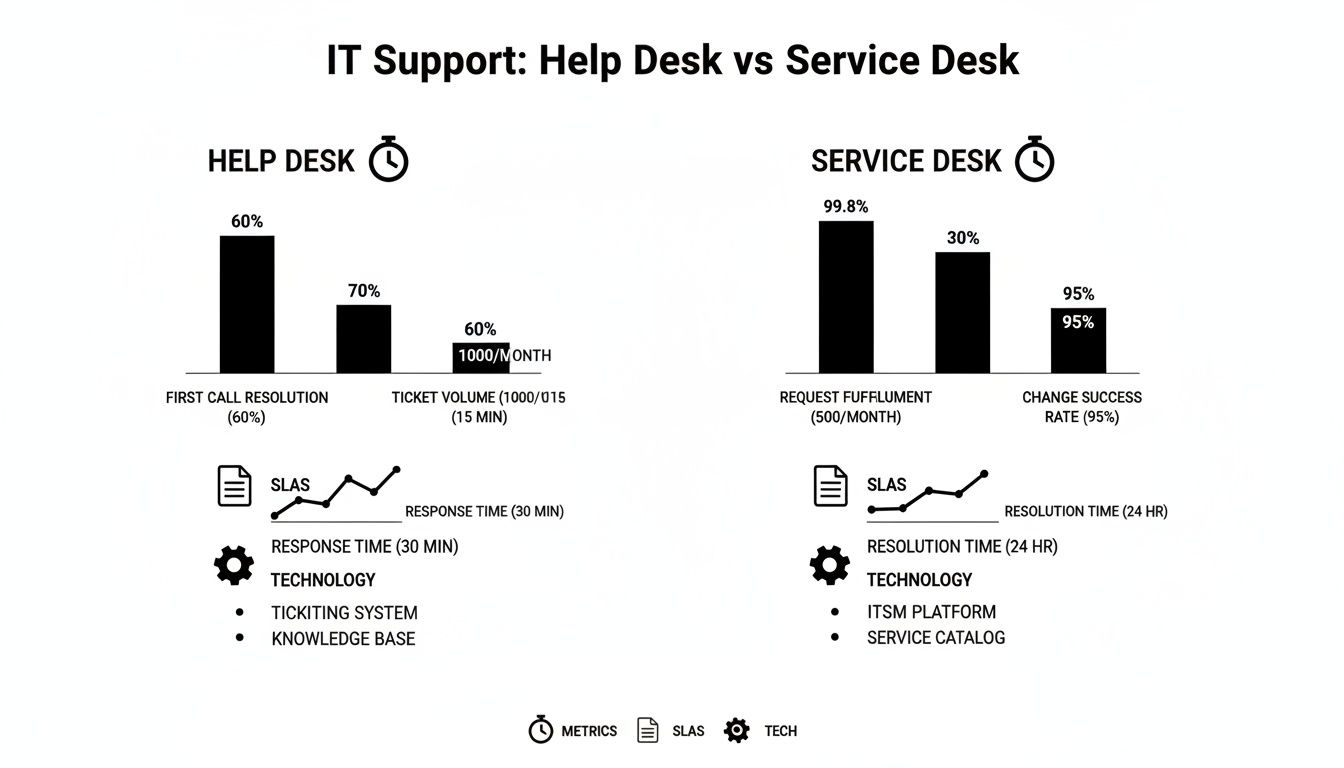
You can see how the help desk’s tactical metrics stand in sharp contrast to the service desk's strategic, business-focused approach to service delivery.
When a Service Desk is a Necessity
A service desk becomes non-negotiable when IT support has to be woven into the fabric of the business. It’s built for organizations that see technology as a strategic asset, not just a cost center.
A service desk is essential if your organization:
- Is a large enterprise with a complex, integrated IT ecosystem.
- Needs to manage the entire service lifecycle, from service requests and change management to problem management.
- Operates in a regulated industry that demands strict process controls and auditable trails.
- Aims to proactively improve service quality and align IT performance with bigger business objectives.
Exploring The Hybrid Model
For many organizations, a pure help desk or a pure service desk just doesn't feel right. This reality has given rise to the hybrid model, which cherry-picks elements from both worlds.
A common hybrid approach involves using a tactical help desk for external, customer-facing support while implementing a strategic, ITIL-aligned service desk for internal IT operations.
This dual structure lets a company provide rapid, responsive support to its customers while managing its internal tech with the discipline and strategic foresight of a service desk. It’s a practical way to get the best of both worlds, tailoring support to the unique needs of different audiences.
Decision Framework: Help Desk vs. Service Desk
Still on the fence? This checklist can help you weigh the factors and see which model aligns better with your current needs and future goals. Run through these considerations to get a clearer picture of your best path forward.
| Consideration | Favours Help Desk | Favours Service Desk |
|---|---|---|
| Primary Focus | Reactive, break-fix support | Proactive service delivery and business alignment |
| Business Size/Maturity | Startup or SMB with simple needs | Mid-size to large enterprise with complex operations |
| Scope of Work | Incident management (password resets, troubleshooting) | Full service lifecycle (requests, changes, problems) |
| Integration Needs | Minimal integration with other business systems | Deep integration with IT and business processes |
| Budget | Cost-conscious, looking for efficiency | Investment in strategic value and process maturity |
| Key Metrics | Ticket volume, first-call resolution, response time | Business outcomes, service availability, cost of service |
| Compliance/Auditing | Low to moderate regulatory requirements | High compliance needs (SOX, HIPAA, etc.) |
Ultimately, this framework isn't about finding a "right" or "wrong" answer. It's about finding the best fit for your organization right now, with an eye toward where you plan to be in the next few years. The model you choose today should be able to support the business you're building for tomorrow.
Outsourcing and Staffing Considerations for Each Model
Choosing between a service desk and a help desk isn't just an internal debate—it fundamentally shapes your staffing strategy and how you approach outsourcing. This decision dictates the kind of talent you need on your team, the partners you look for, and even how you structure your operational contracts. Each model requires a completely different mindset for building and managing a support team.
When companies outsource a traditional help desk, it's usually a play for cost-efficiency and scalability. The tactical, high-volume nature of a help desk makes it a perfect fit for a Business Process Outsourcing (BPO) partner. These partnerships are all about managing a large number of low-complexity tickets—think password resets or basic software troubleshooting—where standardized scripts and hitting resolution targets are the name of the game.
Outsourcing a service desk, on the other hand, is a much bigger strategic move. You’re not just offloading tickets; you’re handing over a core business function. This requires a partner with serious business acumen and specialized IT Service Management (ITSM) skills. They need to integrate deeply with your internal workflows and understand the business impact behind every single action they take.
Crafting the Right Agent Profile
The skills needed for each model couldn't be more different. For a help desk, you’re looking for people with sharp technical troubleshooting abilities, fantastic communication skills, and an aptitude for following procedures to the letter. A top-tier help desk agent is a master of first-call resolution.
A service desk analyst, however, needs a much broader skillset. Technical skill is just the starting point. They also need a solid grasp of ITIL processes, business impact analysis, and problem management. They’re less like problem-solvers and more like investigators and coordinators.
A help desk agent's primary skill is fixing a reported issue. A service desk analyst's primary skill is understanding how that issue fits into the larger business ecosystem and preventing it from happening again.
This distinction is absolutely critical when you're writing job descriptions or vetting potential outsourcing providers. A vendor that shines at high-volume, scripted help desk support might not have the strategic depth to handle a complex service desk environment.
Evaluating Outsourcing Partners
When you decide to bring in an external team, your evaluation criteria have to match the model you’ve chosen. This is an increasingly common move, as reflected by a significant market trend. The IT services outsourcing market in the Middle East and Africa (MEA) region, where helpdesk services are a major component, generated USD 49,390.9 million and is projected to reach USD 90,546.2 million by 2030. This growth shows just how many leaders are turning to outsourcing for scalable, 24/7 coverage. For more details, you can discover more insights about the MEA IT outsourcing market on GrandViewResearch.com.
For a help desk partnership, your Request for Proposal (RFP) and evaluation should zero in on:
- Cost-per-ticket or per-agent models that reward efficiency.
- Rock-solid training and quality assurance programs to ensure standardized responses.
- A proven track record of handling high ticket volumes while meeting strict SLAs for response time.
For a service desk partnership, the focus shifts to strategic fit:
- Demonstrated expertise in ITIL and other ITSM frameworks.
- Real-world experience integrating with client business processes and tools like CMDBs.
- A collaborative mindset geared toward continuous service improvement, not just clearing a ticket queue.
Bringing an external team into your operations successfully requires careful planning from the get-go. For some practical advice, check out our guide on how to seamlessly integrate outsourced support with your in-house team. Following a clear process ensures that whether you choose a BPO for a help desk or a strategic partner for a service desk, the collaboration is set up for success from day one. Structuring the right contract is essential to make sure your operational goals and strategic vision are perfectly aligned with your provider's capabilities.
Frequently Asked Questions
When you get down to the brass tacks of service desk vs. help desk, a few common questions always come up. Here are some straight answers to help clear the air, based on what we see in the field every day.
Can a Help Desk Evolve into a Service Desk ?
Absolutely. In fact, it's a very common growth path. Most organizations start with a help desk because it solves an immediate, tactical need: fixing broken things. But as a business grows and its IT environment gets more complex, a purely reactive model starts to show its cracks.
This evolution isn’t an overnight flip of a switch; it’s a deliberate journey. It starts with a shift in mindset, moving from firefighting to strategic service delivery. The first practical step is usually adopting an IT Service Management (ITSM) framework like ITIL. From there, the team starts integrating broader functions like formal change and problem management, which are well beyond the scope of a typical help desk.
The whole point is to move from a ticket-focused, reactive posture to a proactive service model that actually anticipates what the business needs. It's a natural progression that requires investment in both better tools (like a true ITSM platform) and better training for your people.
What Is the Role of ITIL ?
The Information Technology Infrastructure Library (ITIL) is the operational DNA of a mature service desk, but it’s more of a casual acquaintance for a help desk. For a service desk, ITIL provides the entire playbook for the service lifecycle—strategy, design, transition, operation, and continual improvement.
A service desk is built on ITIL principles to make sure services are managed consistently, reliably, and in lockstep with business goals. It uses ITIL to standardize critical processes like incident, problem, and change management, creating an operational model that’s both predictable and auditable.
A help desk, on the other hand, can run perfectly well without formal ITIL adoption. Its mission is to fix what’s broken, and you don’t need a comprehensive framework for that. While some help desks might borrow a few ITIL concepts to get more organized, it's not the guiding philosophy that drives their day-to-day operations.
Think of it this way: a service desk uses ITIL as its architectural blueprint. A help desk might just grab a few good ideas from the ITIL library to improve its workflow.
How Does AI Impact Both Models ?
Artificial intelligence is changing the game for both service desk help desk models, but it plays a very different role in each. For a help desk, AI is an efficiency engine. For a service desk, it’s a strategic powerhouse.
In a classic help desk setting, AI is all about automation and speed. The most common applications are:
- AI-powered Chatbots: These bots handle the high-volume, low-effort stuff like password resets or "what's the status of my ticket?" queries. They provide instant answers and keep simple requests from ever hitting a human agent's queue.
- Automated Ticket Routing: AI can instantly analyze an incoming ticket, figure out what it’s about, and assign it to the right person or team. This cuts out a ton of manual triage time.
For a service desk, AI’s job is much bigger and more proactive. It goes beyond simple automation to deliver deep operational intelligence. For instance:
- Predictive Analytics: AI algorithms sift through historical data to spot trends and predict major problems—like a server that’s about to fail—before they impact users.
- Intelligent Workflow Automation: AI can automate complex, multi-step processes that cross departmental lines, like onboarding a new employee or coordinating a major system update.
- Advanced Self-Service: An AI-driven knowledge base can serve up hyper-relevant solutions to users based on their role, department, and past issues, making self-service far more effective.
The trend is clear: research suggests that by 2029, AI will be able to resolve 80% of common customer service issues without any human help, a shift that will radically reshape both models.
Is One Model Better Than the Other ?
There's no "better" option here. The right choice is all about context—your organization’s size, maturity, and what you’re trying to achieve.
A help desk is the perfect fit for a startup or a small business with a straightforward IT setup. When your main goal is efficient, reactive support that doesn't break the bank, the lean, incident-focused structure of a help desk is exactly what you need.
A service desk becomes the smarter—and often essential—choice for larger, more complex organizations. Once you’re managing an intricate IT ecosystem, dealing with strict compliance rules, and trying to align technology directly with business strategy, you need the process-driven, holistic approach of a service desk to maintain stability and fuel growth.
The decision between a service desk help desk isn't about which is superior in a vacuum, but which is the right fit for your business today.


