


It’s an intelligent system designed specifically for the hustle of agents and brokers, helping you organize contacts, automate follow-ups, and track deals all the way from the first handshake to the celebratory closing gift.
Why Your Agency Needs a Command Centre

Let's be honest. Trying to juggle dozens of clients—each with their own unique needs, deadlines, and communication histories—using spreadsheets and sticky notes is a recipe for disaster. Important details inevitably slip through the cracks, leading to missed opportunities and a client experience that feels rushed and impersonal. This is where a real estate CRM steps in, transforming that chaos into a smooth, efficient operation.
Picture it as the ultimate personal assistant—one that never forgets a birthday, a specific property preference, or a crucial follow-up call. It becomes the single source of truth for your business, empowering you to build stronger, more meaningful relationships. Instead of drowning in administrative tasks, you can finally focus your energy on what you do best: advising clients and closing deals.
More Than Just a Digital Address Book
At its core, a CRM isn't just a piece of software; it's a strategy for growth. It provides the framework to deliver exceptional, consistent service, which is the secret sauce for generating referrals and repeat business. It shifts your workflow from being reactive—scrambling to find that one email or note—to proactive, where you're anticipating client needs before they even have to ask.
With a dedicated CRM, you’ll find that:
- Client Data is Centralized: Every email, phone call, text, and note about a client lives in one easily accessible profile. No more digging through your inbox.
- Communication Becomes Automated: You can schedule follow-up emails, send out market updates, and nurture leads automatically without lifting a finger.
- Your Pipeline is Crystal Clear: Get a clean, at-a-glance view of every deal in your pipeline, from new prospect to closed and funded.
- You Gain Actionable Insights: Use real data to understand what's working in your business and identify your most valuable lead sources.
A CRM isn't about managing contacts; it’s about managing relationships at scale. It turns scattered bits of data into powerful, actionable insights that drive business growth and elevate the client experience from start to finish.
The industry is catching on fast. The real estate software market in the Middle East and Africa was valued at USD 825.9 million in 2023 and is projected to skyrocket to USD 1,754.1 million by 2030. Within that massive market, CRM solutions are a critical piece of the puzzle, commanding about 28.3% of the global market share in 2024. That alone proves just how vital they've become.
For a broader look at the core concept, understanding the fundamentals of CRM software systems can give you some valuable context.
The Must-Have Features of a Powerful Real Estate CRM
Not all CRMs are created equal, and that distinction is everything in the property market. While a generic system might offer basic contact storage, a specialized real estate CRM is engineered with industry-specific tools designed to manage the unique lifecycle of a property deal. It’s the difference between a standard kitchen knife and a surgeon's scalpel—both cut, but only one is built for precision.
To really drive efficiency and growth, your CRM has to be more than just a digital address book. It needs to function as an intelligent partner that anticipates needs and automates the routine tasks that eat up an agent's valuable time. This is where a focus on the right features becomes critical.
Core Functionality for Agents
The most impactful features are those that directly support an agent's daily workflow. This starts with intelligent contact management, which goes far beyond just names and numbers. A powerful system lets you tag clients with specific property preferences, track their budget, and log every single interaction, from emails to phone calls.
On top of that, you should be looking for these critical components:
- Visual Deal Pipelines: This feature gives you a clear, at-a-glance view of every transaction. You can instantly see which deals are close to closing, which have stalled, and where you need to focus your energy next.
- Lead Scoring: Not all leads are ready to buy. Lead scoring automatically ranks prospects based on their engagement and demographic data, helping you prioritize follow-ups with the most promising clients first.
- Integrated Communication: Tools like automated SMS and email sequences ensure no client ever falls through the cracks. You can set up campaigns to nurture new leads or stay in touch with past clients, all without lifting a finger. To get a better handle on how these systems work, exploring the principles behind client database software can provide some valuable context.
The goal of a real estate CRM is not just to store data, but to make that data actionable. It should turn a long list of contacts into a clear roadmap, showing you exactly who to call, what to say, and when to say it.
Why Specialization Matters
The real power kicks in when these core features are tailored specifically for the property sector. A generic CRM just can’t keep up with a platform built with real estate workflows in mind from the ground up.
Take a look at how they stack up.
General CRM vs. Real Estate CRM Feature Comparison
| Feature Category | General CRM Capability | Specialised Real Estate CRM Capability |
|---|---|---|
| Listings | Stores product or service info | Integrates with MLS to pull property data, photos, and status updates automatically. |
| Transactions | Tracks standard sales stages | Manages complex property closing checklists, key dates, and document storage. |
| Marketing | Sends generic email blasts | Creates property-specific marketing campaigns and generates flyers and landing pages. |
Choosing a specialized real estate CRM means you get tools that speak your language and are designed to solve your most specific challenges right out of the box.
Automating Your Client Journey from First Contact to Referral
Imagine a system that works around the clock to nurture your client relationships, making sure no opportunity ever slips through the cracks. A powerful real estate CRM does just that. It’s like an automated engine driving a consistent, top-notch client experience from the first handshake to the final signature and beyond, turning tedious manual tasks into smooth, automated workflows.
The journey kicks off the moment a potential client shows interest. Whether they fill out a form on your website or ask about a listing on a property portal, the CRM instantly captures their details. There’s no delay, and no risk of a hot lead getting buried in a cluttered inbox.
Instead of you having to remember to follow up, an automated drip campaign springs into action. The CRM can send a personalized welcome email, followed by a series of messages sharing relevant listings, local market insights, or helpful guides for first-time buyers. This immediate, relevant contact keeps prospects engaged while you’re out showing properties or closing deals.
Streamlining the Transaction Process
Once a client is ready to make a move, the CRM’s role shifts from a nurturing tool to a transaction coordinator. Property deals are complex, involving countless deadlines, documents, and people. This is where automation becomes a real game-changer, preventing critical steps from being missed.
You can set up your CRM to:
- Send automatic reminders for key dates like inspections, mortgage applications, and closing.
- Trigger notifications to chase up pending documents from clients, lawyers, or other agents.
- Log every single communication related to the deal, creating one central record for compliance and peace of mind.
This flow chart gives you a simple visual of how a CRM organizes your contacts, manages the deal pipeline, and automates the most important steps.
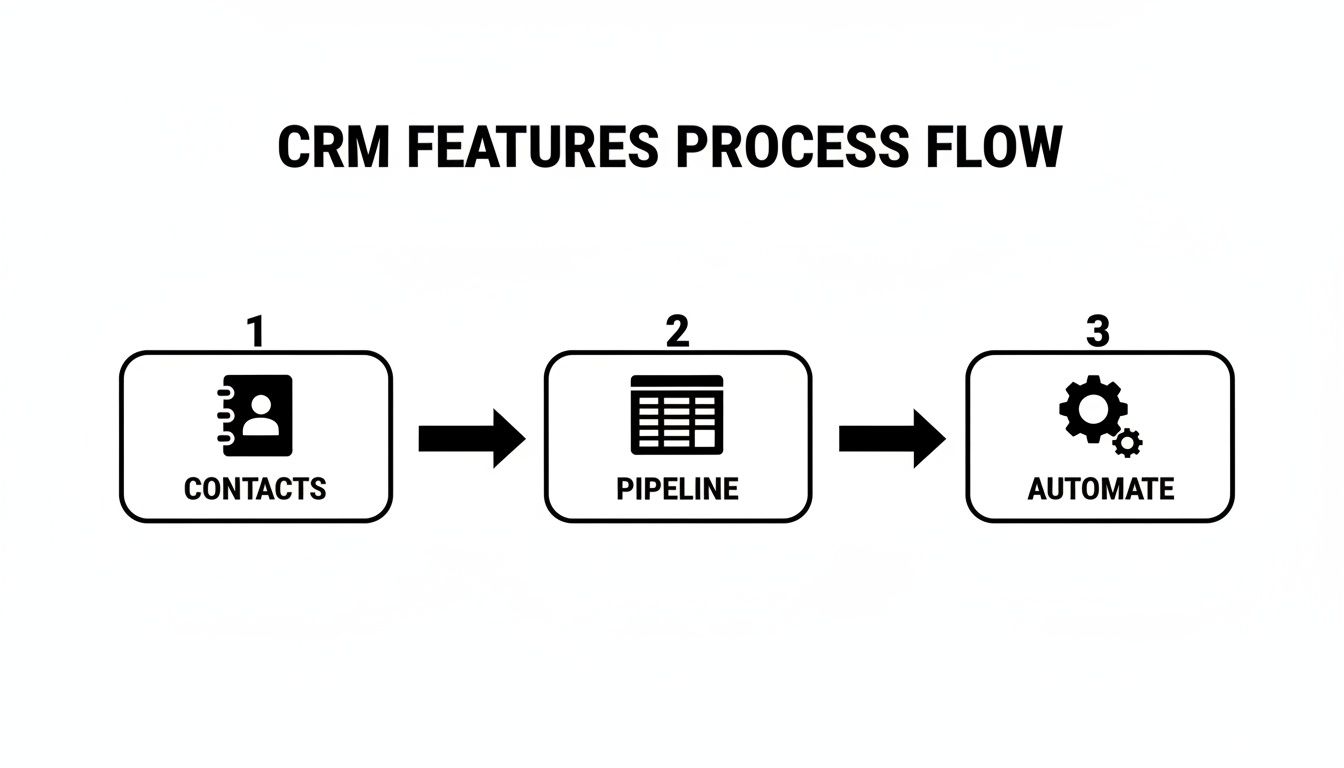
Each stage builds logically on the last, creating a repeatable system you can count on as your business grows. This methodical approach is a huge reason why automation technology is being adopted so quickly across the region.
In fact, the business process automation market in the Middle East and Africa hit USD 6.13 billion in 2024 and is projected to reach USD 11 billion by 2032. This growth shows just how essential integrated platforms that improve both customer experience and operational efficiency have become. You can dig deeper into this trend in the full business process automation software market research.
Nurturing Past Clients into Future Business
The real secret to a long and successful real estate career? It’s all about repeat and referral business. But let’s be honest, staying in touch with past clients is often the first thing that gets dropped when you get busy. A real estate CRM fixes this by automating your post-sale follow-up.
Your database of past clients is your most valuable asset. Automation is the key to unlocking its full potential, turning one-time transactions into a lifetime of opportunities.
You can set up workflows to automatically send home anniversary congratulations, share annual local market reports, or even just a simple check-in email on their birthday. These small, consistent touchpoints keep you top-of-mind, ensuring that when your past clients—or their friends and family—need an agent, you’re the first person they think of.
Integrating Your CRM with Outsourced Support Partners
As your real estate business grows, bringing in extra help becomes essential. Whether you hire someone in-house or team up with an outsourced support partner, the mission is the same: deliver a seamless, high-quality experience for every client. Your real estate CRM is the glue that makes this collaboration stick, acting as the central hub where your internal and external teams can work as one.
Think of your CRM as a shared playbook. It gets you out of the messy world of disjointed email chains and scattered spreadsheets, logging every single interaction in one unified system. This setup allows you to grant secure, role-based access to your support partners for specific jobs—like qualifying new leads or scheduling viewings—without ever handing over full control of your data.
Establishing Consistent Communication
When you're working with a third party, brand consistency is everything. Every single client communication needs to reflect your agency's professional standards and tone of voice. Your CRM is the perfect place to build and store shared communication resources, making sure everyone is always on the same page.
You can create a central library of:
- Email Templates: For common inquiries, follow-ups, and appointment confirmations.
- Call Scripts: To guide lead qualification calls and ensure every critical piece of information is gathered.
- Standardized Responses: For frequently asked questions about listings, processes, or next steps.
This ensures that whether a client is talking to your top agent or a support partner, the experience feels cohesive and professional. It takes the guesswork out of the equation and empowers your outsourced team to operate as a true extension of your brand. For a deeper dive into making this work, you can learn more about how to seamlessly integrate outsourced support with your in-house team in our detailed guide.
Managing Security and Compliance
Handing over access to client data requires a foundation of trust and solid security protocols. A modern real estate CRM is built with this exact challenge in mind, offering features that help you collaborate safely while staying compliant with data protection regulations.
Granting access isn't about giving away the keys to the kingdom. It's about providing a specific key for a specific door, ensuring your outsourced partners have exactly what they need to do their job—and nothing more.
Use your CRM’s permission settings to define precisely what each user can see and do. For example, a virtual assistant might only need access to new leads and your calendar, but they certainly don't need to see your financial reports or full transaction histories.
By setting these clear boundaries, you protect sensitive client information while still getting all the operational benefits of an extended support team. It’s a controlled approach that lets you scale your business with confidence.
Choosing and Implementing Your First Real Estate CRM

Making the jump to your first real estate CRM is a big step for any agency. It’s the moment you move from scattered notes and spreadsheets to a truly streamlined, professional operation. The key isn't just picking any platform off the shelf, but finding the right one that solves your specific problems and can grow with you.
Before you even think about watching a demo, start by figuring out what you actually need. Are you dropping the ball on lead follow-up? Is managing transactions an absolute mess? Do you feel like you have zero visibility into your sales pipeline? Your answers to these questions will build the foundation for how you evaluate your options, helping you cut through the marketing fluff and focus on features that will make a real difference.
This initial soul-searching is crucial. The CRM market is booming, especially for smaller businesses. The customer relationship management market across the Middle East and Africa generated USD 3,917.9 million in 2024 and is expected to hit USD 9,049.3 million by 2030. While big companies still lead, the fastest growth is happening among SMEs—underscoring the demand for systems that can scale.
A Practical Framework For Evaluation
Once you have a clear picture of your needs, you can start looking at potential systems. The best way to do this is to create a simple checklist so you can compare each platform fairly.
- Ease of Use: Let's be honest, if the system is clunky and confusing, your agents just won't use it. You need an intuitive interface that doesn't require a week of training.
- Scalability: Will this CRM work for you when you have five agents and when you have fifty? Choose a platform that won’t hold you back as your business expands.
- Essential Integrations: Your CRM has to play nice with the tools you already use every day, like your email, calendar, and property listing portals.
- Mobile Access: Real estate agents are always on the go. A solid mobile app isn't a "nice-to-have"; it's a non-negotiable for managing leads and deals from anywhere.
As you start comparing options, a good guide can show you what the leading platforms offer. You can see how different systems stack up by checking out a list of the top real estate CRMs for Australian agents.
Strategies For a Smooth Implementation
Picking the software is only half the job. A successful implementation is where the real work—and the real value—begins. This stage is what determines whether your CRM becomes a go-to tool or an expensive subscription nobody uses.
The biggest mistake you can make with a new CRM is treating it like a technology project instead of a people project. Your goal isn't just to install software; it's to change habits and make your team's workflow better.
For a smooth launch, nail these three critical steps:
- Clean and Migrate Your Data: Start with a clean slate. Seriously, take the time to de-duplicate and organize your existing contacts before you import them. Garbage in, garbage out.
- Provide Comprehensive Training: Don’t just show agents how to use the CRM; show them why it matters. Focus on the real-world benefits, like how it will save them time and help them close more deals.
- Drive Team Adoption: You have to lead by example. Make the CRM the single source of truth for all client information, communication, and pipeline updates. If you don't use it, they won't either.
To dive deeper into getting this crucial phase right, take a look at our guide on effective CRM implementation strategies for organisational success.
Got Questions About Real Estate CRMs? We’ve Got Answers.
Jumping into new tech for your agency always brings up a ton of questions. That’s not just normal—it’s smart. To make things easier, we’ve put together some straight-to-the-point answers for the most common things agents and brokers ask us about real estate CRMs.
Think of this as your no-fluff guide to understanding the costs, benefits, and real-world hurdles of bringing a CRM into your day-to-day work. Our goal here is to give you the clarity you need to make a solid, informed decision for your business.
How Much Does a Real Estate CRM Typically Cost ?
The price tag on a real estate CRM can swing pretty wildly depending on what your agency needs. For solo agents or small teams just starting out, you can find solid entry-level plans from around $25 to $50 per user, per month. These usually cover the essentials like managing your contacts and tracking your deals.
If you’re looking for a system with all the bells and whistles—like full marketing automation, lead scoring, and tons of integrations—you’re probably looking at a range of $150 to over $300 per user, per month. Don’t forget to ask about one-time costs, either. Things like setup, migrating your data, or getting specialized training can add to the initial investment.
Most companies use a tiered pricing model, which is actually great for you. It means you can start with a more affordable plan and upgrade as your team and client list grow. Your CRM can scale right alongside your business.
Can I Use a Generic CRM for My Business ?
Technically, yes, you could try to make a generic CRM like Salesforce work for real estate. But honestly, it’s a bit like trying to fit a square peg in a round hole. These all-purpose platforms are missing the specific tools agents live and die by, like MLS integration for pulling property listings, transaction checklists, and marketing templates designed for real estate.
Trying to customize a generic CRM to do all that is usually a massive, expensive headache. On the flip side, a purpose-built real estate CRM is designed from day one with your workflow in mind. It just works right out of the box.
For nearly every agency, the time you save and the immediate access to the right tools mean a specialized CRM will give you a much faster and bigger return on your investment.
The single greatest challenge is not the technology itself, but team adoption. Even the most powerful CRM is useless if your agents don't see its value and refuse to use it consistently.
What Is the Biggest Challenge of Adopting a New CRM ?
Getting your team to actually use it. That’s almost always the biggest hurdle. Real estate agents are creatures of habit, and if they have a system that they feel works, getting them to change can be tough. The trick is to show them exactly how the CRM makes their life easier.
You need to focus on how it will:
- Save them time by automating the boring, repetitive admin stuff.
- Help them close more deals with smarter lead nurturing and follow-up reminders that don't let anything slip through the cracks.
- Organize their day so they can spend more time on what makes them money—like showing properties and meeting clients.
Get your top agents involved in picking the CRM, provide great training (and keep providing it), and make sure the team leads are championing it. Once agents see the CRM as a tool to help them earn more, you’ll see adoption take off.
How Does a CRM Help with Client Retention ?
A real estate CRM is basically your secret weapon for turning past clients into a steady stream of future business and referrals. It’s brilliant at keeping those long-term relationships alive by automating the little personal touches that are so easy to forget when you’re swamped.
With automated workflows, you can set up personalized "Happy Home Anniversary" emails, send out an annual market report for their neighborhood, or just get a simple reminder to give them a check-in call. This kind of consistent, low-effort communication keeps you top-of-mind long after the ink has dried on the contract.
This is how you build deep-rooted loyalty and make it a no-brainer for past clients to send their friends and family your way. It’s the difference between a business built on one-off transactions and one built on relationships that last a career.


