


This job is so much more than just managing a vendor. It’s about forging a real, strategic partnership.
Understanding the Partner Relationship Manager

Think of a Partner Relationship Manager as the conductor of an orchestra. Your company has the musical score—that’s your brand voice, customer service standards, and business goals. Your outsourced partners are the talented musicians, each bringing their own expertise to the table. The PRM’s job is to make sure every single musician plays in perfect harmony, creating a beautiful and consistent performance for your audience: the customers.
Without that conductor, you get chaos. Each outsourced team starts playing its own tune, leading to disjointed customer experiences, wildly inconsistent support quality, and a total failure to hit your strategic goals.
Beyond a Typical Vendor Manager
A traditional vendor manager usually gets stuck on the tactical stuff: contracts, service level agreements (SLAs), and keeping costs down. And while all of that is important, a PRM's role is much broader and far more strategic.
They are on the hook for:
- Cultural Alignment: Making sure partner agents don't just know your company's mission and values, but actually live and breathe them in every single customer interaction.
- Performance Enablement: They act as a coach and an advocate, equipping partners with the training, tools, and insights they need to knock it out of the park.
- Strategic Integration: They take your high-level business goals and translate them into concrete, actionable targets and workflows for the partner teams.
A successful relationship manager doesn’t just oversee accounts; they also possess deep product knowledge to support their clients effectively. They act as both advocates and educators, helping clients navigate new systems and processes.
This strategic oversight is what turns a simple transactional relationship into a game-changing one. As your business grows and starts relying on partners for 24/7 global support, this role becomes absolutely essential for maintaining a unified brand. The PRM is the one who guarantees that no matter where an agent is located, the customer always feels like they’re talking directly to your company.
To get a better sense of the big picture, it's worth exploring the broader concept of Partner Relationship Management (PRM). And while it’s closely related, it’s also helpful to see how the role of a https://www.customer-service.cx/service-relationship-manager-transform-business/ can transform business outcomes.
The Core Responsibilities of a Modern PRM

A Partner Relationship Manager (PRM) has to wear a lot of hats, juggling a unique mix of high-level strategy, on-the-ground operations, and good old-fashioned people skills. Their day-to-day isn't about just checking boxes on a task list; it’s about turning big-picture company goals into real, tangible actions for your outsourced teams. Think of them as the architects of a healthy, productive partnership.
Their job isn't to just monitor what's happening but to actively make success possible. The PRM serves as the central hub for communication, making sure information flows freely—and accurately—between your company and your partners. This single point of contact prevents crossed wires and keeps everyone pulling in the same direction.
Strategic and Performance Oversight
From a strategic perch, the PRM is in charge of the partnership's overall health and performance. They aren't just looking at today’s numbers. They're constantly planning for the future, spotting opportunities for growth, and heading off potential risks before they turn into full-blown problems.
This involves a few key activities:
- Translating Goals: They take broad business objectives, like "improve customer retention by 15%," and translate them into specific KPIs and workflows that partner teams can actually execute.
- Conducting Business Reviews: A PRM is the one leading regular quarterly business reviews (QBRs). This is where they dive into performance data, celebrate wins, and work with partner leadership to solve challenges together.
- Contractual Management: They keep a close eye on service level agreements (SLAs), making sure all obligations are met while also looking for chances to fine-tune and improve the partnership terms over time.
A Partner Relationship Manager acts as a bridge, enabler, and strategic navigator all at once. By strengthening relationships, promoting collaboration, and using structured communication, they create measurable value for both the business and its partners.
This strategic guidance ensures the partnership is a genuine value-driver that helps the business grow, not just a line item on the expense report. Without it, an outsourced relationship can easily slip into a reactive mode, only putting out fires after they’ve already impacted customers.
Operational and Relational Duties
Down in the trenches, the PRM is deeply plugged into the daily operational rhythm. They are your brand’s advocate within the partner’s organization, making sure your company culture and quality standards are always front and center. They are the go-to problem-solvers and relationship builders who create the trust needed for a partnership to thrive.
The table below breaks down the wide-ranging functions a skilled partner relationship manager handles to strike that perfect balance between efficiency and a stellar customer experience.
Key Responsibilities of a Partner Relationship Manager
| Responsibility Area | Core Tasks | Impact on CX |
|---|---|---|
| Performance Management | Tracking KPIs, analyzing agent scorecards, and identifying performance trends. | Ensures consistent service quality and quick resolution of customer issues. |
| Quality Assurance | Calibrating quality scores, reviewing customer interactions, and coaching partner teams. | Upholds brand standards and guarantees a high-quality, positive customer journey. |
| Cultural Alignment | Sharing company updates, championing brand values, and organizing joint team activities. | Creates a unified team culture where outsourced agents feel like true brand ambassadors. |
| Communication Bridge | Serving as the main point of contact for escalations and process changes. | Provides a clear, reliable channel for information, reducing friction and delays. |
Ultimately, these duties ensure that the outsourced team doesn't just feel like a vendor—they feel like an extension of your own team, fully invested in delivering the best possible experience for your customers.
The Makings of a Great Partner Manager
A top-tier Partner Relationship Manager isn't just one thing. They’re a unique hybrid—part strategist, part diplomat, and part data nerd. Anyone can keep a contract in a filing cabinet, but it takes a special kind of talent to turn a simple vendor agreement into a powerhouse partnership that actually moves the needle.
On one side of the coin, you have the analyst. This person has to be comfortable getting their hands dirty with performance data, spotting trends, and turning a spreadsheet of numbers into a clear, compelling story. This knack for data is absolutely critical when it's time for business reviews or for negotiating SLAs that protect your interests while still motivating your partner.
But on the other side, you have the relationship builder. A PRM lives and breathes communication. They need a high degree of emotional intelligence to navigate tricky conversations, smooth over conflicts, and build a genuine sense of "we're in this together."
The Art of Balancing Hard and Soft Skills
The best managers don't just have these skills; they weave them together seamlessly. Imagine a partner's performance starts to slip. A manager who only sees the numbers might just point to the red KPIs on a chart, which immediately puts the partner on the defensive. A manager focused only on the relationship might shy away from the tough conversation altogether to avoid awkwardness.
A truly skilled Partner Relationship Manager does both. They start with the data to pinpoint the problem but approach the partner with empathy to figure out the why behind the numbers. This simple shift turns a potentially tense meeting into a collaborative problem-solving session.
This balanced skill set is becoming more and more valuable. In the Middle East and Africa alone, the partner relationship management market is expected to jump from $150 million in 2019 to $350 million by 2026. That kind of growth signals a huge demand for managers who can forge these strong, effective alliances. You can get more insights on this regional growth and what’s driving it.
Core Competencies for Success
If you're trying to build a blueprint for the ideal PRM, here are the non-negotiables:
- Strategic Negotiation: This is way more than just haggling over price. It’s about structuring deals that create a win-win, making sure your partner’s incentives are directly aligned with your company’s biggest goals. When they win, you win.
- Cross-Cultural Communication: In today’s global support world, a PRM has to be a cultural chameleon. Understanding different communication styles and business etiquette is the only way to build real trust with international partners.
- Conflict Resolution: Let’s be honest—disagreements are going to happen. A great PRM doesn't run from them. They step in as a mediator, find that slice of common ground, and use the conflict as a chance to actually make the relationship stronger.
- Analytical Acumen: The ability to look at KPIs, CSAT scores, and dense operational reports and see the story behind the data is a must-have. This is what allows a manager to spot trouble before it starts and make smart, strategic calls.
Measuring the Success of Your CX Partnerships
That old saying, "If you can’t measure it, you can’t improve it," is the gospel truth for a Partner Relationship Manager. Gut feelings about a partnership's health are not enough. You need clear, objective data that tells a compelling story about performance and value.
A skilled PRM doesn't just pull metrics for a monthly report. They use data to diagnose issues, celebrate victories, and make strategic decisions that keep the outsourced team tightly aligned with core business goals. This isn't just about tracking agent efficiency; it's about measuring the partnership's direct impact on customer loyalty and the company's bottom line.
Distinguishing Operational from Strategic KPIs
To get the complete picture, a PRM has to look at two different but deeply connected types of Key Performance Indicators (KPIs): operational and strategic.
Think of it like maintaining a car. Operational metrics are like checking the tire pressure and oil levels—they’re essential for daily performance. Strategic metrics are like checking your fuel efficiency and overall engine health—they tell you if you’ll actually reach your long-term destination.
Operational KPIs focus on the "how" of day-to-day work. They measure the efficiency and effectiveness of the partner's team at a granular level.
Strategic KPIs, on the other hand, measure the "why." They connect the partnership's activities to bigger business outcomes, like customer sentiment and financial growth. A great partner relationship manager knows that hitting operational targets is completely meaningless if strategic goals are falling short.
The ultimate goal is to move beyond simply monitoring activity to measuring impact. An effective PRM uses data to prove that the partnership isn't a cost center, but a powerful engine for improving customer satisfaction and driving revenue.
Let's break down the difference between these two critical categories of metrics.
PRM Performance Metrics Operational vs Strategic KPIs
The table below gives a side-by-side look at how operational and strategic metrics work together to paint a full picture of partnership health.
| Metric Type | Example KPI | What It Measures |
|---|---|---|
| Operational | First Contact Resolution (FCR) | The percentage of customer issues solved during the very first interaction, indicating agent knowledge and process efficiency. |
| Strategic | Customer Satisfaction (CSAT) | The overall happiness of customers with the service they received, directly measuring the quality of the customer experience. |
| Operational | Average Handle Time (AHT) | The average duration of a single customer interaction, from start to finish, used to gauge agent productivity. |
| Strategic | Partner Retention Rate | The length of time a partnership remains active and successful, reflecting the health and mutual value of the relationship. |
By tracking both sets of metrics, a Partner Relationship Manager gets a truly holistic view. They can see if agents are resolving issues quickly (AHT) and also if customers are actually happy with those quick resolutions (CSAT). This dual focus ensures that the hunt for efficiency never comes at the expense of genuine customer delight, building the foundation for a partnership that’s truly successful and built to last.
Giving Your Partner Manager the Right Tech Advantage

Even the most skilled Partner Relationship Manager can't build a great partnership with spreadsheets and email alone. In today’s world, strong partnerships depend on a solid tech stack that brings clarity, drives collaboration, and gives everyone a single source of truth. Without the right tools, information gets stuck in silos, creating friction and leading to inconsistent customer experiences.
At the heart of this tech stack is the connection between Partner Relationship Management (PRM) software and your company's Customer Relationship Management (CRM) system. Think of your CRM as the complete history of your customer, and the PRM platform as the partner’s playbook. Integrating them is like connecting the brain to the nervous system—it enables seamless, real-time communication and coordinated action.
This integrated approach gives your PRM the visibility they need to guide the partnership proactively instead of just reacting to problems.
Creating a Single Source of Truth
When you integrate your PRM and CRM systems, you create a powerful, unified platform. This central hub pulls together all critical information, ensuring both your internal teams and external partners are working from the same playbook. It cuts through the confusion and empowers everyone to make data-driven decisions.
A unified platform typically offers:
- Shared Performance Dashboards: Real-time visibility into key metrics like CSAT, FCR, and agent productivity.
- Centralized Training Materials: A single library for onboarding documents, product updates, and best-practice guides.
- Streamlined Communication Channels: Secure messaging and ticketing systems that keep conversations organized and transparent.
By breaking down information silos, a unified tech stack gives a Partner Relationship Manager a 360-degree view of the partnership's health, linking operational performance directly to customer outcomes.
This approach is already proving its worth. For customer service outsourcing in the UAE, integrating PRM tools with CRMs has improved partner-driven satisfaction scores by 32% since 2020. This is part of a bigger trend, with the MEA CRM market projected to grow significantly, showing a clear push toward combining partner and customer data. You can find more details in the latest MEA customer relationship management market report.
This unified system is the foundation for a scalable and resilient outsourced support operation. To get a better handle on the systems that store this crucial data, check out our guide to client database software for modern CX. When you equip your Partner Relationship Manager with the right technology, you empower them to build a high-performing partnership that consistently delights your customers.
Building Your Partner Management Function
So, you’re ready to build a world-class partner management program? Fantastic. But let's be clear: this isn't just about posting a job opening and hoping for the best. A truly great program starts long before the first interview. It begins with defining what success actually looks like and then carving out a dedicated spot for this function within your company’s DNA. You're not just hiring a person; you're building an engine designed to squeeze every drop of value out of your outsourcing partnerships.
The first real step is crafting a compelling and razor-sharp job description. Think of this document as your north star. It’s what will attract the right kind of talent by painting a clear picture of the responsibilities, the skills needed, and the real-world impact the partner relationship manager will have. Go beyond a boring list of duties and articulate how this role plugs directly into your bigger CX goals and company growth.
Sample Partner Relationship Manager Job Description
A solid job description is everything. It shouldn’t just list tasks; it needs to sell the vision of the role and make the right person think, "That's me."
- Role Summary: As the Partner Relationship Manager, you are the key strategic link between our company and our outsourced customer experience partners. Your mission is to ensure our BPO partners operate as a seamless extension of our brand, relentlessly driving performance, championing quality, and fostering a culture of never-ending improvement.
- Key Responsibilities: You’ll lead quarterly business reviews, dissect partner performance against both contractual SLAs and strategic KPIs, and act as the main point of escalation. A huge part of your job will be to live and breathe our brand values and instill them within the partner teams.
- Required Skills: We’re looking for someone with proven experience in BPO or vendor management. You need strong analytical skills and a knack for telling compelling stories with data. Exceptional cross-cultural communication is a must, as is a real talent for strategic negotiation.
Your Hiring and Onboarding Playbook
Once you have a pool of promising candidates, a structured interview process is what separates the contenders from the pretenders. Your questions need to dig into both the hard skills and those crucial soft skills that make a partner manager truly great.
Here’s a quick checklist to keep your hiring on track:
- Define Core Competencies: What are the three absolute, non-negotiable skills for this role in your company?
- Develop Situational Questions: Don't ask what they would do. Ask what they have done. "Tell me about a time you had to turn around an underperforming partner," or "Walk me through a difficult contract renewal you managed."
- Conduct a Data Test: Give them a sample performance report and ask for their top takeaways and a proposed action plan. See how they think.
Onboarding isn't just a handover of documents and a welcome lunch. It's a strategic integration process. The first 90 days should be meticulously planned out, filled with structured introductions to key stakeholders, deep dives into partner contracts, and joint calibration sessions with the BPO's quality teams.
This kind of structured onboarding ensures your new partner relationship manager can hit the ground running and start making an impact from day one. As you build out this function, it helps to see how it connects to the bigger picture, drawing lessons from a broad Revenue Operations framework. And for a closer look at the art and science of building strong connections, our guide can help you enhance your relationship management process. This proactive approach is what sets the stage for a resilient, high-performing partnership function that truly delivers.
Common Questions About the PRM Role
Even with a solid grasp of the role, a few questions always pop up when companies start thinking seriously about bringing on a Partner Relationship Manager. Let's clear those up, because the answers really highlight the unique value this person brings to a CX organization that leans on outsourced partners.
PRM vs. Vendor Manager
What’s the real difference between a Partner Relationship Manager and a Vendor Manager? This is a big one.
Think of a Vendor Manager as being focused on the "what"—the transactional nuts and bolts. They're masters of contracts, pricing negotiations, and making sure all the compliance boxes are checked. It's a critical, but fundamentally operational, role.
A Partner Relationship Manager, on the other hand, is all about the "how" and the "why." They operate on a strategic level. Their job is to weave the partner's team into the fabric of your company's culture and goals. They act less like an overseer and more like a coach, a strategic guide ensuring the partnership isn't just fulfilling a contract but is actively driving mutual growth and making the customer experience better.
When to Hire a PRM
Okay, so when’s the right time to pull the trigger and hire a dedicated PRM?
The short answer: hire one the moment your outsourced partnerships become mission-critical to your customer experience. If a partner failing would cause a serious, immediate problem for your customers, you're already there.
More specific triggers include managing multiple BPO partners, expanding into new global territories, or when you notice the sheer complexity of managing partners is starting to bog down your internal operations team. If you wait until you're overwhelmed, your CX quality has likely already taken a hit. Hiring proactively is the smart move.
This diagram lays out the three core phases of building out this function.
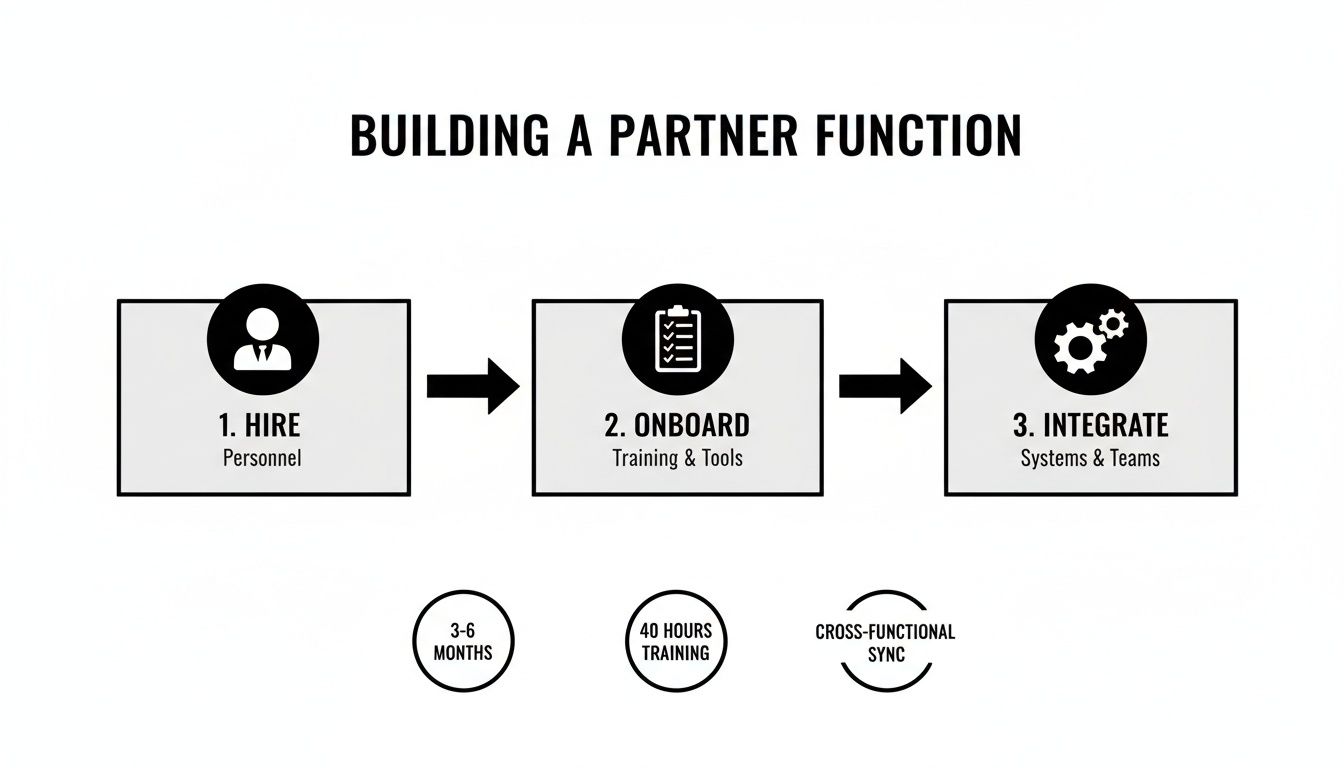
It’s a simple but powerful visual that shows this isn't just a single hire. It's about building a structured, repeatable process that moves from finding the right talent to getting them onboarded and, finally, deeply integrating them with your partners.
Impact on Customer Satisfaction
How exactly does a PRM move the needle on something like customer satisfaction (CSAT)?
A PRM boosts CSAT by ensuring outsourced agents are deeply integrated, well-trained, and motivated. They analyze performance data to pinpoint improvement areas, facilitate seamless knowledge sharing, and make sure customer feedback leads to real changes.
It’s about holistic management. When partner agents feel like part of the team, have the right tools, and understand the "why" behind their work, the quality of their interactions skyrockets. This creates a more consistent and genuinely helpful customer journey, which directly lifts those satisfaction scores across the board.


