

Why Loyalty Software Is a Core CX Investment
Let's be honest, the days of simple paper punch cards are long gone. Today’s customers expect personalized, immediate, and genuinely valuable interactions from the brands they choose to support. This shift has turned loyalty software from a nice-to-have marketing tool into an essential part of any modern customer experience (CX) stack.

What's driving this change? Data. Modern platforms don’t just track points anymore; they pull together customer behavior, purchase history, and engagement levels to build a rich profile of each person. This is what allows businesses to move beyond generic discounts and start delivering hyper-relevant offers that people actually want.
A Strategic Shift in Customer Retention
The real value of these platforms goes way beyond the marketing department. When you integrate loyalty data correctly, it becomes a powerful asset for the entire organization.
Imagine a contact center agent on a call with a frustrated customer. With real-time loyalty data at their fingertips, the agent can instantly see the customer’s tier, recent activity, and point balance.
This context completely changes the game:
- Empowered Problem-Solving: The agent can proactively offer a points-based apology or an exclusive perk, turning a negative moment into a surprisingly positive one.
- Personalized Engagement: Knowing a customer is just one purchase away from hitting a new tier lets the agent make tailored suggestions that feel helpful, not like a hard sell.
- Unified Customer View: It finally connects the dots between someone’s online shopping habits and their direct support calls, creating a truly complete picture.
This strategic importance is mirrored in the market’s growth. In the United Arab Emirates, for example, loyalty and rewards have evolved from simple stamp cards into a software-driven industry worth around US$422.7 million in 2024. Forecasts predict it will hit US$817.6 million by 2029. This kind of rapid expansion is forcing CX leaders to treat loyalty platforms as a core piece of their tech stack.
The fundamental connection between customer experience and retention is undeniable. A loyalty program powered by robust software acts as the bridge, turning positive interactions into measurable, long-term value.
Ultimately, investing in loyalty software is an investment in understanding and responding to your customers on a massive scale. It gives you the foundation not just to reward what they’ve done in the past, but to actively shape their future engagement, cementing the bond between good experiences and lasting loyalty. For a deeper look, check out our guide on how customer experience affects customer loyalty.
Defining Your Goals and Must-Have Features
Before you even think about booking demos or hopping on sales calls, let's talk about the most important first step: figuring out what success actually looks like for your business. It's easy to get dazzled by flashy features, but a powerful loyalty program isn't just about handing out points. It's a strategic tool meant to hit specific business targets.
Without a clear vision, you’ll end up with a platform that looks great but doesn’t solve your real problems. The key is to translate your big-picture business objectives into tangible loyalty program goals.
Are you trying to stop the bleeding from a high churn rate among first-time buyers? Or is your main goal to get your existing customers to spend more with each purchase? These are two very different problems that demand completely different software features and reward structures.
For instance, a business struggling with churn needs a platform that’s a rockstar at sending automated “we miss you” offers with bonus points to customers who haven’t bought anything in 60 days. On the flip side, a brand trying to boost spend needs features like tiered rewards and spend-based bonuses to encourage bigger, more frequent orders.
Aligning Program Goals with Business KPIs
To make your goals truly actionable, you have to connect them directly to the Key Performance Indicators (KPIs) your team is already obsessed with. This move from abstract ideas to concrete metrics is what will guide you to the right software. Plus, it makes it a whole lot easier to get buy-in from other departments when they see how the program impacts the numbers they care about.
Here’s how that connection might look in the real world:
- Business Goal: Increase Customer Lifetime Value (CLV).
- Program Goal: Encourage repeat purchases and a higher average order value (AOV).
- Must-Have Features: A tiered system that makes customers feel like VIPs as they spend more, plus the ability to offer bonus points on specific high-margin products.
- Business Goal: Reduce Customer Churn.
- Program Goal: Re-engage customers who are slipping away and build a stronger emotional bond.
- Must-Have Features: Automated triggers for inactivity, surprise-and-delight rewards (like birthday points), and a seamless hook-up with your email marketing platform for personalized outreach.
- Business Goal: Acquire New Customers More Cost-Effectively.
- Program Goal: Turn your most loyal customers into your best marketers.
- Must-Have Features: A solid referral engine that tracks shares, offers two-sided rewards (for both the advocate and the new customer), and generates unique, shareable links.
Mapping these connections brings your priorities into sharp focus. It stops you from getting distracted by features that sound cool but do nothing for your bottom line. A great way to visualize this is through customer experience journey mapping, which helps you pinpoint the exact moments a loyalty interaction can make the biggest difference.
A well-defined goal is your ultimate filter. When a vendor shows off some exciting new feature, your first question should always be, "That's neat, but how does this help us increase CLV by our target of 15%?" If they don't have a solid answer, it's a 'nice-to-have,' not a necessity.
Distinguishing Must-Haves from Nice-to-Haves
With your goals locked in, you can build a prioritized feature list. This is where you draw a hard line between your non-negotiables and the bells and whistles. The simplest way to do this is to sort features based on how directly they impact your main objectives.
Let’s take a direct-to-consumer (DTC) beauty brand as an example. Their number one goal is to build a strong community and drive repeat purchases in a crowded market.
Their Must-Have Feature List Might Include:
- Tiered Rewards: Essential for making top customers feel like VIPs with exclusive perks.
- Points for Engagement: Rewarding actions like writing reviews or sharing on social media helps build that community feel.
- Mobile-First Interface: A flawless app or mobile web experience is non-negotiable since their audience shops almost exclusively on their phones.
Their Nice-to-Have List Could Be:
- Complex Gamification: Leaderboards might be fun, but they aren't critical to their core goal of community building.
- In-Store POS Integration: As an online-only brand, this feature is completely irrelevant.
This sorting process is absolutely vital. It gives you a clear decision-making framework that keeps your team focused during the evaluation phase. When you ground your search for a loyalty rewards program in clear goals and prioritized features, you set yourself up to choose a platform that will deliver real, measurable results from day one.
Evaluating Vendors with a Clear Selection Framework
Choosing the right loyalty rewards software is less about finding the platform with the most features and more about finding the right partner. A structured, objective approach is your best defense against shiny marketing demos and overwhelming feature lists, helping you cut through the noise to find a solution that actually fits your business.
Without a clear framework, it's easy to get lost. You’ll be pulled in different directions by impressive sales pitches, quickly losing sight of what your program truly needs to succeed. The goal here is to build a scoring matrix that lets you compare vendors on the criteria that matter most to your unique situation.
Building Your Vendor Scoring Matrix
A scoring matrix is your best friend in this process. It’s a simple but incredibly powerful tool that transforms what can be a subjective, gut-feel decision into a data-driven one. By assigning weights to different criteria based on your priorities, you ensure the final choice is strategic, not just emotional.
Start by listing your non-negotiables. This should be a healthy mix of technical specs, user experience must-haves, and practical business considerations.
Key Criteria to Include:
- API Flexibility and Documentation: How easily can this software talk to your existing tech stack (CRM, ecommerce platform, contact center)? Is the API documentation clear enough for your dev team to hit the ground running?
- Scalability: Can the platform handle your current customer volume and grow with you? A system that works for 10,000 members might completely buckle under the pressure of one million.
- Ease of Use (Customer-Facing): Is the interface intuitive and mobile-friendly for your members? A clunky redemption process will kill engagement before it even gets off the ground.
- Ease of Use (Admin Panel): How much heavy lifting will your marketing and support teams have to do? Think about the training required to manage campaigns, pull reports, or help members.
- Support and Onboarding: What kind of support is included? Are you getting a dedicated account manager, or will you be stuck in a ticket-based system?
Once you have your list, assign a weight to each category based on its importance. For a fast-growing DTC brand with a small dev team, Ease of Use (Admin Panel) might get a heavier weight than API Flexibility. For an enterprise-level SaaS company, the opposite is probably true.
The most effective selection frameworks are built around real-world scenarios. Before you score a vendor, ask yourself: "How would this platform handle our biggest annual sales event?" or "How quickly could a support agent resolve a points-discrepancy issue for a VIP customer?"
Comparing Different Software Architectures
Not all loyalty software is built the same. Getting a handle on the underlying architecture is critical for matching a platform to your technical resources and long-term vision. The right choice depends entirely on your needs for speed, customization, and control.
Your program's main objective often points you in the right direction. This infographic shows how core goals branch into different strategic paths.
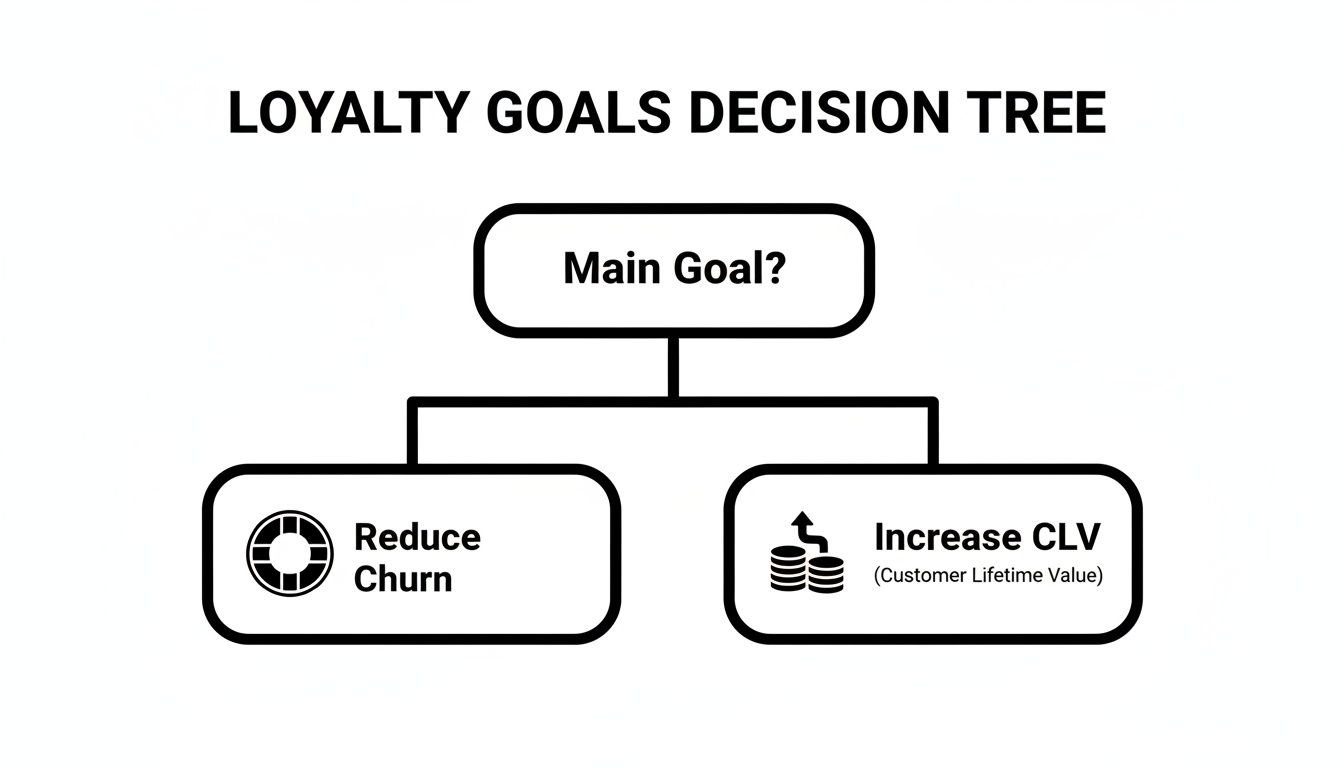
The decision to focus on either churn reduction or CLV growth directly influences which software architecture will serve you best.
The software architecture you choose is a major fork in the road, defining how much control you have versus how quickly you can launch. Here’s a quick rundown of the common approaches you'll encounter.
Comparing Loyalty Software Architectural Approaches
| Software Type | Best For | Key Strengths | Potential Limitations |
|---|---|---|---|
| Plug-and-Play | Small businesses, startups, or teams needing a quick launch with minimal technical overhead. | Fast implementation, lower upfront cost, pre-built integrations with major platforms. | Limited customization, may not scale well, dependent on the vendor's roadmap. |
| Modular | Mid-sized businesses that want a balance of pre-built features and the ability to add custom modules. | Good balance of speed and flexibility, can add functionality as the program grows. | Can become complex to manage, module costs can add up over time. |
| API-First | Enterprise businesses or companies with unique requirements and dedicated development resources. | Maximum flexibility and control, seamless integration into any tech stack, future-proof. | Higher development cost, longer implementation time, requires in-house expertise. |
Ultimately, choosing between plug-and-play simplicity and API-first flexibility comes down to your in-house resources and how unique your loyalty program needs to be.
When you're digging into different loyalty vendors, it’s also smart to understand the broader ecosystem of tracking platforms they might integrate with. This guide on the best affiliate tracking software solutions for SaaS offers some great insights that are highly relevant when you're assessing the referral and advocacy features of a potential loyalty partner.
At the end of the day, this evaluation framework is all about making a confident, well-informed decision. It shifts the focus from a simple feature-for-feature race to a strategic assessment of which loyalty rewards program software will serve as a true partner in your long-term growth.
Weaving Your Loyalty Platform into Your Tech Stack
Your new loyalty rewards program software can't be a standalone island. Its real power is unlocked only when it's deeply woven into the fabric of your existing technology. Think of it as the central nervous system for customer data, feeding crucial insights to every other platform your team uses daily.
A disconnected loyalty program is a huge missed opportunity. When your systems don't talk to each other, you create frustrating information silos. Your marketing team is blind to which loyalty offers are driving support tickets, and your contact center agents have no clue if the person on the line is a brand-new customer or a top-tier VIP.
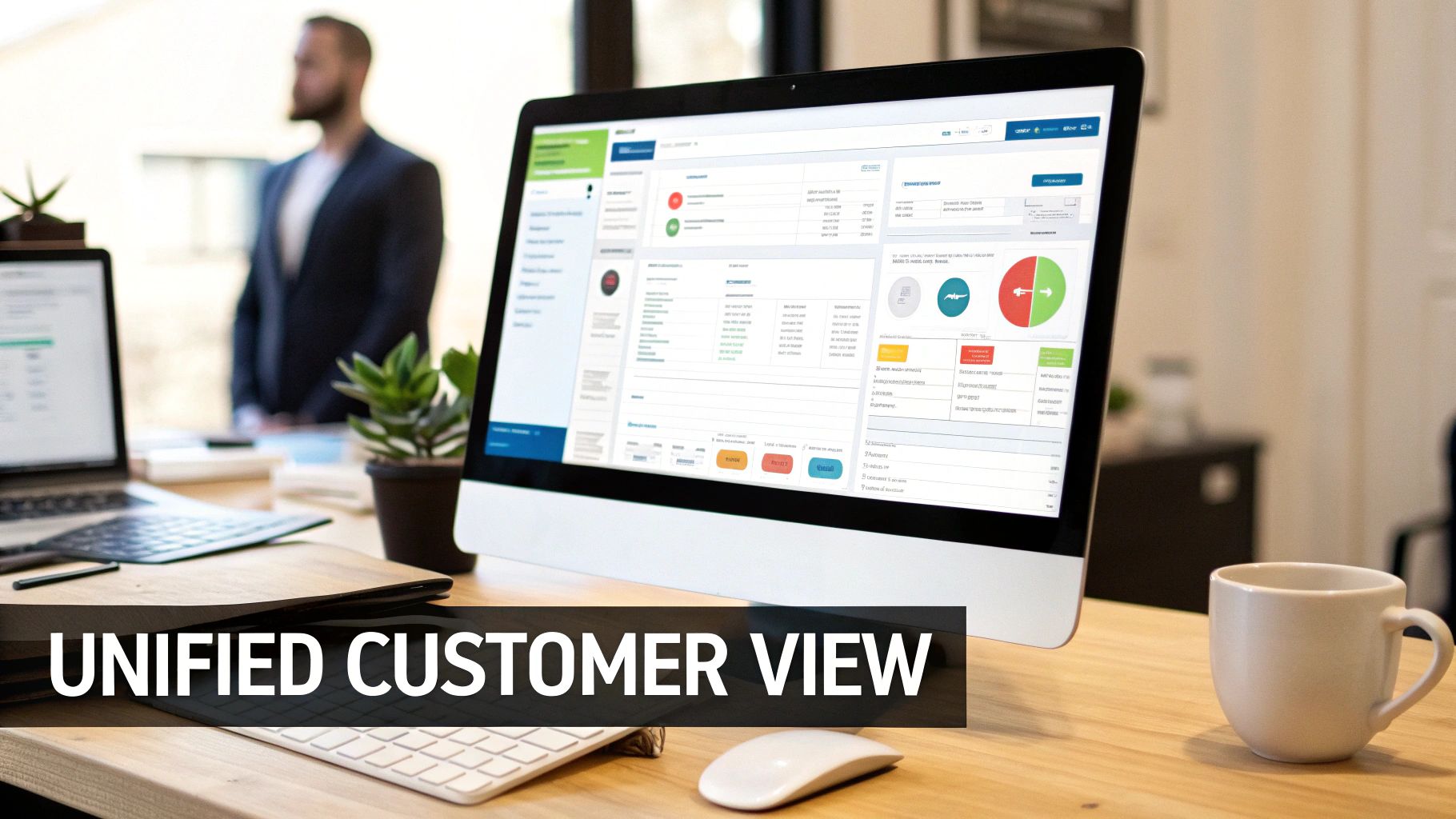
Seamless integration solves all of this by creating a single, unified view of the customer. This means that no matter where an employee interacts with a customer—whether in the CRM, the support queue, or the e-commerce back end—they see the complete picture. Their loyalty status, points balance, recent redemptions, and tier level are all right there.
Creating a Unified Customer View
The whole point of integration is to make loyalty data accessible and actionable across your entire organization. When a support agent pulls up a customer's record, they shouldn't have to toggle between five different screens to understand that person's history with your brand.
Imagine this scenario: a customer who just reached your "Platinum" tier contacts support about a delayed shipment.
- Without integration: The agent sees just another support ticket. It gets treated like any other query, and the customer feels completely unrecognized for their loyalty.
- With integration: The agent's contact center software instantly flags the customer as a "Platinum VIP." This can automatically trigger a priority routing rule, bumping them to the front of the queue for a senior agent. The agent can immediately see their new status and say, "I see you just became a Platinum member—congratulations! Let me sort this shipping issue out for you right away."
That single interaction, powered by connected data, turns a potentially negative experience into a moment that reinforces the value of your loyalty program. You've shown that you see them and appreciate their business.
Mapping Your Core Data Flows
To get to that level of sync, you have to map out how data will flow between your systems. This means identifying the primary "source of truth" for different pieces of information and defining the triggers that pass data back and forth. The most critical connections are almost always with your CRM, e-commerce platform, and contact center software.
Here are the key integration points you'll need to plan for:
- CRM Integration: Your loyalty software should push updates like tier changes, points balances, and recent reward redemptions directly into the customer profile in your CRM. This arms your sales and marketing teams with a much richer dataset for segmentation and personalization.
- E-commerce Platform Integration: This connection is vital for tracking purchases that earn points and for letting customers redeem rewards right at checkout. The data flow has to be instant and reliable to avoid frustrating your customers.
- Contact Center Software Integration: As mentioned, this gives agents a view of loyalty status within their main dashboard. It also opens the door to automated workflows, like routing high-value customers to specialized support queues.
A loyalty program is only as good as the experiences it powers. Deep integration ensures that the promises you make in your marketing are delivered upon every time a customer interacts with your support team, making them feel valued at every touchpoint.
This approach is especially critical in markets where customer expectations are sky-high. Across the Middle East, for instance, loyalty trends show that 53% of consumers are enthusiastic about instant digital rewards, and 70% want personalized offers. These seamless experiences are only possible when loyalty platforms are deeply integrated with POS, e-commerce, and CRM data. To get a better handle on these regional expectations, discover more insights on MEA loyalty trends.
Properly integrating your loyalty rewards program software is the technical foundation for turning passive members into active, engaged brand advocates. It transforms data from a simple record-keeping tool into a strategic asset that enhances every single customer interaction.
Navigating Data Security and Regulatory Compliance
When you launch a loyalty program, you’re not just collecting purchase history—you’re gathering sensitive personal data. This isn't a minor detail; it makes data security and regulatory compliance the absolute bedrock of your strategy. A single data breach can shatter years of customer trust, so you have to choose a loyalty rewards program software vendor that treats security as a core function, not just a feature on a sales sheet.
Think about it: the data your program collects, from shopping habits to contact information, is incredibly valuable. It’s also a prime target. That’s why digging into a potential vendor's security posture is one of the most critical steps you'll take.
Your Vendor Security Checklist
Before you even think about signing a contract, it’s time to get your hands dirty and investigate a potential partner's security and compliance framework. Don't just accept their marketing claims at face value. Ask for the documentation that proves they’re serious about protecting your customers' data.
A solid evaluation should confirm these non-negotiables:
- Data Encryption: Make sure all data is encrypted, both in transit (as it moves between your systems and theirs) and at rest (while stored on their servers). The industry benchmark here is AES-256 encryption. Anything less is a red flag.
- Compliance Certifications: Look for recognized, third-party audited certifications. Credentials like ISO 27001 and SOC 2 (Service Organization Control 2) prove a vendor has established and actually follows strict information security policies. They aren't just pieces of paper; they're proof of a security-first culture.
- Regular Security Audits: Ask them how often they conduct penetration testing and vulnerability scans. A proactive partner will regularly hire independent security firms to try and break into their own systems. This lets them find and fix weaknesses before malicious actors can exploit them.
Trust is the currency of loyalty. If customers don't feel their data is safe with you, no amount of points or rewards will keep them engaged. A secure program is a trustworthy program.
As part of your due diligence, you absolutely must review their Data Processing Agreement (DPA). This is the legal document that outlines precisely how they will handle and protect the customer data you're entrusting to them. It provides clear accountability and is a must-have for any partnership.
Managing Consent and Building Trust
Technical security measures are only half the battle. Your loyalty program must be built on a foundation of transparency and explicit customer consent. Regulations like the General Data Protection Regulation (GDPR) in Europe, along with a growing number of local data protection laws, have strict rules about how you can collect, use, and store personal information.
Getting a customer to sign up for your program simply isn't enough anymore. You have to be crystal clear about what data you’re collecting and how you plan to use it, especially when it comes to personalization.
For example, if you want to use a customer's purchase history to send them targeted offers, you need their explicit permission to do it. This is usually handled through clear, easy-to-understand privacy policies and consent checkboxes during the sign-up process. Whatever you do, avoid burying these details in long legal documents filled with jargon.
Here are a few best practices for managing consent effectively:
- Granular Opt-ins: Let customers choose what kinds of communications they want (like emails or SMS alerts) and what data can be used for personalization. Give them control.
- Easy Opt-outs: Make it incredibly simple for members to change their preferences or delete their data whenever they want. A complicated opt-out process erodes trust almost instantly.
- Clear Language: Explain the value exchange in plain English. For instance, say something like, "By sharing your purchase history, you'll receive offers tailored to your tastes." When the benefit is clear, people are more willing to share.
By prioritizing robust security protocols and transparent consent management, you turn your loyalty program into a tool that strengthens relationships, not a source of privacy risk. This focus is essential for building consumer trust through secure data practices, ensuring your program fosters confidence and genuine long-term engagement.
Measuring Success and Scaling Your Program for Growth
Getting your loyalty program off the ground is a huge win, but it’s just the beginning. The real work starts now: proving its ROI and figuring out how to grow it strategically. Without a solid plan for measuring what works and what doesn't, even the best-designed program can stall out.

This is the point where your loyalty rewards program software stops being just an operational tool and becomes your mission control for business intelligence. Its analytics are everything. They’ll show you what’s resonating with customers, what’s falling flat, and where your biggest opportunities are hiding. The aim here is to cut through the noise and focus on the Key Performance Indicators (KPIs) that actually move the needle for your business.
Defining Your Most Important KPIs
To show your program is worth the investment, you have to track metrics that tie directly back to your core business goals. Sure, sign-up numbers look nice on a slide, but they don’t tell you if the program is actually changing customer behavior. That’s where the real value is.
You'll want to zero in on these essential KPIs:
- Redemption Rate: This is the percentage of earned rewards that people actually use. If this number is low, it could mean your rewards aren't exciting enough, or maybe the redemption process is just too much of a hassle. Historically, rates were around 50%, but today's customers are much more savvy.
- Customer Lifetime Value (CLV): This is the holy grail. Your software should let you slice and dice the data to compare the CLV of loyalty members against non-members. A successful program will always show a much higher CLV for its members.
- Repeat Purchase Rate: How often are members buying from you compared to everyone else? Loyal customers spend 67% more on average than new ones, and your program should be the engine driving that repeat business.
- Churn Rate: A great loyalty program is one of your best defenses against customer churn. Keep a close eye on the churn rate among your members—it needs to be significantly lower than your overall customer base.
These numbers give you a clear, data-driven story about your program's financial impact. You can stop saying, "People are signing up," and start saying, "Our program is increasing spending from our most valuable customers by 20%."
Using Analytics for Continuous Improvement
That analytics dashboard in your software isn’t just for looking back at what happened last month. It’s a lab for optimizing what happens next. The trick is to get into a rhythm of constantly testing and tweaking. One of the best ways to do this is by A/B testing different reward structures.
For instance, you might be debating whether customers would rather have a discount or a freebie. You can test it.
- Group A: Gets a "15% off your next purchase" reward.
- Group B: Gets a "Free gift with your next purchase" reward.
Let the test run for a couple of weeks, then dive into the data. Look at the redemption rates and, just as importantly, the average order values for both groups. Maybe you discover the free gift leads to a higher AOV, even if the redemption rate is a little lower. That one insight could reshape your entire rewards strategy.
Your loyalty program data is a direct line into your customers' motivations. Analyzing it consistently allows you to move from making educated guesses to making data-driven decisions that foster genuine, long-term loyalty.
This iterative process is absolutely vital. Customer tastes change, and what worked six months ago might not land the same way today. Regular analysis keeps you in sync with those shifts.
Strategies for Scaling Your Program
As your business expands, your loyalty program has to keep up. Scaling isn't just about handling more members; it's about making the program smarter and more sophisticated. The right loyalty platform will give you the foundation you need to grow.
Here are a few strategic paths to consider as you scale:
- Expanding to New Markets: When you launch in new regions, your software needs to handle different currencies and languages without breaking a sweat. You'll also need to tweak your rewards to fit local tastes—use data from small pilot groups in those new markets to see what resonates before you go all in.
- Leveraging AI for Hyper-Personalization: More advanced platforms use artificial intelligence to look at individual customer behavior and predict what they'll do next. This lets you move past broad customer segments and start delivering one-to-one offers, like a personalized bonus sent to a customer who the AI flags as a churn risk.
- Training a Growing Support Team: The bigger your program gets, the more support questions you'll receive. Make sure your contact center agents are experts on the program’s rules and have a unified view of member data right in their console. This helps them solve problems fast and even use loyalty perks to turn a frustrating situation into a positive one.
Ultimately, scaling a loyalty program is a cycle: you measure, you learn, and you adapt. By focusing on the right KPIs and using your software’s analytics to find actionable insights, you can ensure your program remains a powerful engine for keeping customers and driving sustainable growth.


