


Understanding the Go Chat Messenger Strategy

Think of a "go chat messenger" strategy as setting up a digital concierge for your business. Rather than making customers navigate a clunky web form or wait on hold, you open a direct line of communication on the apps they use to chat with friends and family every single day.
This simple shift transforms customer service from a slow, formal process into a fluid, real-time conversation. It's a direct response to what customers now expect, especially in fast-paced markets like the UAE where instant communication is king. People just don't have the patience for hold music or 24-hour email response times anymore. They want quick, convenient, and personal support, and a smart chat strategy delivers just that.
Core Components of the Strategy
A solid go chat messenger plan is built on a few key pillars that work together. It’s about much more than just turning on your WhatsApp notifications; it's about building an entire support ecosystem around conversational channels.
- Platform Selection: You have to be where your audience is. This means picking the right chat apps based on their daily habits. In the UAE, for instance, prioritizing the WhatsApp Business API is often a no-brainer.
- System Integration: To avoid chaos, your chat messenger needs to talk to your other business tools. Connecting it to your CRM and contact center software gives you a single, unified view of every customer interaction.
- Automation and AI: Let's be realistic—you can't have human agents available 24/7. This is where chatbots and AI come in, handling routine questions around the clock and intelligently routing the tricky issues to the right person.
- Team Enablement: Chat is a different ballgame. Your support agents need training on the unique skills required for text-based conversations, like mastering tone and juggling multiple chats at once.
To put these pieces together, it helps to map out the core components of your strategy.
Key Elements of a Go Chat Messenger Strategy
| Component | Description | Primary Goal |
|---|---|---|
| Channel Selection | Identifying and prioritizing the chat apps your customers use most frequently. | Meet customers on their preferred platforms to reduce friction. |
| Technology Stack | Integrating chat with your CRM, helpdesk, and analytics tools. | Create a unified customer profile and streamline agent workflows. |
| Automation Layer | Deploying chatbots for FAQs, initial triage, and 24/7 availability. | Improve efficiency, reduce response times, and free up human agents. |
| Human Handoff | Defining clear escalation paths from bots to live agents for complex issues. | Ensure seamless support and prevent customer frustration. |
| Agent Training | Equipping your team with skills for conversational support and multitasking. | Maintain brand voice and deliver high-quality, empathetic service. |
| Performance Metrics | Tracking KPIs like first-response time, resolution rate, and CSAT. | Measure success, identify bottlenecks, and continuously improve. |
With these elements in place, you can move from simply offering chat to strategically mastering it as a core part of your business.
Why It Matters for Modern Businesses
The financial and cultural impact here is massive. In the Middle East and Africa alone, the mobile messaging app market hit a staggering USD 2,108.42 million in revenue in 2024. That growth shows just how deeply embedded these platforms are in everyday life and commerce.
By meeting customers on their preferred channels, businesses can significantly reduce friction in the support process, leading to higher satisfaction, increased loyalty, and more efficient service delivery.
Ultimately, this strategy is about being accessible, responsive, and personal. For businesses in the MENA region, this often translates into building powerful WhatsApp-first sales funnels that scale lead generation and boost conversion rates. When done right, a simple chat tool becomes a powerful engine for business growth.
Choosing the Right Chat Platform for Your Business
Picking the right platform for your "go chat messenger" strategy is a lot like choosing the foundation for a new building. It’s a foundational decision. Not all options are built the same, and the one you go with will directly define your ability to deliver excellent, secure, and scalable customer service. A quick look at a feature list just won't cut it; you have to dig deeper.
The real work is in mapping each platform’s capabilities to the specific touchpoints in your customer journey. Think of it as creating a service blueprint. Does a platform’s rich media support line up with your need to send product videos? Do its automated response options actually solve your plan for handling after-hours queries?
Evaluating Key Platforms in the UAE
Here in the UAE, two names always come up in conversations about business communications: WhatsApp and Telegram. Both are powerful, no doubt, but they serve very different strategic purposes depending on what you need operationally and how seriously you take security.
To make the right call, you need to analyze what truly matters for professional-grade customer service.
- End-to-End Encryption: Is every single conversation protected from sender to receiver? This isn't a "nice-to-have"; it's a must for protecting customer data.
- Robust API Capabilities: How cleanly can the platform plug into your existing CRM or helpdesk software? A strong API is the difference between a unified customer view and a mess of data silos.
- Scalability for Peak Demand: Can the platform handle a massive surge in customer messages during a big sale without crashing or even slowing down?
The objective is to find a platform that doesn't just meet your customers where they are but also makes your internal workflows stronger.
Choosing a chat platform isn't just a technical decision; it's a strategic one. The right tool empowers your team, secures customer data, and seamlessly integrates into your existing operational ecosystem, becoming a core asset for growth.
The Undeniable Dominance of WhatsApp
When you look at user adoption in the region, one platform is in a league of its own. WhatsApp, the cornerstone "go chat messenger" for any business here, boasts an incredible 85.8% penetration rate among the UAE population aged 16 to 64. This market dominance makes it an almost non-negotiable channel for any customer-focused business. You can learn more about the digital consumer landscape in the Middle East from recent studies.
This widespread familiarity is a massive advantage. Your customers don't need to learn a new app or figure out an unfamiliar interface, which removes friction right away and encourages them to reach out. For CX managers, using the WhatsApp Business API means you're tapping into a pre-existing daily habit, making it far easier to provide smooth, 24/7 support.
Sure, other platforms like Telegram offer unique features like massive group capacities and broadcast channels, but WhatsApp's sheer user base in the UAE often makes it the default primary choice. Your final decision should come down to a clear-eyed analysis of your specific customer demographics, security needs, and integration capabilities. This ensures your chosen "go chat messenger" truly aligns with where your business is headed long-term.
Connecting Chat Messengers with Your CRM
A popular chat messenger is great, but on its own, it’s a dead end. It quickly becomes an isolated data silo where customer conversations live, completely disconnected from their purchase history, support tickets, and contact details stored somewhere else. This forces your agents to constantly juggle screens, creating a clunky experience that slows down service for everyone.
The only way forward is to build a bridge between your go chat messenger and your core business systems. Think of an Application Programming Interface, or API, as the central nervous system of your tech stack. It's the powerful connector that lets different software—like WhatsApp Business and Salesforce—talk to each other seamlessly and in real time.
This isn’t just a technical fix. It’s a strategic move that creates a single, unified view of every customer.
Creating a Single Source of Truth
The moment your chat platform connects to your Customer Relationship Management (CRM) system, the benefits are immediate. Agents no longer have to play detective, piecing together a customer’s story from fragmented apps.
This service console screenshot shows exactly what that looks like in practice. Agents can see case details, customer history, and the live conversation all in one unified dashboard.
When all this information is in one place, your team can deliver faster, more personalized service without the frustrating delays caused by app-switching.
An integrated system transforms customer service from a series of isolated transactions into a continuous, contextual conversation. Every agent has the full story, every time, leading to quicker resolutions and happier customers.
For example, when a chat comes in from a known customer, the integration can automatically pull up their entire history. An agent instantly sees past purchases, previous support queries, and any notes left by other team members. That full context is the key to providing relevant and empathetic support.
Practical Benefits of Integration
Connecting your go chat messenger with a CRM like HubSpot or Zoho delivers concrete operational wins that directly impact your bottom line and customer satisfaction.
- Automated Ticket Creation: A new chat query can instantly generate a support ticket in your helpdesk, making sure no request ever falls through the cracks.
- Complete Conversation History: Every single message is logged directly into the customer's CRM profile, creating a complete, time-stamped record of all interactions.
- Enhanced Personalization: Agents can greet customers by name and reference past conversations, making the experience feel personal and valued, not anonymous and transactional.
- Streamlined Agent Workflow: With every tool and piece of information in a single window, agents can solve issues faster, handle more conversations, and reduce their own cognitive load.
By weaving your chat messenger into your core operations, you move beyond simply answering questions. You start building a smarter, more responsive service ecosystem. To manage all this new data effectively, understanding the role of robust client database software is a critical next step in building a truly customer-centric operation.
Leveraging Chatbots and AI for Smarter Support
Scaling your support team often feels like you're stuck between two bad options: hire more agents you can't afford, or completely overwhelm the team you already have. But there’s a third way. Smart automation lets you handle way more customer volume without letting quality slide, and it all starts with integrating chatbots and AI into your go chat messenger setup.
Of course, not all automation is created equal. The most basic bots are rule-based, which is a fancy way of saying they follow a script. They're perfect for knocking out those simple, repetitive questions like "What are your business hours?" or "Where's the nearest store?" Think of them as a digital FAQ that’s always on, ready to answer.
The Digital Triage Nurse
For anything more complex, you'll want to bring in AI assistants. I like to think of these bots as a digital triage nurse in a busy hospital emergency room. They're smart enough to understand what a customer actually wants, analyze the situation, and figure out how urgent it is. This lets them instantly qualify and route every single chat that comes in.
For example, a customer asking for a tracking number gets an instant, automated answer. But a complicated complaint about a faulty product? That gets seamlessly handed off to a specialized human agent, complete with the full conversation history. This frees up your best people to focus on the high-value problems where their expertise really makes a difference. You can see these principles in action and learn more about how to revolutionize customer support with custom bots.
This flow shows how a customer chat can connect right into your CRM through an API, creating a single, unified system for managing interactions.
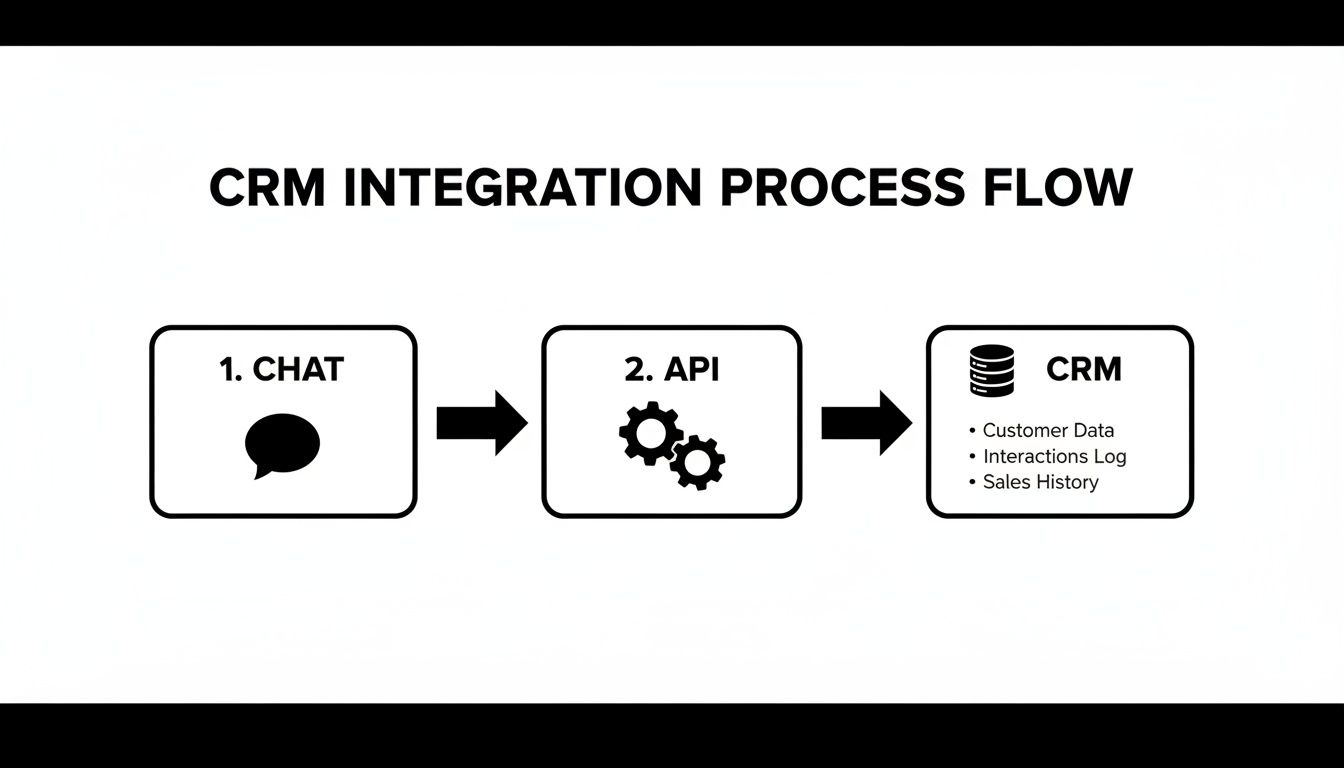
The main takeaway is that automation isn't just about deflecting tickets; it's the bridge that connects your customer-facing chat with your internal systems of record.
Key Considerations for the UAE Market
Rolling this kind of tech out in the UAE means you have to get a few local details right. The most important one? Your bot needs to be fluent in Arabic—and not just a clunky translation. We're talking about handling its various dialects and nuances.
An effective AI must not only translate but also understand the nuances and cultural context of local communication styles to provide truly helpful and empathetic support.
Another vital piece is designing a transparent and painless handoff from the bot to a human. Nobody wants to feel like they're trapped in an endless loop with a machine. You need clear, simple escalation paths so that when a human needs to step in, the transition is fast and smooth. To take your support even further, it's worth exploring how AI customer service solutions can automate more interactions and improve your team's overall efficiency.
The potential here is massive. The Middle East & Africa chatbot market hit USD 786.0 million in 2024 and is on track to explode to USD 2,272.0 million by 2030. That kind of growth tells you just how essential these tools are becoming for businesses in the region.
Navigating Security and Data Privacy
When a customer reaches out through a go chat messenger, they aren't just sending a message—they're handing you a piece of their trust. Protecting that trust is non-negotiable. This turns security and data privacy from simple IT tasks into core pillars of your customer service strategy. One careless slip can destroy years of brand loyalty in a heartbeat.
Your first line of defense should always be end-to-end encryption (E2EE). Think of E2EE as a digital sealed envelope. It guarantees that only the customer and your agent can read what's inside, locking out everyone else—including the platform provider. Using a messenger without it is like sending sensitive documents on a postcard for the world to see.
Adhering to Local and Global Regulations
For businesses operating in the UAE, data residency laws are a critical piece of the puzzle. These regulations aren't just suggestions; they legally require that customer data collected in the country must be stored on servers located within the UAE's borders. This reality directly impacts your choice of platform and who you partner with for implementation.
And it doesn't stop there. Even if your business is based in the UAE, international rules like the General Data Protection Regulation (GDPR) can still apply if you serve customers in the European Union. This means your data handling practices must meet some of the most stringent standards on the planet.
Being transparent with customers about how their data is used, stored, and protected is not merely a legal checkbox. It is a fundamental act of respect that builds lasting relationships and secures the long-term success of your chat channel.
Key Questions for Vetting Platforms
Before you commit to any go chat messenger solution, you have to ask some tough questions about its security architecture. A proactive approach here is the only way to safeguard both your customers and your business.
When you're evaluating potential vendors, it's easy to get lost in feature lists. The table below is a simple checklist to help you cut through the noise and focus on what truly matters for security and compliance. Use it to guide your conversations and compare platforms effectively.
Security and Compliance Checklist for Chat Messengers
| Feature/Consideration | Importance Level | Questions to Ask Vendors |
|---|---|---|
| End-to-End Encryption (E2EE) | Critical | Is E2EE enabled by default for all conversations? Who holds the encryption keys? |
| Data Residency & Storage | Critical | Where will our customer data be stored physically? Can we specify the region (e.g., UAE)? |
| Access Controls | High | What role-based access controls are available? Can we restrict agent access by team or function? |
| Compliance Certifications | High | Does your platform hold certifications like ISO 27001, SOC 2, or GDPR compliance? |
| Data Encryption at Rest | High | How is data encrypted when stored on your servers? What encryption standards do you use? |
| Audit Trails & Logging | Medium | Can we access detailed logs of agent activity and conversations for security audits? |
| Data Retention Policies | Medium | Can we configure custom data retention and deletion policies to meet our compliance needs? |
This checklist isn't exhaustive, but it covers the non-negotiable items. A vendor who can't provide clear, confident answers to these questions should be a major red flag. Your customers' trust—and your company's reputation—depends on getting this right.
Building an Effective Chat Support Team
Adopting a powerful go chat messenger platform is a great start, but the tech alone won’t deliver an amazing customer experience. The real difference-maker? Your people and the operational structure you build around them. Your team is what brings your chat strategy to life, so you have to give them the right skills and support.
Running a chat channel successfully means you can't just apply old-school call center thinking. Chat support is a whole different ballgame. Agents need to be masters of conveying tone and empathy through text alone, a skill that's far more nuanced than just talking on the phone. They also have to juggle several conversations at once without letting service quality dip, which takes serious focus and organizational chops.
Designing Smart Routing and Training
To set your team up for success, start with smart routing. You need rules that automatically send customer questions to the agent who’s best equipped to handle them. For example, a technical question about a product should go straight to a product specialist, while a billing inquiry gets routed to the finance support team. This cuts down on transfers and gets customers their answers much faster.
Next, get serious about targeted training. Your training program should cover:
- Tone Management: Teaching agents how to use language, punctuation, and even emojis the right way to sound helpful, human, and professional.
- Multitasking Effectively: Giving them real strategies for handling 3-4 chats at the same time without sacrificing quality or speed.
- Platform Proficiency: Making sure agents are experts at using the go chat messenger software, including all its shortcuts and integrated features.
A well-trained chat agent does more than just answer questions; they manage conversations. They know how to de-escalate tension, build rapport, and guide a customer to a resolution efficiently, all through a text-based medium.
For businesses looking to scale up their support team quickly, bringing in a specialized BPO provider can be a smart move. Many of these organizations offer agents who are already trained and skilled in chat support, which can seriously shorten your ramp-up time. You can check out a curated list of top-tier BPO companies in Dubai that specialize in modern customer communication channels.
Measuring What Matters in Chat Support
Finally, you can’t improve what you don’t measure. Tracking the right Key Performance Indicators (KPIs) is the only way to really understand how your team is performing and where you can get better. While a lot of metrics overlap with other support channels, a few are especially critical for chat.
Make sure you prioritize tracking KPIs like first-response time (FRT), which tells you how quickly an agent sends that first reply, and average resolution time (ART), which clocks the total time it takes to solve a customer's problem. And, of course, keep a close eye on your customer satisfaction (CSAT) scores specifically for the chat channel. Together, these numbers give you a clear picture of both efficiency and quality, allowing you to constantly fine-tune your process and deliver a consistently great experience.
Common Go Chat Messenger Questions
Rolling out a new communication channel always brings up questions, even for seasoned leaders. A go chat messenger strategy isn't just a tech project; it touches everything from your budget and IT infrastructure to the customer experience itself. Below, I’ll tackle the most common strategic hurdles and practical challenges that come up.
Think of these as the clear answers you need to make confident decisions and sidestep the pitfalls that can derail an otherwise solid plan.
How Can We Manage Costs at Scale ?
This is usually the first question on everyone's mind. How will the costs of a go chat messenger grow as our conversation volume shoots up? Unlike old-school channels, many official business APIs—think WhatsApp's—use a conversation-based pricing model. This means you're paying for each 24-hour interaction window, not just per message sent.
Here’s how you keep those costs from spiraling out of control:
- Deploy Smart Automation: This is your first line of defense. Use chatbots to handle the simple, high-volume stuff like "Where's my order?" or "What are your store hours?" This tactic resolves tons of conversations before a human ever has to touch them, which directly cuts down your billable interactions.
- Optimize Agent Efficiency: The beauty of chat is that one agent can handle multiple conversations at once. With the right training and tools, a single agent can easily manage 3-4 chats simultaneously, boosting productivity without needing to triple your headcount.
- Monitor Conversation Analytics: Keep a close eye on your data. What are the top reasons people are reaching out? If you spot a trend, you can get ahead of it. For instance, if everyone is asking about your return policy, maybe it’s time to make your website's FAQ page clearer. This deflects queries before they even hit the chat channel.
What Is the Best Way to Measure ROI ?
Measuring the return on investment for a chat channel goes way beyond just counting conversations. To get a real sense of its value, you need to look at both the efficiency gains for your team and the improvements in your customer experience.
The true ROI of a go chat messenger strategy is found not just in cost savings, but in its impact on customer loyalty and lifetime value. It's an investment in a modern, frictionless customer relationship.
Start by tracking these key metrics to build your business case:
- Cost Per Resolution: This is a straightforward comparison. How much does it cost to solve an issue via chat versus a much more expensive phone call? The answer is usually eye-opening.
- Agent Productivity: Look at the numbers. How many issues can one agent resolve per hour on chat compared to other channels? This metric highlights the efficiency gains.
- Customer Satisfaction (CSAT): Are your customers actually happy with the chat experience? Track CSAT scores specifically for your chat interactions to make sure you're hitting the mark on quality.
- First-Contact Resolution (FCR): A high FCR rate in chat is a huge win. It means you’re solving problems on the first try, which is one of the most direct ways to boost customer satisfaction and loyalty.


