


What Excellence in Customer Service Really Means

It’s easy to confuse good customer service with excellent customer service, but they operate on completely different levels. Good service is reactive—it solves a problem after a customer points it out. Excellence, on the other hand, is proactive and built on relationships. It anticipates needs, remembers past conversations, and makes every customer feel seen, not just processed.
Think about the difference between a fast-food counter and a five-star restaurant. One gets you your order efficiently. The other curates an entire experience, anticipating you need a refill before you even have to ask. That’s the leap from a transactional mindset to an experiential one, and it’s the heart of service excellence. With 86% of customers ready to walk away after just one bad experience, every single interaction counts.
The Three Pillars of Modern Service Excellence
To elevate your service from simply good to genuinely excellent, your entire strategy needs to stand on three core pillars. These aren't just buzzwords; they're the foundation of a customer journey that sticks.
- Empathy: This is all about the ability to truly understand and share what a customer is feeling. It means listening carefully, validating their frustrations, and showing you genuinely care. This is how a routine transaction becomes a reassuring human connection.
- Efficiency: Customers are busy, and they value their time. Excellence means delivering quick, accurate, and hassle-free solutions. This requires knowledgeable agents, streamlined processes, and the right tools to get things sorted on the first try.
- Empowerment: This is a two-way street, applying to both your agents and your customers. Empowered agents have the authority to make smart decisions and go the extra mile without wading through red tape. Empowered customers have access to great self-service tools, letting them find answers on their own terms, whenever they want.
"Good customer service always starts with a human touch. Personalised interactions greatly improve customer service and let customers know that your company cares about them and their problems."
At the end of the day, excellence means consistently providing excellent customer service and delivering value that goes far beyond the initial transaction.
From Problem-Solving to Relationship-Building
Reaching true excellence demands a fundamental shift in how you think about support. Too many companies see customer service as a cost center, a place where the goal is to resolve issues as quickly as possible. The best companies, however, see it as a growth engine.
Every interaction is a chance to strengthen the relationship.
This proactive mindset is about more than just fixing what’s broken. It's about spotting patterns in feedback to improve your product, reaching out before a small snag becomes a major headache, and tailoring every communication based on a customer's history. This guide will give you the framework to build that capability, turning your customer experience into your most powerful competitive advantage.
The Four Pillars of a World-Class Service Framework
Great customer service isn't a fluke. It doesn't just happen because you hired a few friendly people. Consistent, high-quality service is the direct result of a well-designed system, one built on a solid foundation.
Think of it like building a house. You can't just throw up some walls and hope for the best. You need strong structural supports. In customer service, that support system rests on four interconnected pillars: Culture, People, Process, and Technology. When these are strong and working together, they create a framework that can handle any customer interaction with empathy, efficiency, and a memorable touch. But if one pillar is weak, the whole structure starts to wobble.
This table gives you a high-level look at how these four pillars come together.
The Four Pillars of Service Excellence
| Pillar | Strategic Focus | Key Actions |
|---|---|---|
| Culture | Ingraining a customer-first mindset across the entire organization. | Foster leadership buy-in, break down departmental silos, and celebrate customer-centric behaviors. |
| People | Building a team with the right skills and empowering them to succeed. | Hire for empathy, provide continuous training in soft skills, and grant agents autonomy to solve problems. |
| Process | Designing customer journeys that are intuitive and friction-free. | Map customer interactions, identify and eliminate pain points, and provide clear escalation paths. |
| Technology | Using the right tools to support your team and scale your operations. | Implement a central CRM, automate repetitive tasks, and use data to drive continuous improvement. |
Each of these pillars is crucial. Let's break down what it takes to build them right.
Cultivating a Customer-First Culture
Culture isn’t just a mission statement hanging on the wall; it’s the invisible force that guides every decision when a manager isn't looking. A genuine customer-first culture means that every single department—from product development to finance—understands how their work ultimately lands on the customer's plate. It’s a shared belief that the company only wins when the customer wins.
This has to start at the top. When leadership consistently talks about customer feedback in meetings and publicly celebrates employees who go the extra mile, it sends a message that ripples through the entire organization. The goal is to shift from being a company that simply has a customer service department to a company that is a customer service organization at its core.
"A customer-first culture is the bedrock of service excellence. It empowers every team member to think like a customer advocate, transforming routine service into genuine relationship-building."
This means tearing down the walls between departments. For instance, if the marketing team runs a campaign promising a new feature, the service team needs to be fully briefed and ready to support it from day one. This kind of alignment is what creates a seamless journey for the customer, free from the frustrating gaps caused by internal disconnects.
Investing in the Right People
Your team is the human face of your brand. They are the voice that can turn a frustrating technical problem into a moment of relief and loyalty. Building a team that can deliver this level of service isn't about luck; it's about a deliberate approach to hiring, training, and, most importantly, empowerment.
First, hire for empathy and problem-solving aptitude, not just technical know-how. You can easily teach someone how to use a new software tool, but it's a whole lot harder to teach them how to genuinely care about a stranger's frustration. I always look for candidates who are naturally patient, attentive, and resourceful.
Next, you need to implement continuous training that goes way beyond product features. Your team needs to be equipped with crucial soft skills:
- Active Listening: Training them to hear what the customer isn't saying.
- Positive Language: Reframing negative situations to focus on solutions, not problems.
- De-escalation: Managing high-stress interactions with composure and grace.
Finally, you have to empower your agents. Give them the autonomy to make decisions—like issuing a refund or offering a service credit—without needing to climb a ladder of approvals. An empowered agent can resolve an issue in five minutes. A restricted agent creates a frustrating, hour-long ordeal that makes customers want to leave for good.
Designing Frictionless Processes
Even the most talented, empathetic team will fail if they’re trapped inside broken or overly complicated processes. World-class service is built on processes designed from the customer’s point of view. The goal here is simple: make it as easy as humanly possible for customers to get the help they need.
This starts with mapping out every potential customer journey. Find all the points of friction—things like long hold times, getting transferred multiple times, or having to repeat information to different agents—and then eliminate them one by one. A great process is basically invisible to the customer because it just works.
Key elements of a frictionless process include:
- Clear escalation paths for tough issues.
- Self-service options that are actually easy to find and use.
- An omnichannel approach where conversations can move from chat to email to phone without a hitch.
Adopting Enabling Technology
Technology is the pillar that supports and scales the other three. The right tech stack doesn't just make things faster; it automates the mundane, gives agents the context they need to be brilliant, and provides leaders with the data to make smart decisions. It's the engine that powers a modern service operation.
A Customer Relationship Management (CRM) system is the non-negotiable heart of this stack. It serves as the single source of truth, giving every agent a complete history of a customer's interactions. This context is what stops customers from having to repeat their story over and over again, allowing for personalized and efficient support.
The importance of this technology is clear in major market trends. In the Middle East and Africa, for example, the CRM market was valued at USD 3,917.9 million and is projected to grow at 15.4% annually through 2030. This signals a massive regional focus on using technology to build better customer relationships. You can dive deeper into this growth on ResearchAndMarkets.com.
Building Your Engine for Service Excellence
If a customer-first culture, great people, and smooth processes are the foundation of service excellence, then technology is the engine that actually drives it forward. The right tech stack doesn't replace the human touch; it amplifies it. It gives your team the superpowers they need to deliver personalized, efficient, and context-aware support at scale.
Truthfully, without a modern technology backbone, even the best intentions will fall flat against today’s customer expectations.
At the very heart of this engine is a solid Customer Relationship Management (CRM) system. Think of a CRM as the central nervous system for all your customer operations. It’s your single source of truth, gathering every interaction—from past purchases to recent support chats—into one clean, unified view. This alone eliminates the number one customer frustration: having to repeat their story over and over again.
This infographic shows how technology isn't just an add-on but an integral piece that works with culture, people, and process to create a world-class service experience.
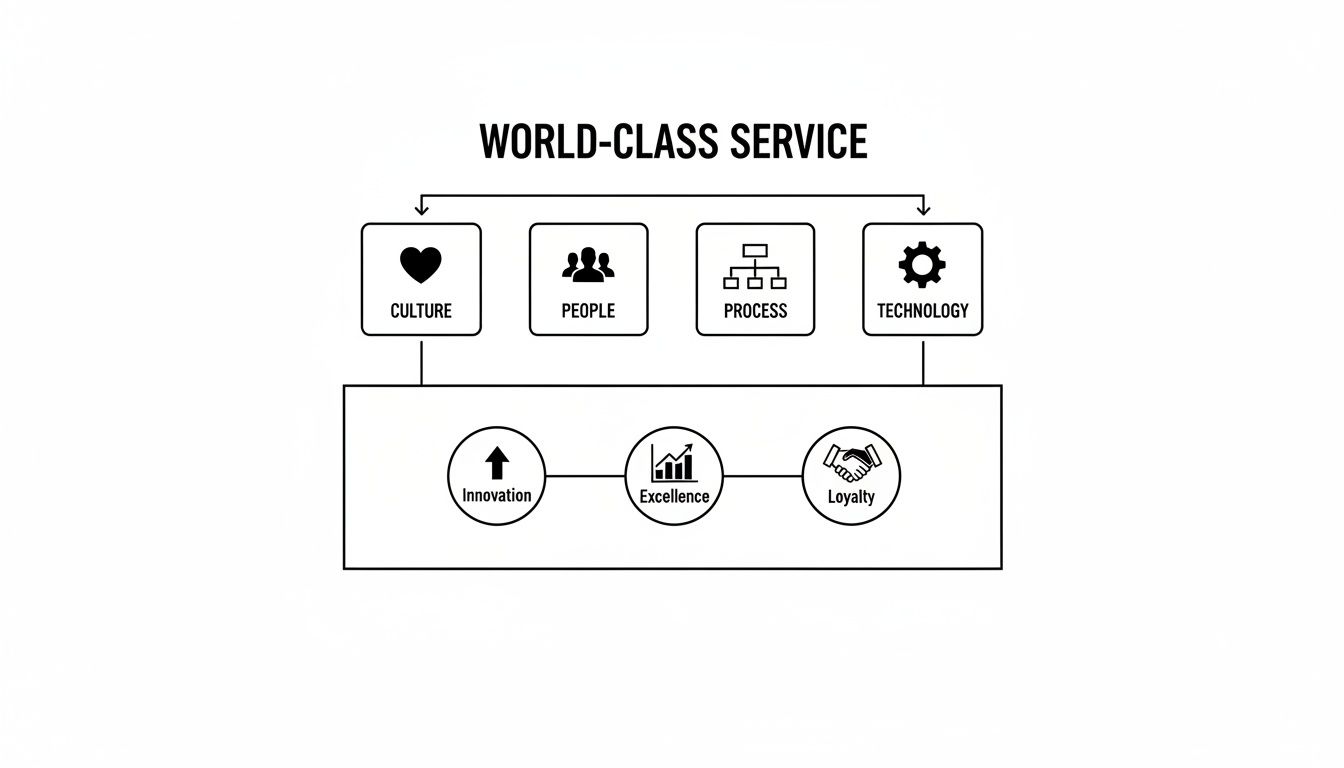
As you can see, technology isn’t some isolated silo. It’s the enabler that makes your people more effective and your processes more efficient, all within a culture that puts the customer first.
Essential Tools for Modern Support Teams
Beyond the CRM, a few other technologies are becoming non-negotiable for teams serious about customer service excellence. These tools all work together, creating a seamless support ecosystem.
First, AI-powered tools have moved from a "nice-to-have" to a "must-have." AI chatbots can handle routine, high-volume questions 24/7, freeing up your human agents to tackle the more complex and emotionally charged issues where they're needed most. On top of that, sentiment analysis tools can automatically read a customer's emotional state from their writing, giving agents a quick heads-up so they can approach the conversation with the right level of empathy from the start.
Next up is an integrated communications platform. Customers today expect to move effortlessly between email, live chat, social media, and phone calls without the conversation breaking. An integrated platform pulls all these channels into a single agent dashboard, ensuring the conversation is consistent and uninterrupted. This is a massive part of creating that frictionless experience that defines service excellence. You can dive deeper into optimizing your channels in our guide to the modern call centre.
Scaling Excellence with CCaaS
For companies looking to scale their support operations without a massive upfront investment, Contact Center as a Service (CCaaS) platforms are a game-changer. CCaaS is a cloud-based model that gives you all the software and infrastructure you need to run a cutting-edge contact center on a subscription basis.
A CCaaS solution allows businesses to quickly adapt to changing call volumes, add new communication channels, and integrate advanced features like AI and analytics without the headache of managing on-premise hardware. This agility is vital for maintaining high service standards during periods of rapid growth.
The market data confirms this shift. The Middle East Call Centres market, crucial for delivering excellence in customer service, reached USD 6,309.68 million and is expected to grow at a 12.2% CAGR. At the same time, the region's CCaaS market is exploding, projected to jump from USD 487.9 million to USD 1,570.8 million by 2030—an incredible 22.2% CAGR, with Saudi Arabia leading the charge. You can find more details about this trend on CognitiveMarketResearch.com.
These numbers tell a clear story: businesses are investing heavily in scalable technology to power their service engines. By choosing and integrating these tools thoughtfully, you empower your team to turn every interaction from a simple transaction into an experience that builds real, lasting loyalty.
Measuring What Truly Matters for Service Excellence
You’ve heard the old saying, "If you can't measure it, you can't improve it." It’s a classic for a reason, especially in customer service. The problem is, too many companies are still measuring the wrong things. They get stuck on outdated metrics that value speed over substance, creating a support culture that feels more like a factory assembly line than a human-to-human interaction.
To really build an operation that delivers excellence, you have to stop counting interactions and start measuring their impact. It’s a fundamental shift away from efficiency and toward outcomes.
Think about Average Handle Time (AHT). It’s useful for staffing, sure, but it says absolutely nothing about whether the customer left happy or frustrated. Pushing agents to get off the phone faster often works directly against the empathy and care required for a great resolution. You’re not just closing a ticket; you’re strengthening—or weakening—a customer relationship.
From Efficiency Metrics to Outcome-Focused KPIs
The most powerful Key Performance Indicators (KPIs) answer one simple question: "Did we solve the customer's problem and make their life easier?" That’s where outcome-focused metrics come in, giving you a real, unfiltered view of your service quality.
Here are the KPIs that truly define a modern service operation:
- Customer Satisfaction (CSAT): This is your immediate pulse check. Asking, "How satisfied were you with this interaction?" gives you direct feedback on that specific moment, agent, and process. It’s clean, simple, and incredibly actionable.
- Net Promoter Score (NPS): Moving beyond a single interaction, NPS measures long-term loyalty by asking how likely a customer is to recommend your brand. This metric tells you about the overall health of the customer relationship, not just one touchpoint.
- Customer Effort Score (CES): This might be the most telling indicator of a smooth experience. CES asks how easy it was to get help. Low-effort experiences are one of the strongest predictors of customer loyalty. Make it easy for them, and they’ll stick around.
- First Contact Resolution (FCR): A foundational metric. Did you solve the issue on the first try, with no transfers or callbacks? A high FCR rate is a surefire sign that your people, processes, and technology are working together seamlessly.
"Focusing on outcome-driven KPIs like CSAT and CES transforms your support team from a cost center focused on speed to a value center focused on building lasting customer loyalty. It’s a fundamental shift from 'how fast did we close the ticket?' to 'how well did we solve the problem?'"
Benchmarking for Continuous Improvement
Once you’re tracking the right metrics, you need to know what "good" looks like. Meaningful benchmarks are what fuel a culture of continuous improvement. The best place to start is with yourself. Establish an internal baseline—your performance over the last quarter—and then set small, achievable goals for improvement each month.
It's also smart to look at industry benchmarks to see how you compare to others, but don't treat them as gospel. Your main objective should always be to outdo your own past performance. For a deeper look at which metrics matter most, our guide on the top 10 customer service KPIs to track in 2025 is a great resource.
The table below really highlights the difference between the old way of thinking and the new, excellence-focused approach.
Comparing Traditional vs Excellence-Focused KPIs
| Metric Type | Traditional KPI (Efficiency Focus) | Excellence-Focused KPI (Outcome Focus) |
|---|---|---|
| Speed | Average Handle Time (AHT) | First Contact Resolution (FCR) |
| Volume | Number of Tickets Closed | Customer Satisfaction (CSAT) |
| Loyalty | Customer Retention Rate (Lagging) | Net Promoter Score (NPS) |
| Process | Number of Escalations | Customer Effort Score (CES) |
Switching to this modern framework does more than just change your dashboard. It gives your entire team a clear, shared goal that aligns perfectly with the principles of excellence in customer service. You’re no longer just managing a team; you’re leading them toward creating experiences that customers remember for all the right reasons.
Actionable Playbooks for In-House and Outsourced Teams
Great customer service doesn't come from a cookie-cutter template. The right strategy really depends on how your team is built. Whether you’re running an in-house crew or working with an external partner, your game plan for success is going to look completely different.
Let's break down two distinct, practical playbooks to help you build that excellence. One is all about nurturing a world-class team right under your own roof, and the other focuses on forging a seamless, high-performance partnership with an outsourced provider.
The In-House Excellence Playbook
When your team is in-house, your biggest superpower is direct control. You get to shape the culture and grow your talent from the ground up. The idea is to build a self-sustaining ecosystem where service excellence becomes second nature. This playbook hones in on three core areas.
- Build an Unbeatable Culture: This is about more than just posters on the wall. It means leadership has to consistently celebrate customer-centric wins, share positive feedback far and wide, and genuinely empower agents to make judgment calls. Create rituals, like a "Customer Story of the Week," to keep everyone connected to the impact they're making.
- Implement Robust Training Programmes: Onboarding needs to go beyond product features and scripts. You have to dedicate serious time to soft skills—things like active listening, empathy, and de-escalation. But it can't stop there. Follow up with continuous, bite-sized training sessions to keep skills sharp and introduce new techniques.
- Establish Clear Career Paths: Your best people will walk if they don't see a future. Map out a clear progression from an entry-level agent to a senior specialist, team lead, or even a quality assurance analyst. This isn't just about keeping people around; it ensures your most seasoned veterans are mentoring the next generation.
An in-house team's strength lies in its cultural DNA. By investing in people, training, and clear growth opportunities, you create an environment where excellence becomes the standard, not the exception. This fosters a deep sense of ownership and brand advocacy.
The digital-first habits of today's consumers practically demand this level of deep, in-house expertise. For example, recent regional consumer data shows 30% of shoppers in the AE region now use on-demand platforms for frequent purchases—that's double the global average of 15%. This rapid shift to complex digital services requires a support team that’s woven into the very fabric of the company's operations and culture. You can dive deeper into these Middle East consumer trends from PwC.
The Outsourced Partnership Playbook
When you're teaming up with an external partner, everything comes down to three things: selection, integration, and alignment. Picking a low-cost provider that doesn't fit your culture can backfire spectacularly. This playbook is designed to make sure your outsourced partner operates as a true extension of your brand.
First up, your vendor selection process has to look beyond the price tag. Find a partner whose company values actually reflect your own. Dig into their data security protocols, and demand case studies that are relevant to your industry. During interviews, throw some behavioral questions at them to get a real feel for their agents' problem-solving and empathy skills.
Next, you have to focus on deep integration and shared training. Don’t just email them a manual and call it a day. Your BPO partner should go through the exact same onboarding as your internal team. Give them the right level of access to your CRM and communication tools so they aren't flying blind and have the full customer context. For businesses looking into flexible support, exploring customer service virtual assistant services can be a smart move to make sure this level of integration is achievable.
Finally, establish aligned KPIs and continuous communication. Your partner needs to be measured on the same outcome-focused metrics as your own team—CSAT, NPS, and FCR. Get regular weekly check-ins on the calendar and hold quarterly business reviews to go over performance, share product updates, and tackle challenges together. Making sure your external and internal teams work as one is absolutely critical, and our guide on how to seamlessly integrate outsourced support with your in-house team provides a detailed roadmap for that.
Whether you go in-house or outsource, the foundation of excellence in customer service is a deliberate, strategic plan. By tailoring your playbook to your specific operational model, you can build a resilient and effective service engine that consistently delights customers and drives real business growth.
Your Roadmap to Achieving Service Excellence

Moving your customer service from just "good enough" to genuinely great is a process, not an overnight fix. This roadmap is your starting line, designed to turn the principles we’ve talked about into a concrete plan of attack.
The first move? Become your own customer. Seriously. Go through the entire process from start to finish—ask a simple question, navigate your IVR, try to resolve a complaint. This self-audit will shine a harsh light on friction points you never knew your customers were dealing with, giving you an honest baseline to build from.
Define Your Path Forward
Once you have a clear picture of where you are, you can start mapping out where you need to go. Don't try to boil the ocean. Focus on the high-impact areas that will deliver immediate, tangible improvements for both your customers and your team.
- Evaluate Your Tech Stack: Does your team have a single, unified view of the customer? If your agents are constantly toggling between five different windows just to find an order number, it's time to streamline. Give them the tools and context they need to be effective.
- Redefine Your KPIs: It's time to shift your focus. Move away from old-school efficiency metrics like average handle time and toward outcome-driven goals like First Contact Resolution (FCR) and Customer Effort Score (CES). This simple change aligns your team's incentives with what actually creates happy customers.
True excellence in customer service isn't about closing tickets faster. It's about making each interaction so smooth and effective that the customer feels completely seen, heard, and valued.
Build the Business Case
Finally, you need to connect the dots for leadership. Translate your findings and proposed changes into a rock-solid business case. Show exactly how better service metrics lead to better business outcomes, like higher customer retention and increased lifetime value.
Demonstrating a clear return on investment is how you get the budget and buy-in needed to make lasting changes.
Think of this roadmap not as a finish line, but as the start of a continuous improvement loop. By taking these deliberate steps, you'll start elevating every single interaction, building a service operation that becomes your most powerful competitive advantage.
Frequently Asked Questions
When you start down the path of customer service excellence, a lot of practical questions pop up. Leaders often wonder about the resources, priorities, and real-world challenges of turning a great strategy into a daily reality. Here are some of the most common questions we hear.
How Can Small Businesses Achieve Excellence on a Tight Budget ?
Great customer service isn't about having the biggest budget; it's about being smart, resourceful, and genuinely committed. For small businesses, the trick is to lean into high-impact strategies that don't cost a fortune but build real connections.
Your culture is your most powerful—and cheapest—asset. When every single team member feels a sense of ownership over the customer experience, you get incredible results without spending a dime. Empowering your people to solve problems on the spot, without needing to climb a ladder of approvals, is a game-changer. You can also find plenty of affordable cloud-based tools that give you a solid view of your customer without the enterprise-level price tag.
The heart of excellence in customer service for a small business isn't the size of its bank account, but the depth of its commitment. Prioritizing empathy and personal interactions will always make you stand out, no matter how much you're spending.
At the end of the day, focus on what the big guys struggle with: being nimble and adding a personal touch. Something as simple as a handwritten thank-you note or a quick, proactive follow-up call can build more loyalty than a slick, expensive marketing campaign ever could.
What Is the Single Most Important Factor in Customer Service ?
While technology and processes are crucial support systems, the one thing that matters more than anything else is an empowered, empathetic team. Your people are the human face of your brand. Their ability to truly understand and respond to a customer's feelings is something no piece of software can ever fully replace.
An empowered agent is someone who has the authority, the training, and the confidence to make decisions right then and there. They don’t have to fall back on the dreaded, "Let me check with my manager." They can fix the problem directly, turning a moment of frustration into a display of competence and genuine care. Empathy lets them connect with a customer’s frustration and make them feel heard, which is often more important than the solution itself.
How Do You Maintain Excellence While Scaling or Outsourcing ?
Keeping that spark of excellence alive as you grow or bring in outside partners is a huge challenge, but it's completely doable if you're deliberate about it. The secret is to systematize your approach so it doesn't depend on just a few star players.
You’ll need a solid, three-part strategy:
- A Robust Playbook: Create a crystal-clear, easy-to-access guide that details your brand voice, service standards, and how to handle common problems. This becomes the go-to resource for every single agent, whether they’re sitting in your office or working for a partner overseas.
- Standardized Training: Every agent, no matter their location, needs to go through the exact same comprehensive onboarding and ongoing training. This is how you make sure everyone breathes your culture and lives by your processes.
- Shared KPIs: Your in-house and external teams have to be measured by the same yardstick. Use outcome-focused metrics like CSAT and FCR to get everyone aligned on the real goal: delivering an amazing customer experience.


