

Understanding the Employee Self-Service Portal
An employee self-service portal, or ESS portal, is a platform that puts employees in the driver's seat of their own personal and professional information. It’s designed to replace those slow, manual HR processes with an intuitive digital experience you can access from anywhere, at any time.
Not too long ago, a simple request like finding an old payslip or changing a home address meant you had to contact HR, fill out a form, and then wait. This old way of doing things created administrative logjams, opened the door for human error, and pulled everyone away from more important work.
Modern ESS platforms completely change that dynamic. They act as a single source of truth for all employee data, plugging directly into other core business systems to keep everything consistent and accurate.
The Shift from Manual to Digital Empowerment
Bringing in an employee self-service portal is more than just a tech upgrade; it’s a fundamental shift in how a company runs its internal operations. Instead of HR acting as a gatekeeper to information, the department becomes an enabler, giving employees the autonomy to manage their own affairs. The entire model is built on a foundation of trust and efficiency.
Research has found that 36% of employees are unhappy with their workplace services, and it’s usually because of clunky, outdated internal processes. An ESS portal tackles this frustration head-on by giving internal tasks the same smooth, consumer-grade experience we expect everywhere else.
This shift is less about technology and more about philosophy. It’s about treating your employees with the same level of digital convenience and respect you offer your customers. When internal processes are frictionless, that positive experience radiates outward to your clients.
How an ESS Portal Directly Impacts Customer Service
For any team that deals with customers, the benefits of an ESS portal are immediate and significant. A well-designed portal cuts down on internal noise and frees up support agents to focus completely on helping customers.
Just think about the direct wins for your CX teams:
- Reduced Administrative Burden: Agents spend far less time chasing down answers to internal questions about their pay or vacation balance and more time actually solving customer problems.
- Increased Agent Focus: When you remove those administrative hurdles, agents can dedicate all their mental energy to providing great support, which is a straight line to better first-call resolution rates.
- Improved Morale and Retention: Giving employees self-service tools is empowering. It boosts job satisfaction and helps reduce burnout—a massive issue in high-turnover environments like contact centers.
- Faster Access to Information: Agents can quickly find training documents, review performance stats, and access company policies, helping them sharpen their skills and deliver better service.
At the end of the day, an ESS portal might be an internal tool, but its impact is felt externally. When you optimize the employee experience, you build a more engaged, efficient, and resilient team—one that’s ready to provide outstanding customer care.
What Are the Real Business Wins from an ESS Portal?
Rolling out an employee self-service portal is about more than just giving your team a slick new interface. It’s a strategic move that fundamentally changes how your HR department operates, shifting its focus from chasing paperwork to driving real business value. This creates a ripple effect of benefits, from serious cost savings to a more engaged and empowered workforce.
The most immediate win you'll see is the huge drop in the HR team's administrative burden. For years, HR has been buried under a mountain of repetitive tasks—answering the same questions over and over, processing leave requests, and manually punching in employee data updates. An ESS portal automates all of that, freeing up your skilled HR pros to focus on what actually matters: talent development, succession planning, and building a stronger company culture.
This isn’t just about saving time. It's about putting your most valuable resource—your people—on work that moves the needle.
Slash Your Administrative Costs
When you empower employees to handle their own information, you cut out a massive chunk of manual data entry and processing. Every time an employee updates their own address or downloads their payslip, that’s one less task clogging up the HR inbox. These small efficiencies add up to big cost savings, fast.
In the UAE, businesses that implement ESS portals are seeing their HR administrative costs drop by 30-50% in the first year alone. Picture a sales rep in Sharjah approving expenses on the go from their phone, or an engineer in Abu Dhabi instantly checking their overtime hours. None of it requires a call or email to HR. This shift is crucial for staying compliant with complex local rules like visa renewals and MOHRE requirements, as it replaces error-prone manual work. Learn more about how UAE businesses are switching to ESS portals on Truebays.com.
Sharpen Data Accuracy and Security
Let's be honest: no one knows an employee's personal details better than the employee themselves. When they are responsible for their own data, accuracy goes way up. They’ll be the first to spot if their bank details, contact info, or emergency contacts are wrong. Giving them direct access to fix it on the spot kills the risk of typos and errors that happen when an HR admin has to re-key information.
An ESS portal also tightens up your security and makes compliance a whole lot easier by creating a clear, digital audit trail for everything.
- Secure Access: With things like multi-factor authentication and role-based permissions, you ensure employees can only see and edit their own information.
- Timestamped Changes: Every update gets logged with a timestamp, so there's a transparent record of who changed what, and when.
- Centralized Document Management: You can securely store and share sensitive documents like employment contracts or policy updates, and even track who has opened them.
This creates a bulletproof system of record that simplifies compliance audits and keeps sensitive personal data locked down.
When you put data ownership in the hands of your employees, you create a system that’s not just more accurate but inherently more secure. It fosters a culture of accountability where everyone has a stake in keeping information clean and correct.
Boost Employee Morale and Engagement
Maybe the most underrated benefit of an employee self service portal is the massive boost it gives to morale. We can manage our banking, travel, and shopping from our phones, so why should work be any different? Relying on clunky, paper-based HR processes feels ancient and sends a message that you don't value your team's time.
Giving them a modern, easy-to-use ESS portal says the opposite: we trust you, and we respect your autonomy. That feeling of empowerment is a huge driver of job satisfaction. When your team members feel respected and in control of their work life, their engagement skyrockets. This is especially vital in high-pressure roles like customer service, where high agent morale is directly linked to lower turnover and better customer conversations. A focused, resilient support team is the bedrock of any successful customer experience operation.
Must-Have Features for Your ESS Portal
A truly great employee self service portal is so much more than a digital filing cabinet. It's an interactive hub that simplifies daily work and plugs directly into your other critical business systems. To deliver real value, your portal needs a solid foundation of core features combined with smart integrations that create a single, unified experience for your team.
Think of it like building a high-performance car. The core features are the engine, wheels, and chassis—the absolute essentials that make it run. The integrations are the turbocharger and the advanced navigation system—the upgrades that take it from a basic vehicle to a powerful, intuitive machine.
Let's break down exactly what you need.
Core Components for Employee Empowerment
These foundational features are non-negotiable. They are the tools that give employees the autonomy to manage their own information, saving everyone time and cutting down on routine questions for the HR team.
Personal Data Management: This is the bedrock of any ESS portal. Employees must be able to view and update their own information—like their address, emergency contacts, or bank details—without filling out a single paper form. This isn't just about convenience; it dramatically improves the accuracy of your employee data.
Payroll and Compensation Access: Transparency builds trust. Giving employees 24/7 access to their payslips (both current and past), tax forms, and a clear breakdown of their compensation package deflects a massive volume of common HR inquiries.
Leave and Attendance Tracking: Manual leave requests are a huge source of administrative friction. A modern ESS portal lets employees see their leave balances, request time off, and track the status of those requests in real-time. For managers, it provides a simple interface to approve requests and view team calendars to avoid scheduling conflicts.
Secure Document Management: The portal should act as a secure, central library for important documents. This is where employees can find the company handbook, policy updates, their employment contract, and performance reviews. The system also needs to let HR distribute documents securely and track who has acknowledged them.
These features form the essential toolkit that gives your team the autonomy they expect in a modern workplace.
Critical Integrations That Amplify Power
While core features are essential, integrations are what transform an ESS portal from a useful tool into a strategic powerhouse. A well-integrated portal breaks down data silos, automates workflows, and creates a single source of truth across your entire tech stack.
An employee self service portal operating in isolation will always have a limited impact. Real efficiency comes from its ability to talk to the other platforms your business depends on every day.
A standalone ESS portal is like a smartphone with no internet connection. It can still perform basic functions, but its true potential is only unlocked when it connects to a wider network of information and services.
This connectivity is what makes the portal indispensable. For companies with a diverse, global workforce, it's also vital to ensure these integrated systems are accessible to everyone. We cover some valuable strategies in our guide on optimizing self-service portals for multilingual audiences.
Your ESS portal's ability to seamlessly connect with other systems is where its true value shines, turning it from a simple HR tool into a central nervous system for your operations.
Essential Integrations for a High-Impact ESS Portal
The table below outlines the key systems your ESS portal should integrate with and the specific benefits each connection brings to your organization, particularly for customer-facing teams.
| Integration | Core Function | Benefit for CX and Operations |
|---|---|---|
| HRIS | The master record for all employee data. | Ensures data consistency across all systems, eliminating manual entry and errors. |
| CRM | Manages customer interactions and data. | Links agent performance (e.g., training) to CX metrics (e.g., CSAT) for deeper insights. |
| SSO | Provides secure, one-click access. | Improves user experience and enforces company-wide security protocols. |
| Knowledge Base | Central repository for company information. | Allows employees to find answers to policy or process questions instantly without a ticket. |
| Ticketing System | Manages and tracks internal support requests. | Streamlines issue resolution for IT, HR, and facilities, providing a single place to track requests. |
These integrations work together to create a connected ecosystem, ensuring that your portal is not just another piece of software but the true hub of your digital workplace.
How to Implement Your ESS Portal Smoothly
Rolling out an employee self-service portal is a big operational shift, but it doesn't have to be a painful one. With a clear roadmap, you can go from picking a vendor to a successful launch that empowers your team from day one. It's best to think of this not as a tech project, but as a strategic initiative designed to upgrade your internal operations and, in turn, your customer service.
A solid implementation plan is your best defense against common headaches like low adoption or messy data. By breaking the process down into manageable phases, you make sure every detail gets the attention it deserves, from the initial brainstorming to the final go-live. This approach paves the way for a smooth transition that actually helps your employees and delivers a real return on your investment.
Phase 1: Define Your Needs and Configure the System
Before you can build anything, you need a blueprint. This first phase is all about discovery and careful planning.
Start by mapping out your current HR processes. Pinpoint the exact frustrations you want the ESS portal to solve. Is the main goal to cut down on payroll questions? Make leave requests less of a hassle? Or give everyone better access to training materials?
Once your goals are crystal clear, it’s time to work with your vendor to set up the portal to meet those needs. This is where you’ll:
- Customize Workflows: Tailor the approval chains for things like leave requests and expense claims to fit your company's actual structure.
- Set User Permissions: Define roles and access levels so employees only see and edit information that’s relevant to them. This is crucial for protecting sensitive data.
- Brand the Interface: Add your company’s logo and colors to the portal. A familiar look and feel makes the whole experience more cohesive and welcoming for your team.
Getting this initial setup right lays the groundwork for the entire project, ensuring the final product is a perfect fit for how you operate.
A successful ESS portal implementation is built on a simple principle: understand your team's needs first, then configure the technology to serve them. Skipping this deep-dive analysis is the number one reason new systems fail to gain traction.
Phase 2: Migrate Data and Conduct Thorough Testing
With the system configured, the next critical step is moving your existing employee data over. This stage demands a sharp eye for detail to ensure everything is accurate and intact.
You'll need to pull data from your current systems—whether that’s an HRIS or a collection of spreadsheets—clean it up to get rid of duplicates and errors, and then carefully import it into the new portal. For a deeper look into handling this kind of information, our guide on client database software offers valuable principles that also apply here.
After the data is in, user acceptance testing (UAT) is absolutely non-negotiable. This isn't just an IT check; it's about seeing how the portal holds up in the real world. Pull together a pilot group of employees from different departments, especially your customer service team, and have them put the portal through its paces. Ask them to do everyday tasks like submitting a leave request, updating their contact info, or finding a policy document. Their feedback is gold for catching bugs and usability issues before you go live.
The diagram below shows how these core systems link up to create a fluid employee experience.
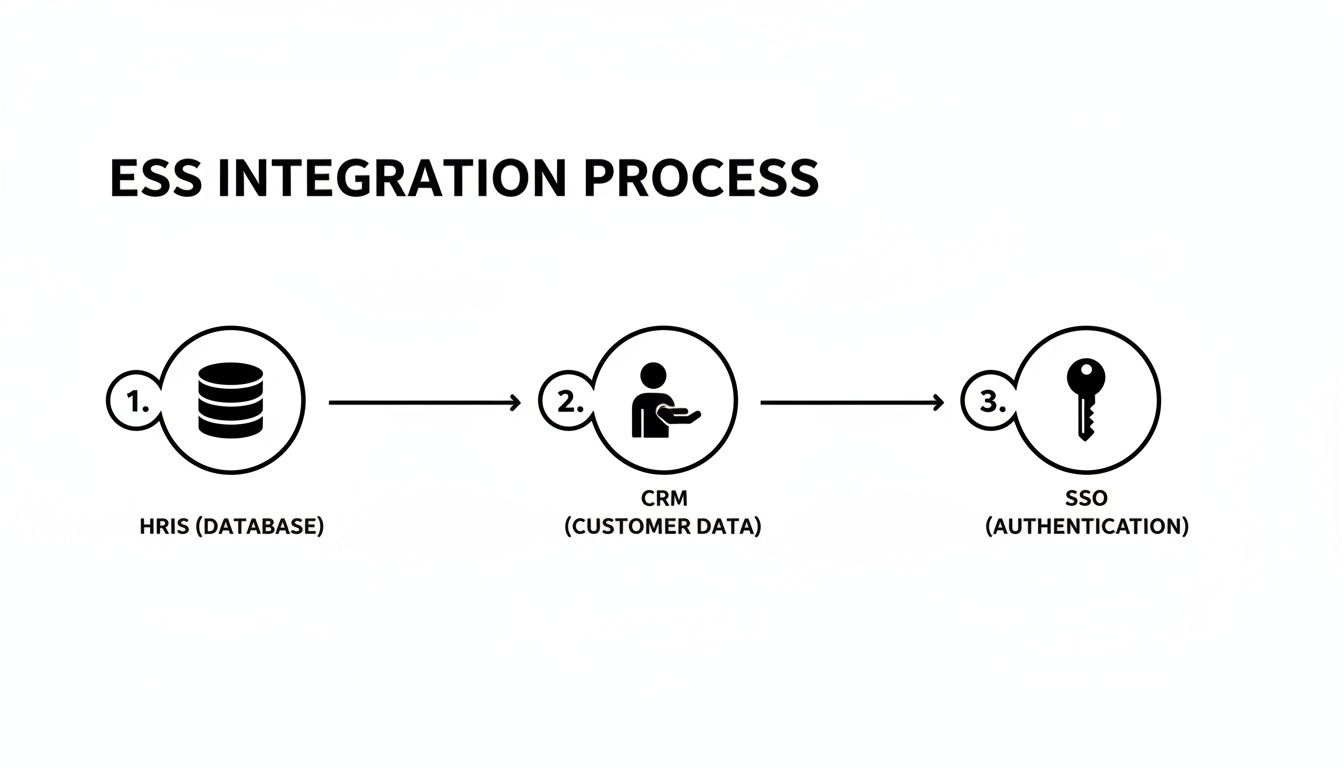
This flow highlights how data from your HRIS acts as the foundation, which can be enriched with CRM data and locked down through Single Sign-On for a unified and secure experience.
Phase 3: Focus on Change Management and Training
The tech is only half the equation; the people are the other half. A solid change management plan is what drives high adoption. You need to start communicating early, focusing on the "why" behind the shift. Explain how the new portal will make your employees' lives easier and free them up for more important work.
Next, develop training materials that are tailored to different groups of users.
- Employee Training: Stick to the basics—how to log in, update personal info, and submit requests. Short videos, quick-reference guides, and interactive sessions work best.
- Manager Training: Give managers extra training on the things they'll need to do, like approving requests, viewing team calendars, and accessing performance tools.
Finally, set up clear governance and usage policies. Document who’s in charge of maintaining the portal, how data will be kept secure, and what the protocol is for support tickets. Clear guidelines prevent confusion and ensure the portal runs smoothly long after you launch it.
Choosing the Right ESS Vendor for Your Business
Picking a partner for your employee self service portal is a big deal—a decision that will ripple through your operations for years. Don't think of it as just buying a piece of software; it’s more like entering a long-term business relationship. The right vendor gives you more than a tool. They provide a foundation for a more efficient, empowered workforce, which directly impacts your customer service team's ability to succeed.
This isn't just about ticking boxes on a feature list. You need a solution that can grow and change with your business, whether you're a scrappy startup in Dubai or a major enterprise with teams across the GCC. The wrong choice can saddle you with frustrating workarounds, security headaches, and a terrible return on your investment.
Aligning Vendor Capabilities with Your Growth Strategy
Scalability is your first major checkpoint. Your business isn't going to stand still, so your ESS portal can't be an anchor holding you back. Picture this: you're a fast-growing e-commerce company planning to double your agent count in the next 18 months. A portal that chokes under a heavier user load or hits you with outrageous fees for new employees will become a liability fast.
When you're talking to vendors, ask the tough questions about how they handle growth:
- Performance Under Load: What happens when hundreds of employees jump on the system at once during peak times, like right after payroll runs? Does it slow to a crawl?
- Pricing Structure: Is the pricing a predictable per-user fee that scales with your team? Or are there hidden costs for things like data storage or transaction volumes that will bite you later?
- Future-Proof Technology: Does the vendor have a clear roadmap for updates and new features? You want a partner who’s investing in their platform, not just maintaining an old system.
A truly scalable solution ensures the portal remains a powerful asset—not a bottleneck—as your company gets bigger.
Prioritising Security and Mobile Accessibility
In today's world, security and mobile access are two sides of the same coin. Your employees, especially remote customer service agents or those in the field, expect to handle HR tasks on their phones as easily as they do their online banking. A clunky, desktop-only portal is a complete non-starter.
Rock-solid security is non-negotiable. This portal is going to hold sensitive personal and financial data, making it a juicy target. A vendor’s security setup has to be one of your top considerations. This is about more than just tech; it's fundamental to building trust with your team. For a deeper dive, our article on building consumer trust through secure data practices has principles that apply just as much to your internal teams.
A vendor’s commitment to security is a direct reflection of their respect for your employees and your business. Weak security protocols are not just a technical flaw; they are a fundamental business risk.
The market for these platforms is booming, particularly in this region. The Middle East & Africa Employee Self-Service Portals market is set to grow with a 4.4% CAGR, hitting $346 million by 2031. This surge is fueled by demand in the UAE and Saudi Arabia for cloud-based tools that empower diverse, multilingual workforces who need constant, secure access to their data. You can find more insights from Archive Market Research about the growing ESS market.
Evaluating User Experience and Vendor Support
Finally, never underestimate the power of a clean, intuitive user interface (UI). If the portal is a pain to navigate, your employees just won't use it. You'll find them falling back into old habits, like emailing HR for every little thing. A great user experience (UX) is what drives adoption and makes sure you get the full value out of the system.
Vendor support is just as important. When things go wrong—and they always do—you need a responsive, knowledgeable support team that can fix problems fast. Before you sign anything, dig into their support model. Do they offer dedicated account managers? What are their guaranteed response times? Look for reviews or ask for references to get a real sense of their post-sales support.
A thoughtful review of these key areas—scalability, security, mobile access, user experience, and support—will lead you to the right employee self service portal vendor. It's a strategic choice that will empower your team, streamline your operations, and ultimately free up your customer service agents to focus on what they do best: delivering fantastic experiences.
How to Measure the Success of Your ESS Portal
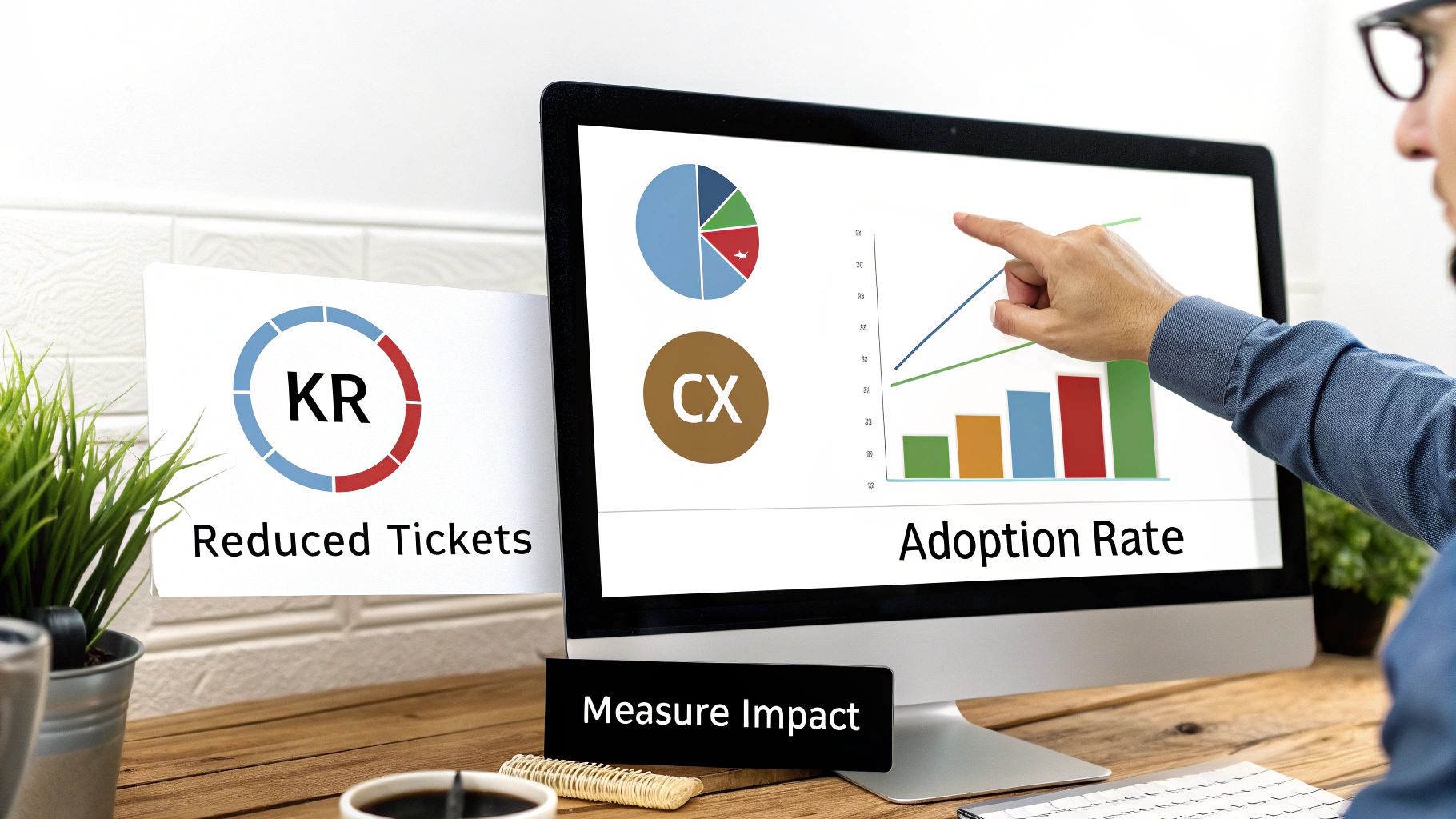
Rolling out an employee self service portal is a major investment in your company's operational backbone. To justify the cost and effort, you need to show clear, measurable results that go far beyond just flipping the switch and calling it a day. The right key performance indicators (KPIs) will tell a compelling story about efficiency gains, cost savings, and a genuinely better employee experience.
Think of your ESS portal as a new engine designed to make your whole organization run smoother. The only way to know if it’s performing as it should is to check the dashboard. This means tracking both the hard numbers—the quantitative data—and the qualitative feedback that captures how your team actually feels about the new tool. Blending these two views gives you the full picture of your return on investment.
Tracking Quantitative Metrics for ROI
The most direct way to prove your portal’s worth is by looking at the numbers that reflect efficiency and cost reduction. These metrics offer concrete evidence that the portal is pulling its weight and simplifying administrative work, which is exactly what it’s supposed to do.
Start by focusing on these core quantitative KPIs:
- Reduction in HR Helpdesk Tickets: This is your knockout metric. Track the volume of routine queries about payslips, leave balances, and personal data updates before and after the launch. A steep drop proves the portal is successfully deflecting those common, time-consuming questions.
- Employee Adoption Rate: A portal that nobody uses is just a failed investment. You need to monitor the percentage of employees who have logged in and actively used its main features. An adoption rate over 80% within the first few months is a fantastic sign of success.
- Time Saved on Administrative Tasks: Do the math on the hours your HR team is getting back by automating manual processes. For example, if processing a single leave request used to take 15 minutes and you handle 200 of them a month, automation just saved your team 50 hours of administrative work. That’s time they can now spend on more strategic initiatives.
Measuring Qualitative Impact and CX Outcomes
While numbers tell a big part of the story, the true value of an employee self service portal is also felt in improved morale and sharper focus—especially within your customer service teams. A streamlined internal experience has a direct ripple effect on the external one.
The ultimate goal of an internal tool like an ESS portal is to remove friction from an employee's day. When you solve internal problems efficiently, your team has more time and energy to solve customer problems, directly linking HR efficiency to customer satisfaction.
You can gather this qualitative feedback through simple methods like pulse surveys or by adding a feedback form directly into the portal itself. Ask your team about ease of use, their satisfaction with new processes, and how much time they feel they’re saving. This input not only helps you refine the portal but also demonstrates its direct impact on job satisfaction.
Ultimately, you can connect these internal wins to crucial CX outcomes. A happier, less distracted customer service team often leads to lower absenteeism and reduced agent turnover. These are the final links in the chain, proving that a well-run employee self service portal isn’t just an HR tool—it's a strategic asset for the entire business.
Got Questions About ESS Portals? We Have Answers
Even with all the clear upsides, rolling out a new system like an employee self-service portal is bound to bring up a few questions. Let's tackle the most common ones we hear from managers and operations leaders, so you can feel confident moving forward.
How Secure Is Our Employee Data in an ESS Portal?
This is usually the first question, and for good reason. Data security is non-negotiable, and any reputable ESS portal is built with multiple layers of protection. Vendors use powerful encryption for data both when it's being sent and when it's stored, making sensitive information completely unreadable to anyone who shouldn't have access.
Access is locked down through role-based permissions, which is just a technical way of saying employees can only see or edit information that's relevant to their job. On top of that, things like multi-factor authentication (MFA) and detailed audit logs add an extra security blanket, tracking every single change made within the system.
Will Our Employees Actually Use It?
Adoption all comes down to user experience. A modern, intuitive employee self-service portal that’s as easy to use as a consumer app will see plenty of action. The secret sauce is a clean interface that works just as well on a phone as it does on a desktop, letting staff get things done in a couple of taps.
To really drive usage, you need solid change management. You have to clearly spell out the benefits—like getting payslips instantly or having leave approved in hours, not days—and offer simple training guides. When employees see how the portal makes their lives easier, they’ll get on board.
Low adoption is rarely a technology problem; it's a communication problem. The best portals succeed because the company effectively answers the core question for every employee: "What's in it for me?"
Can the Portal Integrate with Our Existing Software?
Absolutely. In fact, integration is one of the biggest strengths of modern ESS platforms. Most are designed to connect seamlessly with the tools you already rely on, like your Human Resources Information System (HRIS), payroll software, and even Customer Relationship Management (CRM) tools.
These connections are what make the magic happen. They create a single source of truth for all your employee data and automate workflows that stretch across different departments. This means no more mind-numbing manual data entry between systems, which saves a ton of time and cuts down on errors.