


Hunting for a legitimate discount code for Next can transform your shopping trip from "just browsing" to "checkout complete," but only if you know where the real deals are hiding. The most reliable spots? Next's official email newsletter and the promotional banners on their website.
Why? Because these come straight from the source. They’re verified, up-to-date, and guaranteed to work, saving you that all-too-familiar sting of a rejected code.
Finding Next Discount Codes That Actually Work
Let's be honest, searching for a working discount code can feel like a wild goose chase. You get your hopes up with a promising offer from some random third-party site, only to be hit with that dreaded "invalid code" message at checkout. It's a common frustration that does more than just waste time—it sours the entire experience and is a leading cause of abandoned carts.
To sidestep this cycle of disappointment, always start with the official channels. Subscribing to Next’s newsletter is probably the single most effective move you can make. Retailers love to reward their loyal subscribers with exclusive promotions and a heads-up on upcoming sales.
While reputable affiliate and cashback websites can be good secondary sources, you should always treat codes from unfamiliar sites with a healthy dose of skepticism.
To make things easier, here’s a quick breakdown of where to look and what to do.
Quick Guide to Valid Next Discount Codes
This table summarizes the most reliable sources for finding authentic discount codes for Next and the key terms to check before you try to use one.
| Source Type | Reliability Score | Key Action Required |
|---|---|---|
| Official Next Newsletter | High | Subscribe and watch your inbox for exclusive offers. |
| Next Website Banners | High | Check the homepage and product pages for current deals. |
| Reputable Affiliate Sites | Medium | Verify the site's reputation and check expiration dates. |
| Cashback Platforms | Medium | Register and activate offers before shopping. |
| Random Coupon Sites | Low | Proceed with caution; codes are often expired or fake. |
Stick to the high-reliability sources first, and you'll save yourself a lot of time and frustration.
Why a Smooth Redemption Process Matters
A simple discount code isn't just a marketing gimmick; it's a critical moment in the customer's journey. When a code works seamlessly, it builds trust and gives the customer that final nudge to click "buy." In a crowded market, that tiny positive interaction can be the difference between a one-off purchase and a lifelong fan.
A frictionless checkout, including a successful discount code redemption, is a key driver of customer satisfaction. It validates the customer's effort in seeking a deal and solidifies their decision to purchase from your brand over a competitor.
This is particularly true in markets with sophisticated digital payment infrastructures. Take the UAE, for example, where the boom in e-commerce is directly linked to how effortless transactions have become. The region's digital payments market is on track to capture 24.05% of the entire Middle East and North Africa share by 2025, buoyed by an incredible 88% cashless adoption rate.
This kind of environment sets a high bar. Customers don't just hope for a smooth discount redemption; they expect it. Handling these transactions efficiently is a core part of modern e-commerce, and as we've seen, a self-service customer portal can supercharge your e-commerce sales by empowering customers to solve minor issues on their own.
How Next Promo Codes Work Behind the Scenes
Ever wondered why one Next discount code gives you free shipping while another knocks 20% off your order? It’s not magic. Every code is built with a specific set of rules that act like a unique key for a particular lock at checkout.
Getting a handle on these mechanics is the secret to using codes effectively. For customer support teams, this knowledge is the difference between a confused customer and a happy one, as it lets you explain exactly why a code might not be working.
Think of Next’s promotional system as a master blueprint. Each code is cut from this blueprint but customized with its own unique conditions. These conditions dictate what the code does, when it can be used, and who can use it, making sure every promotion hits a specific business goal, like clearing out old stock or welcoming first-time buyers.
The Different Types of Discount Keys
At the most basic level, discount codes for Next fall into a few common categories. Each one is designed to unlock a different kind of saving. Grasping these differences is the first step to becoming a savvy shopper and a sharp support agent.
- Percentage-Based Discounts: These are the codes you see most often, offering a percentage off your total order or specific items (e.g., "20% off all kidswear"). They’re fantastic for larger hauls because the savings grow as you spend more.
- Fixed Amount Discounts: These codes take a set amount of money off, like "£5 off your order." To keep the order profitable, they’re almost always tied to a minimum spend.
- Free Shipping Codes: This one’s simple—it removes the delivery charge. It's a surprisingly powerful incentive, especially since unexpected shipping fees are a top reason people abandon their carts.
- Category-Specific Offers: Some codes only work on certain departments, like "15% off Home & Garden." This lets Next drive sales in targeted areas of the business when they need to.
Understanding the specific "job" of each promo code is crucial. A code designed to boost clothing sales won't work on homeware, and a free shipping offer won't reduce the price of the items in your basket. This clarity prevents customer frustration at checkout.
The All-Important Terms and Conditions
Beyond the type of discount, every single code is governed by a set of rules. These terms are the gatekeepers that decide if your key will actually turn the lock. In my experience, missing just one of these conditions is the #1 reason a code fails.
Here are the usual suspects:
- Minimum Spend: You have to spend a certain amount for the code to kick in.
- Expiry Date: All good things must come to an end, and promo codes are no exception.
- Product Exclusions: Certain brands or items already on sale are often left out of promotions.
- Single-Use vs. Multi-Use: Some codes are one-and-done, while others are open for everyone to use multiple times.
For anyone who wants to go a layer deeper into how these rules are managed on e-commerce platforms, there's a great podcast on Abra Promotions for Shopify that explains the technical side. Understanding the logic running behind the checkout page helps both shoppers and CX teams troubleshoot issues. Nine times out of ten, when a code doesn’t work, it’s because one of these backend rules wasn't met.
How to Spot Fake Codes and Avoid Common Scams
In the hunt for a great deal on Next, it's easy to get sidetracked by offers that are just too good to be true. Let’s be honest, not every coupon website you stumble upon is trustworthy. Some are just designed to waste your time, while others have a more sinister goal, like harvesting your personal information.
Learning to tell the difference between a genuine discount and a clever scam is crucial for staying safe online.
Think of it this way: an official Next discount code is a key crafted by the brand itself, guaranteed to fit the lock at checkout. A fake code, on the other hand, is just a bad copy that will never work. Scammers flood the internet with these fakes, hoping to lure you to their websites with ridiculous promises like "90% off everything."
These sites often make money from ad clicks or, in worse cases, try to trick you into signing up for unwanted subscriptions or even downloading malware. For customer service teams, knowing these tactics is vital for steering customers away from harm and reinforcing the brand as the only trusted source for promotions.
Your Quick Verification Checklist
Before you copy and paste that promising code, run it through this quick mental checklist. It takes just a few seconds and can save you a ton of frustration—and potential risk.
- Check the Source: Is the website official or a well-known, reputable partner? Be suspicious of unfamiliar domains or any site that’s cluttered with pop-up ads.
- Verify the Offer: Does the discount even seem plausible? A massive, sitewide discount with zero exclusions is a major red flag. Real offers always have clear terms and conditions.
- Protect Your Data: Is the site asking for personal info beyond an email for a newsletter? A coupon site should never need your credit card details, address, or phone number just to give you a code.
The most effective defense against scams is a healthy dose of skepticism. If a discount feels unbelievably good, it probably isn't real. Always trust official channels like the Next website and newsletter over random search results.
This approach not only protects you as a shopper but also gives customer support agents a clear script. When a customer calls about a fake code they found, agents can use this logic to explain why it failed and point them toward legitimate offers, turning a negative experience into a positive, educational one.
Comparing Real vs. Fake Discount Codes
Let’s put them side-by-side to make the differences crystal clear.
| Feature | Legitimate Next Code | Fake or Scam Code |
|---|---|---|
| Origin | From Next’s official website, newsletter, or trusted partners. | Found on obscure, ad-heavy, third-party coupon sites. |
| Discount | Realistic offers like "10% off" or "free delivery over £30." | Unbelievable deals like "75% off all new arrivals." |
| Terms | Clear terms and conditions are readily available. | Vague or non-existent terms. |
| Requirements | May ask you to sign up for a newsletter on the official site. | Asks for excessive personal data or tries to install software. |
Ultimately, the goal of spotting fake discount codes for Next is to make sure your savings are real and your personal information stays secure. By sticking to trusted sources and questioning offers that seem too good to be true, you can shop with confidence. For CX leaders, this vigilance helps protect customers, cuts down on support tickets related to fraud, and builds lasting brand trust.
A Practical Playbook for Customer Support Teams
When a customer punches in a discount code for Next and it fizzles out, that frustration lands squarely on your customer experience (CX) team. This is a make-or-break moment. You can either let a negative interaction sour a customer's perception for good, or you can turn it into a positive, brand-affirming save. A clear, efficient playbook isn't just about solving one person's problem; it’s about protecting customer loyalty and keeping your operations smooth.
Your first line of defense is a well-prepared agent who has the right tools and scripts at their fingertips. Agents need to be trained to quickly figure out why a code failed without making the customer repeat themselves ten times. Was it expired? Was there a minimum spend? Or was it just a simple typo?
A little empathy goes a long way. An agent might kick things off with something like, "I'm sorry to hear that code isn't working for you. Let me quickly check the details on that promotion so we can get this sorted out." This simple opener immediately validates the customer's frustration and shows you're on their side.
Effective Support Scripts for Common Code Issues
Having pre-approved scripts for the most common hiccups helps agents deliver consistent and accurate support. It cuts down on resolution times and stops bad information from spreading. Here are a few core scenarios and some scripts to match.
- For Expired or Invalid Codes: "It looks like that particular discount code has expired. However, I see you're a valued customer, and I'd be happy to offer you a 10% discount on today's order for the inconvenience."
- For Unmet Terms (e.g., Minimum Spend): "I've checked that code, and it becomes active on orders over £50. Your basket is currently at £45—is there anything else I can help you find to unlock those savings?"
- For Technical Glitches: "Thank you for bringing this to our attention. It seems there's a temporary glitch with that code. I can manually apply the discount to your order right now and will escalate this to our technical team to fix."
When it comes to returns, support teams can also get creative. Some brands find a lot of success when they learn how to issue store credit on Shopify instead of discount codes for returns, which keeps cash in the business and encourages customers to come back for another purchase.
To make diagnostics even smoother, this simple process flow can help both customers and agents spot bogus codes in a flash.
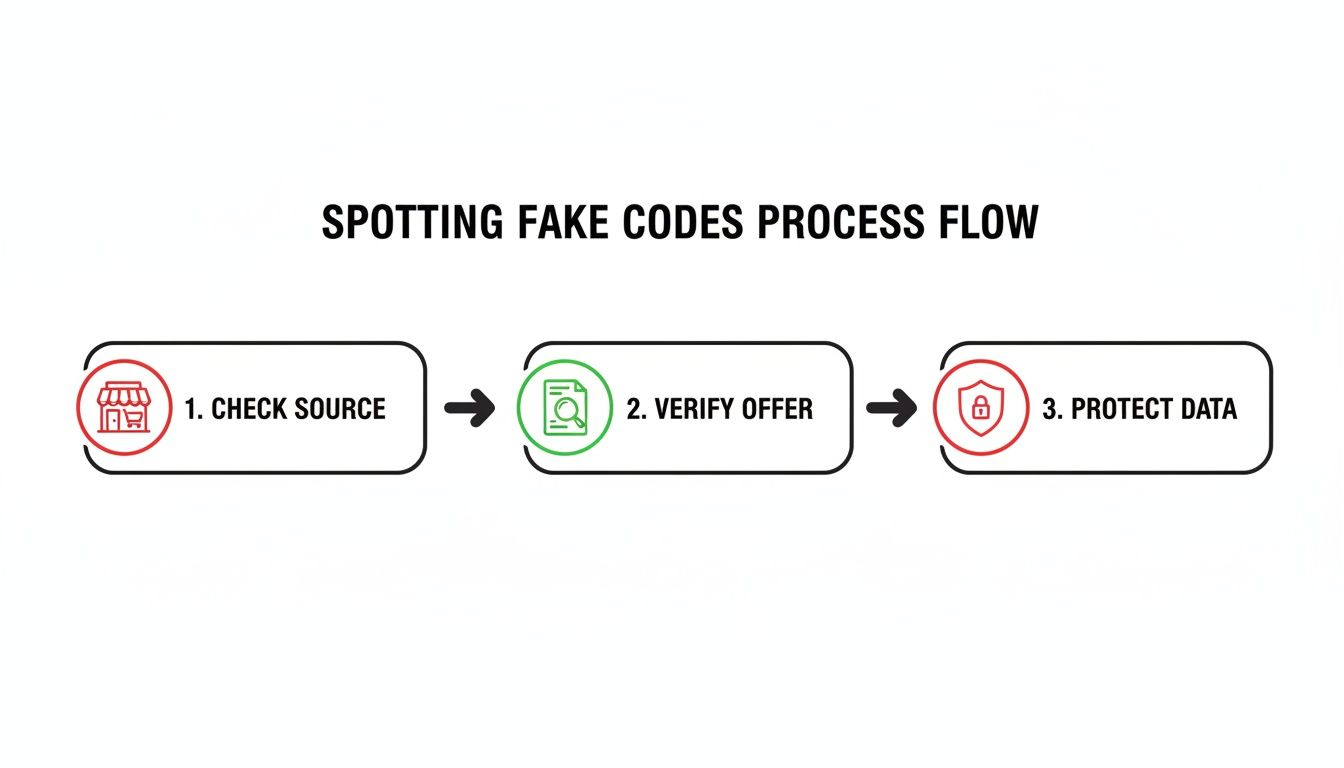
This visual guide boils it down to three steps: always check where the code came from, verify the offer’s fine print, and never hand over personal data to a shady site.
Escalation Paths and CRM Tagging
Not every issue can be solved by a Tier 1 agent. That's why a crystal-clear escalation path is so important. When a seemingly valid code keeps failing or you get a sudden spike in customers reporting the same problem, it’s a red flag for a bigger, systemic issue that needs a closer look.
The agent's job then shifts to gathering specifics—the exact code used, the customer's browser, the time of the error—and flagging it for a team lead or a technical support liaison.
Every single one of these interactions needs to be tagged correctly in your CRM. Using tags like promo-code-failed or technical-glitch-checkout lets you track trends and actually quantify the impact. Good tagging turns your CX team from a reactive problem-solver into a proactive partner for your marketing and IT departments. You can find more strategies for managing complaints from consumers in our detailed guide.
To bring this all together, here’s a simple framework your support team can use to standardize responses and know exactly when to raise a flag.
CX Team Response Framework for Discount Code Issues
This table gives Tier 1 agents a quick-glance guide for handling common discount code problems, from the initial script to the escalation trigger.
| Customer Issue | Tier 1 Agent Script (Summary) | Escalation Trigger |
|---|---|---|
| Code is Expired or Invalid | "Apologies, that code has expired. As a valued customer, let me offer you a 10% discount for the trouble." | Customer disputes validity with proof (e.g., a recent email). |
| Minimum Spend Not Met | "That code kicks in for orders over £50. Your cart is at £45. Can I help you find something else?" | The system doesn't apply the discount even after the threshold is met. |
| Technical Error | "Thanks for flagging this. I'll apply it manually and report the bug to our tech team so they can fix it." | Multiple customers report the same code failing within a short timeframe. |
| Suspected Fraudulent Code | "I can't validate that code from our system. To protect you, please only use codes from our official channels." | A specific fake code is causing a high volume of contacts. |
By structuring responses this way, you create a consistent experience for customers and a clear, data-driven feedback loop for the rest of the business.
Why a Good Discount Strategy Builds Lasting Loyalty
A discount code isn't just a way to save a few dollars; it's a critical moment in the customer journey that can make or break how someone feels about your brand. When a customer successfully redeems a code, it feels like a small win. That positive feeling reinforces their decision to shop with you and makes them much more likely to come back.
But the flip side is just as powerful. A buggy code or a confusing redemption process creates instant frustration. That friction often leads directly to an abandoned cart and can leave a lasting negative impression that’s hard to shake.
That single interaction carries a surprising amount of weight. For anyone working in CX, the real goal is to see the bigger picture—connecting a single "code not working" ticket to the company's broader business objectives. A well-designed discount strategy does exactly that, turning a simple transaction into a meaningful step toward building genuine, long-term customer loyalty.
When the process of finding and using discount codes for Next feels rewarding, customers feel smart and valued. That’s a powerful incentive for them to return and even recommend the brand to their friends and family.
The Psychology of a Successful Discount
A great discount experience taps into some powerful psychological drivers. It creates a sense of exclusivity, of getting an insider deal. This positive emotional payoff is a key ingredient in building brand affinity and making customers feel like they're part of an in-group.
When a customer successfully applies a discount, it validates their choice to shop with you. The immediate saving provides a little dopamine hit that they start to associate with your brand, making them far more likely to open your next promotional email or jump on a future offer. This is how a healthy repeat purchase cycle begins.
A discount is really a conversation between a brand and its customer. A working code says, "We value you and want to reward you for being here." A failed code, however, screams, "We don't have our act together," which erodes trust in an instant.
Discounts in Competitive Markets
In crowded sectors like retail and hospitality, a smooth discount process can be a huge competitive advantage. This is especially true in the AE region, where customer expectations are incredibly high. The recent MENA tourism boom, for example, shows just how effective discount codes are at driving loyalty in e-commerce. You can find more insights about the MENA tourism and hospitality growth on MiddleEastBriefing.com.
In the UAE and surrounding markets, outsourced CX teams are becoming experts at handling travel-related discounts. They're using integrated CRMs to verify codes in real-time, lifting conversion rates by as much as 25%. AI-powered contact centers in the region now handle 40% more discount queries per agent each day—a clear sign of just how important an efficient system has become.
Ultimately, your discount strategy is a core part of your entire customer experience. It has a direct line to customer satisfaction, retention, and brand perception. When you integrate these promotions with solid back-end systems, like a well-designed loyalty and rewards program software, you ensure every discount builds a stronger customer relationship, helping turn one-time buyers into loyal advocates for your brand.
Common Questions About Next Discount Codes
Hunting for deals online can sometimes feel like a wild goose chase. You find a code, get your hopes up, and then... nothing. Let's cut through the confusion. This section tackles the most common questions about Next discount codes, with straightforward answers for shoppers and the customer service teams helping them out.
Think of this as your go-to reference, pulling together everything we've talked about into quick, practical solutions.
Why Isn't My Next Discount Code Working ?
This is the number one frustration customers run into, and it almost always comes down to a handful of simple reasons. A code might fail because it's expired, the items in your cart don't qualify, or it was a one-time-use code that's already been claimed.
Before anything else, go back and double-check the fine print—the terms and conditions tied to the discount. Look for a few key details:
- A minimum spend requirement. Your order total might just be a few pounds short of what's needed to trigger the deal.
- Specific product exclusions. The code might be for full-priced womenswear but your basket is full of sale items or home goods.
- A strict expiry date. These promotions are almost always temporary and won't work a minute past their cutoff time.
If you’ve checked all the terms and the code still isn’t playing ball, try clearing your browser's cache and cookies. It’s a simple trick, but it often works. If that doesn't solve it, it’s time to get in touch with the customer support team. They can look up the code on their end and see if there's a technical glitch getting in the way.
Can I Use More Than One Discount Code on an Order ?
In nearly all cases, Next’s checkout is built to handle just one promotional code at a time. This means you can't "stack" deals, like using a 10% off code and a £5 off code on the same purchase.
You'll have to choose the code that gives you the biggest saving. For a big haul, a percentage-off code is usually your best bet. For a smaller purchase, that fixed-amount discount might save you more.
There's one common exception: free delivery. Often, a site-wide free shipping offer kicks in automatically when you spend a certain amount. This usually works alongside a separate discount code, letting you save on both your items and the delivery fee.
Where Is the Best Place to Find Official Codes ?
For legitimate discount codes for Next that you know will work, your best bet is always to go straight to the source. The safest and most reliable places are:
- The Official Next Email Newsletter: Signing up is the single best way to get exclusive offers and a heads-up on sales sent right to your inbox.
- The Next Website: Keep an eye on the banners at the top of the homepage or category pages. This is prime real estate for advertising current promotions.
- Verified Social Media Accounts: Following Next’s official channels is a great way to catch flash sales or social-media-only deals.
Some trusted affiliate and cashback sites do partner with Next to share valid codes, but you need to be cautious with random third-party coupon sites. Those places are often a dumping ground for expired, fake, or user-submitted codes that will just lead to frustration. Sticking to official channels means the codes you find are the real deal.


