


Think of it as a foundational investment that pays dividends in customer satisfaction, loyalty, and your company's bottom line. The best programs aren't one-and-done events; they're ongoing, data-driven, and equally focused on technical skills and human connection.
Building Your Training From the Ground Up
You can't build a great customer service training program with a slideshow and a dream. It has to start with a deep, honest look at what your team and your customers actually need. Jumping straight into content creation without this critical first step is like building a house without a blueprint. You might end up with something that looks okay from the outside but fails to address the real-world challenges your agents face every single day.
The goal is to design a targeted program that delivers a tangible return from the very first session.

Uncovering Skill Gaps with Real Data
First things first: you need to conduct a thorough needs analysis. This means looking at your operations from every angle to pinpoint specific skill gaps. This isn't about guesswork; it's about gathering cold, hard evidence.
Start by digging into the data you already have. Your Customer Relationship Management (CRM) and contact center platforms are absolute goldmines of information. Look for patterns in:
- Customer Feedback: Dive into your CSAT and NPS scores, but pay special attention to the negative comments. Are customers constantly complaining about long wait times, issues that aren't solved on the first try, or agents who don't know the product?
- Ticket Data: Review metrics like ticket resolution times, first-contact resolution (FCR) rates, and ticket escalation rates. A high number of escalations could be a huge red flag, pointing to a need for advanced problem-solving or de-escalation training.
- Quality Assurance (QA) Scores: Pull up your QA scorecards. Are agents consistently missing the mark in specific areas like demonstrating empathy, using active listening, or following company policies?
Adding the Human Element
Data tells you what is happening, but talking to your people tells you why. Make time to sit down with both your top-performing agents and those who might be struggling.
Ask your star players what makes them so successful. They often have unwritten rules and intuitive techniques that can be documented and turned into powerful, teachable moments for the whole team.
For agents who are having a tougher time, create a safe space for them to open up about where they feel uncertain. They might reveal gaps in your onboarding process or confusion about a new product feature that your data would never show you.
A critical mistake is designing training in a vacuum. Your best insights will come from the people on the front lines every single day. They know the customer's pain points better than anyone.
Defining Clear Learning Objectives
Once you’ve identified the main skill gaps, it's time to translate those insights into clear, measurable learning objectives. A weak objective sounds like, "Improve communication skills." It’s vague and impossible to measure.
A strong, actionable objective is much more specific: "After training, agents will be able to de-escalate a frustrated customer conversation using the three-step XYZ method, resulting in a 15% reduction in escalated tickets." See the difference?
Every single objective should be:
- Specific: Clearly state what the agent will be able to do.
- Measurable: Define how you'll track success (e.g., improved FCR, higher CSAT).
- Achievable: Make sure the goal is realistic for the training timeframe.
- Relevant: Directly connect the skill to a business goal, like customer retention or efficiency.
- Time-bound: Set a deadline for when you expect to see results.
To really nail this foundational work and ensure every module you create is purposeful, check out this modern playbook for effective employee training. Getting this part right guarantees your investment in training actually pays off by directly addressing known issues.
Designing a Curriculum Agents Won't Forget
Now that you have your learning objectives locked in, it’s time to build the actual training content—the modules and exercises that will shape your agents into confident, skilled problem-solvers. A curriculum that sticks goes way beyond reciting product specs and company policies. It has to be a carefully balanced mix of technical know-how and the human-centric skills that empower agents to handle any situation with grace.
The most effective training programs I've seen are always built on a few core modules. These aren't just nice-to-haves; they are the absolute essentials for delivering consistently great customer experiences.
The Three Pillars of a Core Curriculum
Think of your curriculum as having three foundational pillars. Every single agent, from a day-one hire to a seasoned pro, needs to be solid on all three.
- Deep Product and Service Mastery: An agent can't help a customer if they don't know your product inside and out. This isn't just about features; it's about advanced troubleshooting, common workarounds, and real-world use cases. The goal here is to build so much confidence that an agent never has to say, "I'm not sure."
- Confident Policy and Process Navigation: This is all about the internal rules of the road. Your team needs to know the refund policy, escalation paths, and data privacy guidelines cold. Getting this right prevents costly mistakes, keeps service consistent, and protects both the customer and the company.
- Mastery of Communication and Soft Skills: Let's be honest, technical knowledge is only half the battle. This pillar focuses on the art of the conversation—skills like active listening, showing genuine empathy, and mastering positive language. These are the skills that de-escalate tough situations and turn frustrated customers into your biggest fans.
For a deeper look into these crucial abilities, our guide on essential customer care service skills offers practical advice you can plug directly into your training.
Bringing Training to Life with Real-World Scenarios
Abstract ideas are forgotten almost instantly. To make training truly stick, you have to ground it in the reality your agents face every single day. And for that, role-playing is your most powerful tool.
Don't just talk about an angry customer—simulate the entire interaction. Pull detailed scenarios straight from your ticket history.
- Scenario Example: A long-time customer is irate because a recent software update got rid of a feature they depended on. They're threatening to cancel and blast you on social media.
- Role-Play Task: One agent plays the furious customer. The trainee's job is to listen, validate their frustration, explain the change with empathy, and find a workable solution to keep their business.
Exercises like these do more than test what someone knows. They build muscle memory for handling emotionally charged conversations, making agents feel far more prepared and less stressed when a real one comes along.
A curriculum without practical application is just a lecture. Agents learn best by doing, and simulated challenges provide a safe space to practice, make mistakes, and build the confidence they need for live interactions.
Structuring a Tiered Curriculum for Growth
Not every agent needs the same training at the same time. A one-size-fits-all program is inefficient and can bore your experienced team members. A much better approach is to structure your curriculum in tiers.
| Tier Level | Target Audience | Key Training Modules |
|---|---|---|
| Foundational | New Hires | Core product knowledge, basic CRM navigation, company policies, active listening basics. |
| Intermediate | Agents with 6+ months | Advanced troubleshooting, handling complex tickets, de-escalation techniques. |
| Advanced | Seasoned Professionals & Team Leads | Proactive support strategies, customer retention tactics, mentoring new agents, data analysis. |
This tiered structure creates a clear path for professional development. It sends a powerful message that you're invested in your team's growth, which is a huge factor in boosting morale and reducing turnover. It also ensures training stays relevant and challenging, keeping even your most senior agents engaged and sharp.
Picking the Right Training Delivery Methods for Real Impact
Once you’ve mapped out a world-class curriculum, the next big question is how you’ll actually deliver it. The method you choose for your customer service training is every bit as important as the content itself. Get it right, and learning feels intuitive and sticks. Get it wrong, and even the best material can fall flat.
There's no magic bullet here. The best choice depends entirely on your team's setup, the specific skills you're teaching, and the realities of your day-to-day operations. The three main models are live workshops, self-paced e-learning, and a blended approach that pulls the best from both worlds.
This decision tree gives you a great visual for how a learning path can be customized based on an agent's experience level, steering them toward either foundational or more advanced skills.
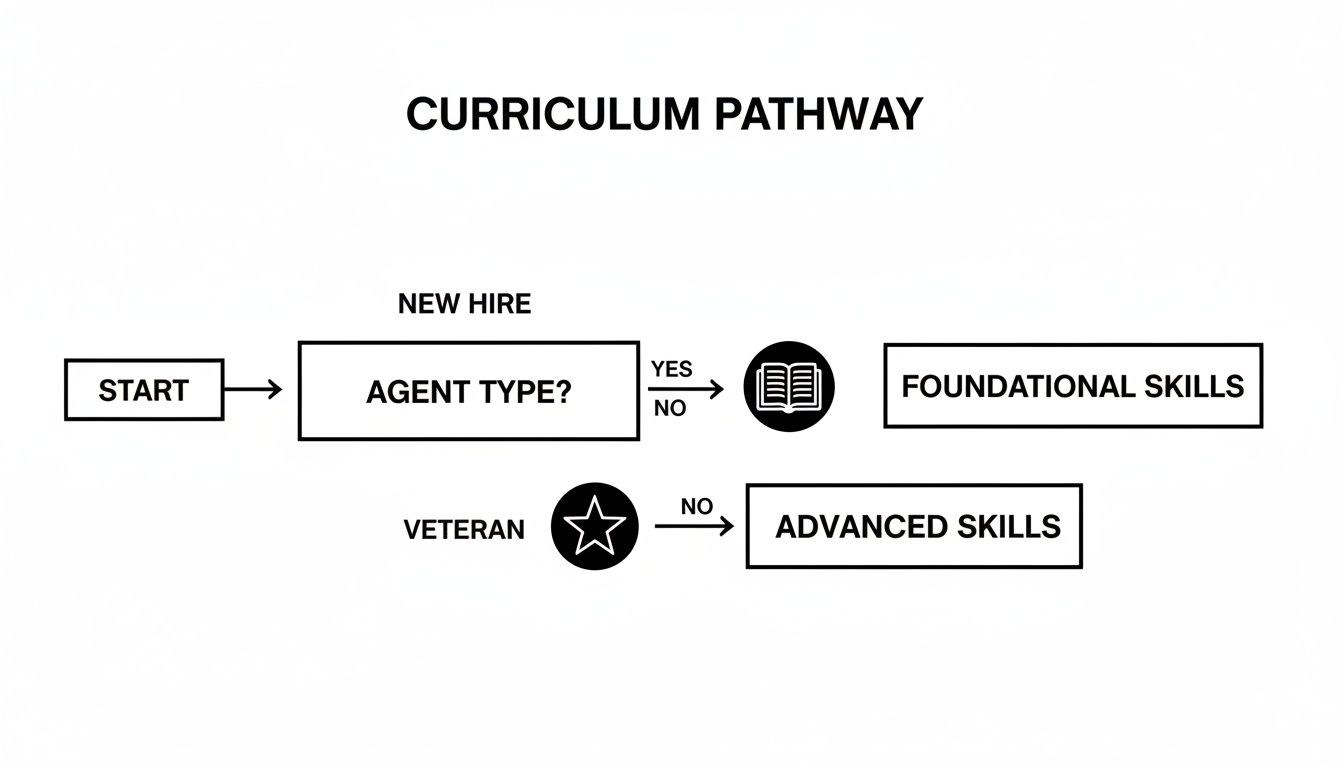
As you can see, it’s all about segmenting your training delivery. This ensures new hires get the core knowledge they need to get started, while your seasoned pros receive specialized content that sharpens their existing skills.
The Case for Live In-Person Workshops
For teaching complex, nuanced soft skills, nothing beats live, instructor-led training. Think about it: de-escalating an angry customer or showing genuine empathy isn't something you can truly master from a manual. Live workshops create a dynamic space where agents can jump into real-time role-playing.
This face-to-face interaction is where the magic happens. Trainers can give immediate, personalized feedback on an agent's tone of voice, word choice, and even body language. The group setting also encourages peer learning and builds team chemistry, which is priceless for creating a supportive culture.
Of course, live training is usually the most expensive and logistically intensive option. It demands dedicated time, physical space, and skilled facilitators, so you'll want to save it for high-impact skills that really need that hands-on practice.
The Power of Flexible E-Learning
Self-paced e-learning brings incredible flexibility and scale to the table, making it a perfect match for foundational knowledge. Things like product features, company policies, or how to navigate the CRM can easily be turned into modules that agents complete on their own time.
This method is a game-changer for remote or globally distributed teams. It guarantees that every single agent, no matter their location or time zone, gets the exact same consistent information. Good e-learning platforms will also let you build in quizzes and quick assessments to check for understanding before an agent moves on.
The real magic of e-learning is consistency. It guarantees that every single team member receives the exact same baseline knowledge on policies and products, eliminating costly "I didn't know" errors down the line.
Crafting a Winning Blended Learning Strategy
For most teams I've worked with, the sweet spot is a blended learning strategy. This approach simply uses each delivery method for what it’s best at, creating a learning journey that’s both powerful and efficient.
A typical blended model might look something like this:
- Foundational Knowledge (E-Learning): Before they even start, new hires complete self-paced online modules covering product specs, refund policies, and software basics.
- Interactive Skill Practice (Live Workshop): Once they're up to speed, they join in-person or live virtual workshops focused entirely on communication skills, packed with role-playing and direct coaching.
- Continuous Reinforcement (Microlearning): After the initial training, agents get bite-sized video refreshers or short quizzes through a tool like Slack to keep key concepts fresh.
This hybrid model respects your agents' time by reserving live sessions for what truly matters: human interaction. It's a smart, cost-effective way to scale high-quality customer service training.
Choosing the right mix of training methods is a key strategic decision. To help you weigh your options, here’s a breakdown of the pros and cons for each delivery format.
Comparison of Training Delivery Methods
| Method | Best For | Pros | Cons |
|---|---|---|---|
| Live Training | Complex soft skills, role-playing, team building | Immediate feedback, high engagement, peer learning | Expensive, logistically complex, difficult to scale |
| E-Learning | Foundational knowledge, policy/product info, remote teams | Scalable, consistent, flexible, cost-effective | Lower engagement, limited soft skill practice, lacks personalization |
| Blended Learning | Comprehensive training programs, varied skill sets | Balances cost and impact, flexible, reinforces learning | Requires careful planning and integration of methods |
Ultimately, a blended approach often provides the most robust and sustainable training program. By thoughtfully combining these methods, you build a program that is not only impactful but also adaptable to your team's evolving needs. For a more detailed breakdown, explore our guide on the best practices for training remote and outsourced support teams, which offers actionable tips for making any delivery method succeed.
Making Sure the Training Actually Sticks
So you've launched your new customer service training program. It feels like a big win, right? Everyone’s energized. But what happens next week? Or next month?
The initial buzz from a great training session fades fast. Without a solid plan for reinforcement, even the best lessons get lost in the shuffle of a busy queue. The real measure of success isn't a one-day workshop; it's seeing those new skills become daily habits long after the course ends.
The goal is to weave learning into the very fabric of your team's day-to-day. This means shifting from a "one-off event" mindset to a culture of continuous improvement, where getting better is an ongoing conversation, not a forgotten memo.
From One-Off Event to Daily Habit
Here’s the most common failure point I see: agents finish training, head back to their desks, and immediately get swamped. The pressure of hitting daily targets pushes those shiny new skills right to the back burner. It’s not their fault; it’s a system failure.
To fix this, you have to build reinforcement directly into your team’s workflow. This isn’t about sending a few reminder emails. It's about creating systems that encourage, support, and even demand that agents use their new skills in real situations.
Here are a few powerful ways I’ve seen this work:
- Peer Mentoring Programs: Pair newer agents with your seasoned top performers. It creates a safe, informal way for them to ask questions and get real-time advice on applying concepts to live tickets. No one wants to look silly in a team meeting, but everyone will ask a trusted peer for help.
- Regular One-on-One Coaching: Block out 30 minutes for coaching every week or two. These shouldn't feel like performance reviews. Think of them as collaborative problem-solving sessions focused on one or two specific skills from the training.
- A Dynamic Knowledge Base: Your internal knowledge base is more than just a reference guide—it's a living training tool. When you teach a new process, immediately create or update an article with a quick video tutorial and clear, scannable steps. Agents need to be able to pull up that info in seconds while on a call.
Connecting Training Directly to Quality Assurance
Want to make sure your training actually translates into results? Create a tight feedback loop between your training content and your Quality Assurance (QA) process. Your QA scorecards are a goldmine of data telling you exactly where reinforcement is needed most.
When your QA analysts review tickets, have them tag interactions that highlight specific skill gaps. Maybe it was a missed opportunity to show empathy or an incorrect explanation of a policy. That data needs to flow directly back to team leads and trainers.
This connection lets you shift from generic feedback to highly targeted micro-coaching. Instead of a manager saying, "You need to be more empathetic," they can say, "In ticket #12345, when the customer mentioned their frustration, let's look at how we could have used one of the empathy statements from training to validate their feelings." That specific, actionable feedback is what makes learning stick.
This feedback loop is non-negotiable. It transforms your QA from a reactive grading system into a proactive coaching engine, ensuring your customer service training constantly evolves to solve the real challenges your agents are facing right now.
Avoiding the Pitfalls of Untrained Teams
Throwing new tech at your team without training them on how to use it is a recipe for disaster. This is especially true in regions seeing rapid digital adoption.
Take the UAE, for example. A recent report found that overall customer satisfaction scores there dropped by 1.5%, and only 17% of brands actually improved. Customers said the decline was because they were being pushed into low-cost digital channels that felt cold and lacked a human touch.
The lesson here is critical: technology alone doesn't create better service. Without training your frontline team to inject empathy and expert problem-solving into every channel, even the most advanced tools can end up damaging customer relationships. You can learn more about these crucial findings on customer experience excellence from KPMG.
At the end of the day, reinforcement isn’t an afterthought. It's a core, integrated part of any training strategy that gets results. By building systems for peer support, connecting QA insights to coaching, and treating your knowledge base like a dynamic learning hub, you create an environment where skills aren't just learned—they're mastered.
Measuring the ROI of Your Training Program
So, how do you prove your training is actually working and not just creating "happy agents"? To lock in future budgets and show your efforts are paying off, you need to go beyond simple completion rates. It's time to connect your customer service training directly to the metrics that the C-suite really cares about.
This means drawing a clear, data-backed line from every training module and coaching session to real improvements in key performance indicators (KPIs). The goal is to tell a story that shows how investing in your people positively impacts customer satisfaction, makes the whole operation more efficient, and ultimately, boosts the bottom line.

Connecting Training to Key Business Metrics
Before you can even think about measuring return on investment (ROI), you have to define what success actually looks like. The first move? Establish baseline metrics before you roll out any training. Then, you'll track those same KPIs in the weeks and months afterward to see what changed.
You’ll want to focus on the metrics that training can directly and logically influence:
- Customer Satisfaction (CSAT): Are CSAT scores trending up for the agents who went through the training? Dig deeper and look for improvements in specific areas you covered, like product knowledge or how to handle escalations.
- First Contact Resolution (FCR): A well-trained team should be able to solve more problems on the first try. A rising FCR rate is one of the strongest signals that your training on product details and problem-solving is hitting the mark.
- Average Handle Time (AHT): You never want agents to rush, but effective training naturally makes them more efficient. If you see AHT tick down slightly without a drop in quality, it's a good sign they're navigating systems and finding answers much faster.
- Agent Retention: Let's be honest, good training is a huge driver of job satisfaction and career growth. Tracking agent turnover before and after you launch a solid training program can reveal some pretty significant cost savings.
A Simple Framework for Evaluation
A truly bulletproof evaluation blends the hard numbers with actual human feedback. Don't just bury yourself in contact center analytics; go talk to the people who actually sat through the program. This is how you get the full picture of your training's impact.
A classic, and still incredibly effective, way to structure this is the Kirkpatrick Model:
- Reaction: Right after the training, get immediate feedback with a survey. Was the content relevant and engaging? Did the facilitator connect with them?
- Learning: Use short quizzes or hands-on assessments to check if agents actually absorbed the key information and can demonstrate the new skills.
- Behavior: Through your regular QA process and manager observations, are agents actually using the new skills in their day-to-day customer interactions? This is where the rubber meets the road.
- Results: This is where you connect everything back to those business KPIs we talked about. Can you see a measurable lift in CSAT or FCR for the group that was trained?
To really make a case for your program, it’s critical to understand how to measure training effectiveness and show its value in a way leaders understand. This framework gives you a structured way to do just that.
Don't make the mistake of measuring only one thing. A high "reaction" score is nice, but if it doesn't lead to a change in "behavior" or "results," the training wasn't truly successful. You need the full story.
Leveraging Technology for Deeper Insights
Modern contact center platforms are your best friend when it comes to proving ROI. Every agent interaction is a goldmine of data. The Middle East contact‑center‑as‑a‑service (CCaaS) market, for example, is on track to hit USD 1,122.9 million by 2032, largely because companies are adopting advanced analytics.
With tools like speech and text analytics, you can automatically scan interactions to see if agents are using specific empathy phrases or following the new de-escalation steps you taught them. This moves you way beyond manual spot-checks. Suddenly, you have performance data across thousands of calls, giving you the hard evidence you need.
For those working with BPOs, our guide on how to measure ROI on outsourced customer service solutions offers some great frameworks you can easily adapt for your in-house teams. By mixing this kind of quantitative data with qualitative feedback, you can build an undeniable case for your training program's value.
Frequently Asked Questions About Customer Service Training
As you start putting together your customer service training strategy, you’re bound to have questions. Every team is different, and what works for a small startup probably won’t scale for a massive enterprise. Here are some of the most common questions I get from CX leaders when they're in the thick of designing their training programs.
My goal here is to give you clear, practical advice that helps you build a learning culture that actually sticks and drives real results for the business.
How Long Should Onboarding Training Last ?
There’s no magic number here, but I’ve found the most effective programs run anywhere from one to four weeks. The real key is to stop focusing on time spent and start focusing on proficiency achieved. A great onboarding process isn't about getting agents on the phones as fast as possible; it’s about building their confidence and competence right from the start.
A solid structure usually blends a few different learning styles. The first week might be all about the fundamentals—deep dives into your product, company policies, and how to navigate the CRM. The following weeks should shift into mentored, hands-on practice. New hires can handle real (but simple) tickets with a seasoned agent right there beside them before they're ever expected to tackle complex problems alone.
What Is the Most Important Customer Service Skill to Teach ?
While deep product knowledge is a given, the single most impactful skill you can teach is active listening. It's the foundation for every other critical soft skill, like empathy, problem-solving, and de-escalation. Without it, agents are just waiting for their turn to talk instead of truly understanding what the customer is going through.
Your training has to go beyond just telling agents to listen. It needs specific, practical exercises. For instance, you can use role-playing scenarios where one agent has to summarize the other's problem back to them perfectly before they’re allowed to offer a solution. This forces them to listen for the underlying need, not just the complaint on the surface.
So many training programs make the mistake of focusing entirely on what agents should say. The best programs, however, dedicate a huge amount of time to teaching agents how to listen. Understanding the customer's true problem is half the battle won.
How Can I Make Training Engaging for Remote Teams ?
Keeping remote teams engaged takes a more deliberate and creative approach than in-person training. The biggest risk is isolation, so your program has to be designed from the ground up to build community and interaction. A blended approach is your best friend here.
Try combining self-paced e-learning modules for foundational knowledge with live, interactive video sessions. These live sessions are where the magic happens and should be saved for activities that need that human connection.
- Interactive Role-Playing: Use breakout rooms in your video calls for small-group practice on handling tough customer scenarios.
- Gamification: Turn product knowledge quizzes into friendly competitions with leaderboards and small prizes. It works surprisingly well.
- Peer-to-Peer Learning: Set up dedicated channels in Slack or Teams where agents can ask questions, share wins, and just connect with each other.
By mixing up the formats, you cater to different learning styles and avoid the monotony that can creep in with purely online courses.
How Often Should We Provide Refresher Training ?
Ongoing training should never be that once-a-year event everyone dreads. For learning to stick, it needs to be consistent, relevant, and delivered in small, manageable doses. The principle to remember is that consistency always beats intensity.
Instead of a massive annual workshop, think in terms of a continuous learning rhythm.
- Weekly Microlearning: A short, 15-minute video or interactive module on a specific skill.
- Monthly Coaching: One-on-one sessions based directly on recent QA scores to give targeted, personalized feedback.
- Quarterly Deep Dives: Workshops focused on new product launches or tackling tricky customer scenarios that keep popping up.
This approach keeps skills sharp without pulling agents off the floor for huge chunks of time. It also sends a clear message that professional development is a core part of your company culture. As companies grow, this commitment to upskilling becomes a real competitive edge. For instance, the corporate training market in the Middle East and Africa was valued at around USD 3,104.3 million in 2024, with major growth in sectors where soft skills training is formally budgeted. You can dig into more of these market trends in this regional corporate training report.


