


This practice is no longer a "nice-to-have"—it's a core business strategy for any company serious about growing revenue and building loyalty.
Why Journey Mapping Is Your New Business Blueprint
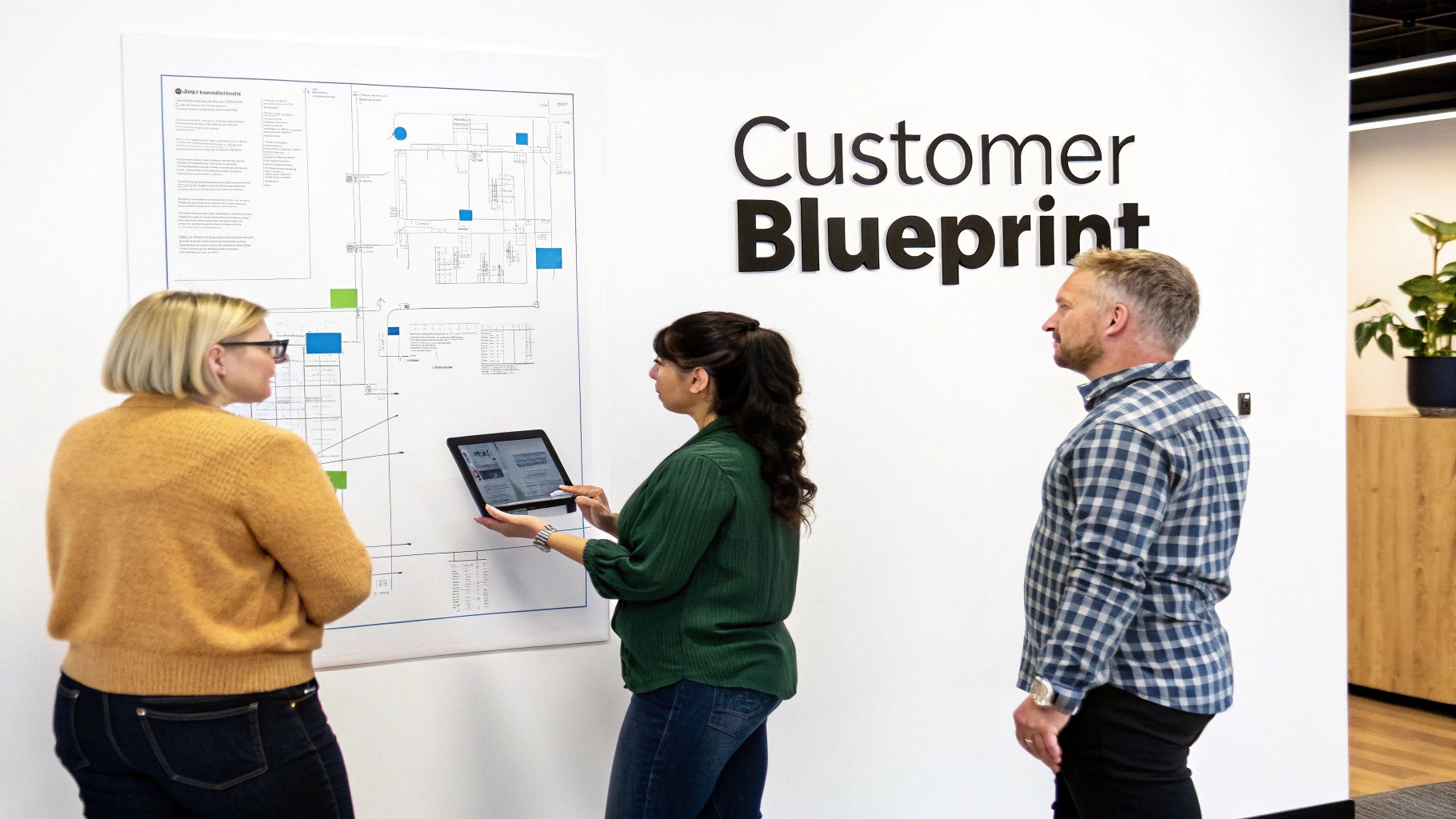
So many businesses think they already get their customers. They look at disconnected data points—sales figures here, website clicks there—and believe they have the full picture. Customer experience journey mapping shatters that assumption by forcing you to actually walk in your customer's shoes, step-by-step.
The outcome? A shared, unified view of the customer that breaks down internal silos. When your marketing, sales, product, and support teams are all looking at the same journey, their priorities magically align. The conversation shifts from hitting departmental metrics to improving the entire customer experience.
From Niche Task to Strategic Imperative
Journey mapping used to be seen as a job for UX designers, tucked away in a corner. Not anymore. Now, it's a discipline discussed in the C-suite. What caused the shift? A well-executed map directly exposes the friction points that cause customers to leave and, just as importantly, highlights the hidden opportunities that drive growth. It turns vague customer feedback into a concrete plan of action.
Imagine a map reveals that while your marketing is brilliant at attracting high-quality leads, the onboarding process is so confusing that you see a 30% drop-off in the first week. Without that map, marketing gets celebrated for hitting their numbers, while the product team gets blamed for poor retention. The real root cause is never addressed. The map connects those dots.
A customer journey map is the organization's memory of what it’s like to be a customer. It forces a company to look at itself from the outside in, revealing truths that are often uncomfortable but always valuable.
This strategic pivot is happening globally. In the UAE and the wider GCC, journey mapping has rapidly moved from a niche activity to a board-level discipline tied directly to revenue. A 2023 analysis of B2B CX in the region found that Gulf markets now boast “numerous companies with dedicated CX teams, formal journey mapping practices, and continual service innovation cycles,” especially in telecom, banking, and government services. Adoption isn't just experimental anymore; it’s standard practice.
The Unifying Power of a Single Blueprint
A journey map's real strength is its ability to create empathy and shared ownership across the organization. It gives everyone, including outsourced partners, a common language to talk about—and solve—customer problems. This shared blueprint ensures every decision, whether it's a new ad campaign or a tweak to a support policy, is made with a full understanding of its ripple effect on the customer.
Ultimately, mastering this process is about more than just boosting satisfaction scores. It’s about building a resilient, customer-centric organization that can adapt and thrive. By understanding the complete journey, you find the insights needed to make meaningful improvements that boost both loyalty and your bottom line. As our guide on the ROI of investing in customer experience explains, investing here has a clear financial upside.
Setting The Stage For An Effective Journey Map
Before a single sticky note hits the whiteboard, the success of your customer experience journey mapping effort is largely decided. The groundwork you lay beforehand is what separates a pretty diagram from a powerful business tool. Without a clear focus and the right people in the room, even the most enthusiastic workshop can go completely off the rails.
The most common mistake I see is teams trying to map everything at once. This "boil the ocean" approach creates a map that's a mile wide and an inch deep, filled with vague insights that are impossible to act on. The real goal is to generate early wins that prove the value of journey mapping and build momentum for more.
Define A Focused Business Objective
First things first: ask yourself what specific business problem you're trying to solve. Tying your map to a concrete objective gives you the guardrails needed to keep the project focused and, more importantly, measurable.
Instead of a broad goal like "improve customer satisfaction," get specific. A much stronger objective sounds like this:
- Reduce customer churn during the first 90 days by finding the friction points in our onboarding process.
- Increase the free-to-paid conversion rate by understanding exactly where trial users get stuck or lose interest.
- Cut down on support tickets for 'how-to' questions by pinpointing confusing features in our user interface.
When you have a sharp, defined objective, every conversation during your mapping session becomes productive and drives toward a tangible outcome.
Select A Single High-Impact Journey
With your objective locked in, the next move is to choose one specific journey to map. Many teams stumble here, but the trick is to start small and prove value quickly. In the UAE, for example, fast-growing e-commerce and SaaS companies often begin with just 2–3 critical journeys, like the first-order experience, subscription renewal, or a crucial support escalation path.
This focused approach is especially popular among small and medium enterprises (SMEs). A recent market study found that SMEs make up 56.8% of global journey-mapping software adoption, largely because they use it to solve immediate, high-impact problems. Structured journey mapping workshops are a go-to for founders in the Middle East who need to visualize real customer behavior and identify friction fast.
The best journey to map first is one that is both valuable to the business and visibly painful for the customer. Look for where your business goals and customer complaints overlap—that's your starting point.
Build Personas That Capture Reality
A journey map is pretty useless if you don't know who is on the journey. This is where customer personas come in, but you need to go far beyond basic demographics like age and location.
Effective personas for journey mapping are rooted in motivations, goals, and frustrations. For a software company, a persona isn't just "Sarah, 35, a marketing manager." It’s "Time-Crunched Sarah," whose main goal is to generate reports quickly for her boss and whose biggest frustration is dealing with complex data filters. That level of detail is what helps your team build genuine empathy.
Assemble Your Cross-Functional Powerhouse Team
Customer journey mapping is a team sport, period. The insights you uncover are only as good as the different perspectives you bring into the room. A map built only by the marketing team will look wildly different—and be far less accurate—than one built with input from across the entire business.
Your core workshop team absolutely should include people from:
- Sales : They know the pre-purchase questions and objections inside and out.
- Product/Engineering : They understand the technical capabilities and limitations.
- Customer Support : They are on the front lines, hearing about customer problems every single day.
- Marketing : They own the initial awareness and consideration stages.
And here’s a critical point: if you use external partners for customer service or other functions, they must be involved. Their agents often have the most direct, unfiltered view of customer pain points. Including them ensures your map reflects the complete reality of the customer experience, a topic we explore in our guide on journey mapping with outsourced CX partners.
Learning how to plan workshops effectively is a cornerstone for this whole process, making sure you get actionable outcomes. This is the prep work that sets the stage for a workshop that produces a truly transformative map.
Uncovering Insights Through Collaborative Workshops
Once your objectives are set and the team is in place, it’s time to shift from planning to doing. This is where the real work of journey mapping kicks off—in a dynamic, collaborative workshop designed to pull out genuine insights.
A great workshop isn't just a brainstorming free-for-all. It's a structured investigation into your customer's world, fueled by a powerful mix of hard data and real human experience. The goal is to build a 360-degree view before anyone even touches a sticky note. Relying only on what your team thinks they know is the fastest way to map a fantasy. Instead, you need to ground the entire session in solid evidence, combining what customers say with what they actually do.
Gathering Your Research Arsenal
To build a map that reflects reality, you need to start with both qualitative and quantitative data. Each one tells a different side of the story. Quantitative data shows you what is happening at scale, while qualitative data explains why it's happening.
Here are the essential sources I always pull from :
- Quantitative Data (The 'What') : This is the hard data that reveals patterns and trends. Think of it as your factual baseline.
- Website Analytics : Dig into metrics like bounce rates on key pages, how long people spend on help articles, and where they drop off in a conversion funnel. A high exit rate on your checkout page is a massive red flag signaling friction.
- Net Promoter Score (NPS) & CSAT Surveys : These scores give you a quick pulse check on customer sentiment at specific moments, like right after a purchase or a support chat.
- CRM Data : Look at purchase frequency, customer lifetime value, and the volume of support tickets coming from different customer segments. This helps you figure out which journeys need fixing first.
- Qualitative Data (The 'Why') : This is where you uncover the emotions, motivations, and frustrations that numbers alone can't capture.
- User Interviews : Direct conversations with customers are pure gold. Ask open-ended questions to understand their goals and pain points in their own words.
- Support Ticket & Live Chat Transcripts : Your support team's records are a treasure trove of unfiltered customer feedback. Hunt for recurring themes and direct quotes that pinpoint what’s making people angry or confused.
- Social Media & Review Sites : See what customers are saying about you in public. These platforms often capture the raw, emotional highs and lows of their experience.
By weaving these sources together, you arm your workshop team with real evidence. This completely changes the conversation from "I think customers feel..." to "Our data shows customers struggle with..."
Facilitating a Dynamic Mapping Session
With all your research gathered and synthesized, the workshop becomes an exercise in guided discovery. The facilitator's role here is absolutely critical—they have to keep the team focused, manage the different personalities in the room, and make sure the session leads to actionable outcomes, not just a wall of complaints. The core principles are the same whether you're in a room with a whiteboard or running it virtually.
You'll want a clear agenda that walks the team through the customer's journey step-by-step. Start with the "Awareness" stage and move logically all the way through to "Loyalty." For each stage, use the research you’ve collected to prompt the discussion and keep it grounded.
The facilitator’s most important job is to be the voice of the customer in the room. When the conversation drifts toward internal jargon or company processes, they need to gently steer it back by asking, "But what is the customer thinking and feeling at this exact moment?"
Managing Group Dynamics For Maximum Insight
A room full of people from different departments will naturally bring different perspectives and priorities to the table. This diversity is a huge strength, but you have to manage it carefully to keep the session productive.
Here are a few techniques that have always worked for me:
- Start with the Persona : Constantly bring the conversation back to the customer persona you've developed. This keeps the focus squarely on the customer’s needs, not departmental agendas.
- Use "How Might We..." Statements : When someone identifies a pain point, reframe it with a "How might we..." question. Instead of just writing down "the checkout is confusing," ask the group, "How might we make the payment process clearer for first-time buyers?" This simple switch encourages solution-oriented thinking.
- Encourage Quiet Voices : Make sure everyone gets a chance to contribute, not just the loudest person in the room. I like to use techniques like silent brainstorming, where everyone jots down ideas on sticky notes before sharing them out loud.
- Create a 'Parking Lot' : When important but off-topic ideas pop up, write them in a designated "parking lot" area on the whiteboard. This validates the idea without derailing the current conversation and ensures you can come back to it later.
A well-run workshop does more than just gather ideas; it transforms raw data and individual opinions into a shared, empathetic understanding of the customer's journey. It’s this collaborative fire that forges the foundation for a map your entire organization can get behind to make real, tangible improvements.
Turning Workshop Chaos Into A Clear Visual Story
A productive workshop is useless if the output is just a confusing mess of sticky notes and scribbled ideas. The real magic happens when you transform that raw, chaotic energy into a powerful visual story that people will actually understand and use. This is where your customer experience journey mapping effort shifts from a collaborative exercise into a strategic business asset.
Without this crucial step, even the best insights get lost. A well-designed map organizes the chaos, translating customer emotions and actions into a clear narrative that exposes friction and reveals opportunities. It becomes the single source of truth your entire organization can rally behind.
The goal here isn't just to plot out isolated touchpoints. It's to visualize the complete journey, capturing the highs and lows of the customer’s emotional state right alongside their actions and the thoughts driving them.
The Essential Components Of An Effective Map
Every great journey map is built on a consistent structure that layers different types of information. Think of it like an archaeological dig—each layer reveals a deeper part of the customer’s story. While formats can vary, every impactful map needs several key components.
Here are the non-negotiable elements you need to build into your visual story :
- Journey Stages : These are the high-level phases the customer moves through, like Awareness, Consideration, Purchase, Onboarding, and Loyalty. They act as the main chapters of your story.
- Customer Actions : For each stage, detail what the customer is actually doing. This could be anything from "Googling for solutions" to "contacting customer support" or "leaving a review."
- Touchpoints : Pinpoint the specific channels or points of interaction. This includes your website, mobile app, social media ads, a support agent, or even an outsourced partner.
- Thoughts and Feelings : This is the emotional core of the map. Capture what the customer is thinking and feeling at each touchpoint. Use direct quotes from your research to bring this to life—words like "confused," "frustrated," "reassured," or "delighted" are essential.
- Pain Points : Clearly identify the moments of friction. Where do things break down? What’s causing frustration or making the customer want to give up?
- Opportunities : For every pain point, there's an opportunity. This is where your map becomes a strategic tool. Frame each opportunity with a "How might we..." statement to spark actionable ideas.
The process of synthesizing all that workshop output into a clear visual story follows a simple flow: gather data, run the workshop, and then find the actionable insights.
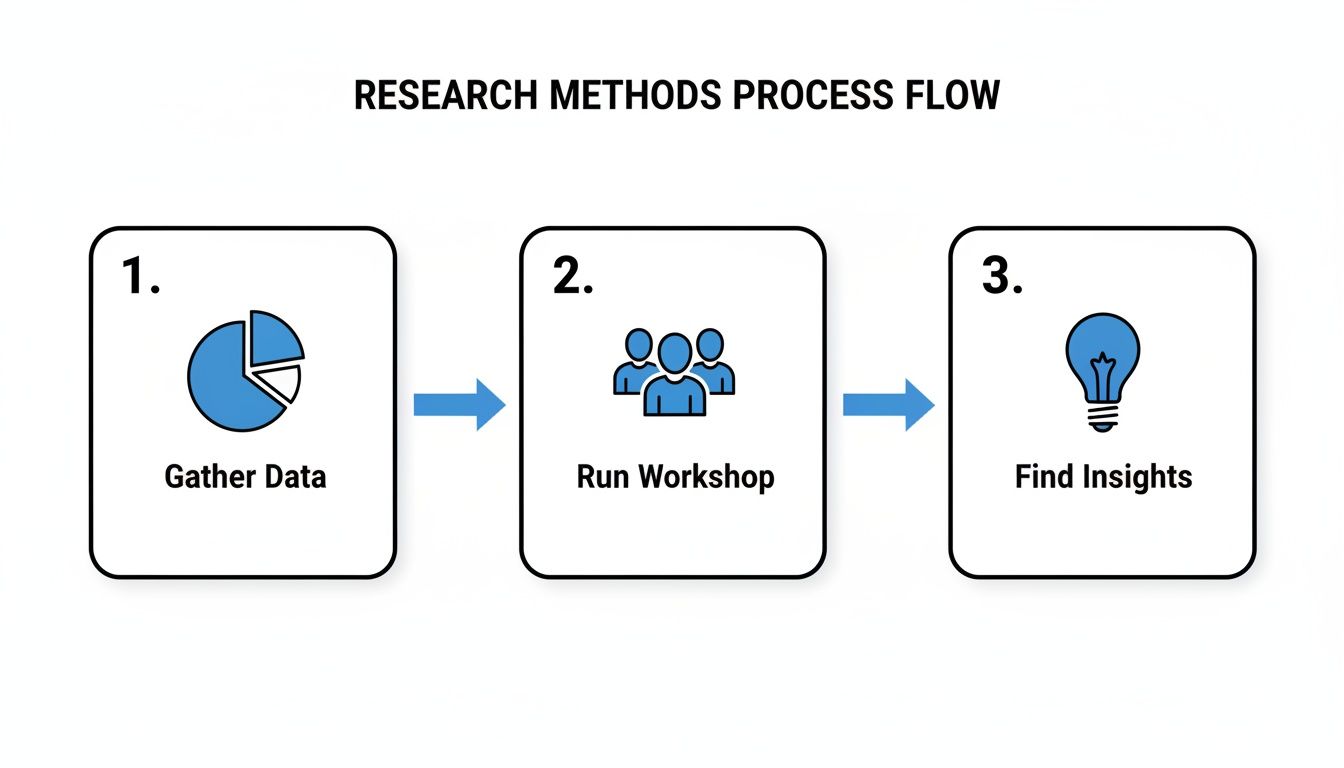
This visual is a great reminder that a map isn't built on guesswork. It's the direct result of consolidating research and workshop collaboration into a focused set of insights.
Choosing The Right Visual Format For Your Story
There's no single "right" way to visualize a journey map. The best format really depends on the complexity of the journey and who you're showing it to. A map for your executive team might need to be simpler and more high-level than one used by your product and support teams.
Consider these common formats:
| Map Type | Best For | Key Characteristic |
|---|---|---|
| Simple Timeline | Presenting high-level journeys to leadership. | A linear, step-by-step view of the key stages and touchpoints. |
| Multi-Lane Diagram | A detailed operational view for internal teams. | A grid-like structure with dedicated "swimlanes" for actions, thoughts, feelings, and pain points. |
| Service Blueprint | Aligning customer actions with internal processes. | Extends a journey map to show the backstage employee actions and systems that support each touchpoint. |
A simple timeline is fantastic for getting initial buy-in, but a multi-lane diagram is where the real work gets done. It provides the depth needed for teams to truly understand the nuanced relationship between a customer's actions and their emotional state.
A journey map should feel like watching a film of your customer's experience. If it’s just a spreadsheet of data points, you’ve missed the point. It has to tell a human story to create empathy and drive action.
Connecting Opportunities To Owners And Actions
This is it. The final, most critical step in turning your map from a pretty picture into a catalyst for real change. A map filled with brilliant insights is still a failure if nobody acts on them.
For every single opportunity you've identified on the map, you must assign two things:
- A Clear Owner : Who is responsible for exploring this opportunity further? Be specific. It could be a person (like the Head of Product) or a team (like the Customer Support Training team).
- A Next Action Item : What is the very next step? It doesn’t have to be a full-blown solution. It could be as simple as "schedule a meeting to investigate the checkout process" or "analyze support tickets related to password resets."
This simple act creates immediate accountability and momentum. Your customer experience journey map becomes a living action plan, ensuring that the valuable insights from your workshop don't just fade away but are translated into real improvements that customers will actually feel.
Making Your Journey Map a Living Business Tool
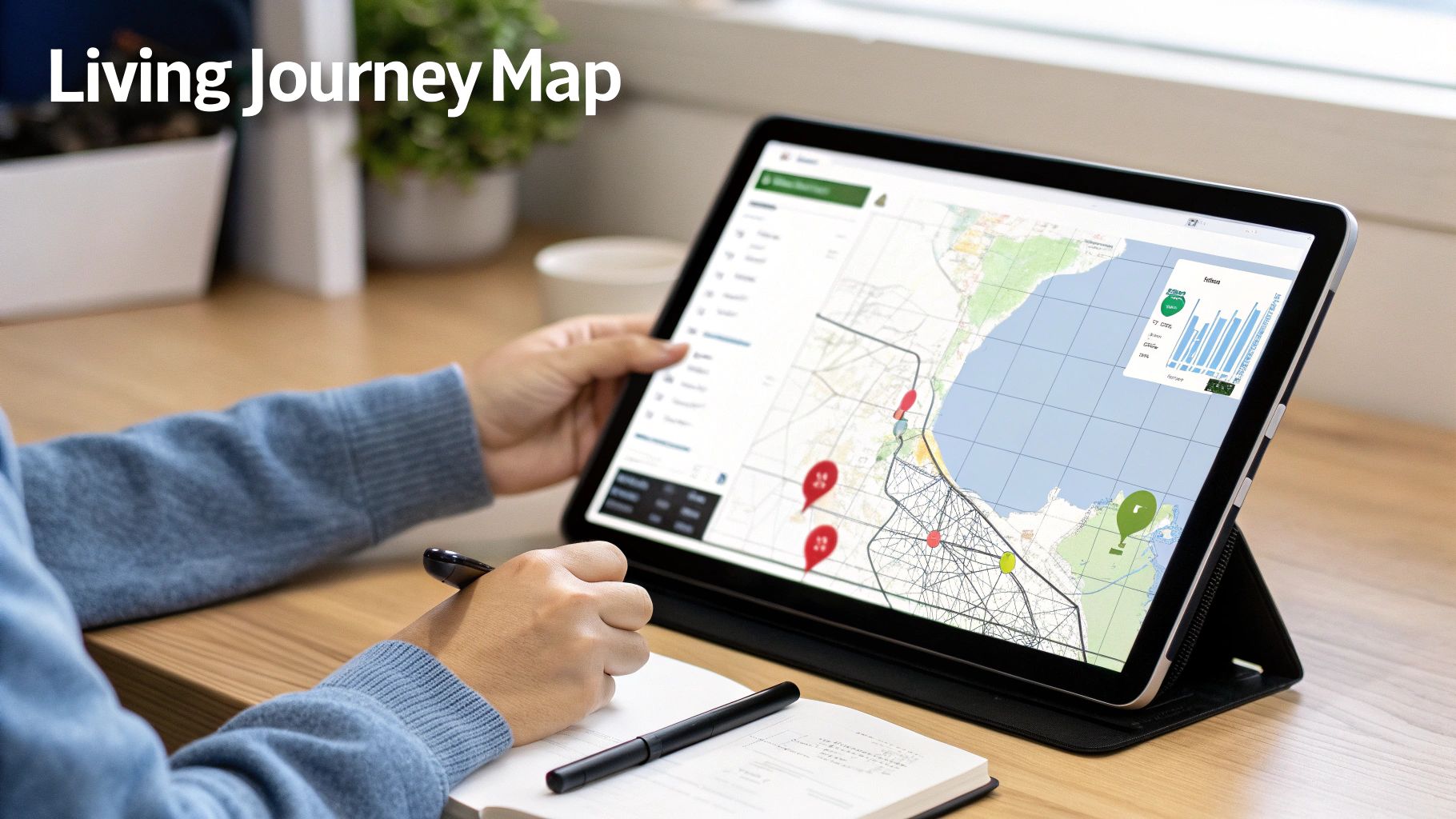
Here’s the single biggest mistake companies make with journey mapping: they create a beautiful, insightful diagram, present it once, and then let it vanish into a forgotten folder. The hard truth is, the failure isn't a bad workshop or an off-base persona—it's treating the map like a trophy instead of a tool.
To avoid this all-too-common fate, you need to shift your mindset from "mapping" as a finite task to "journey management" as an ongoing discipline. A static PDF is just a snapshot in time. A truly effective journey map is a living dashboard that shows you the real-time health of your customer experience. This is what separates the companies that just talk about CX from those that actually move the needle.
Assigning Clear Ownership and Accountability
A journey map without owners is just a wishlist. It’s a nice document, but it won't drive change. To make it actionable, every single touchpoint and every identified opportunity needs a name next to it. Accountability is the engine here.
This extends beyond your internal teams. If your map uncovers friction at a touchpoint handled by an outsourced support partner, their account manager or team lead needs ownership of the fix. This creates a shared stake in the customer's success, which is exactly what you want.
- Touchpoint Owner : The person or team responsible for a specific interaction's performance. For example, the Head of E-commerce owns the online checkout process.
- Initiative Owner : The individual tasked with leading a specific improvement project found on the map, like a Project Manager assigned to simplify the returns process.
A journey map should be the starting point for conversations, not the end of them. Assigning ownership ensures those conversations continue long after the workshop and lead to tangible actions and measurable results.
Moving From Static Diagrams to Dynamic Dashboards
This is where your map truly comes to life. You need to connect it to live data. The best journey maps I've seen are integrated with core business systems, turning them into dynamic dashboards that track performance against customer expectations in near real-time.
Imagine your "Customer Support" touchpoint isn't just a static box. Instead, it displays the current Customer Satisfaction (CSAT) score pulled directly from your CRM. When that number dips, it's a bright, visual alert that something is wrong at that stage. This means pulling in data from multiple sources:
- CRM Systems : To track customer interactions and sentiment.
- Web Analytics Platforms : To monitor user behavior and conversion rates at digital touchpoints.
- Support Desk Software : To pull in ticket volumes, resolution times, and satisfaction scores.
This move toward dynamic, data-driven journey management isn't just a nice-to-have; it's a major trend. Investment in journey-centric monitoring technology is exploding, especially in the UAE and the wider region. In fact, Grand View Research projects the market for these solutions in the Middle East & Africa will grow at a staggering 27.8% compound annual growth rate between 2025 and 2030. This signals a clear shift away from one-off diagrams and toward living maps that are constantly fed by monitoring tools. You can explore more about these trends in their regional market analysis.
To take it a step further, look into AI in customer journey mapping to help automate insight generation and spot problems even faster.
Establishing a Governance Rhythm
Finally, a living map needs a regular pulse check. You have to establish a governance rhythm—a recurring meeting or review cycle—to keep the map relevant. Customer behaviors change, market conditions shift, and business priorities evolve. Your journey map has to keep up.
I recommend scheduling a quarterly review with all touchpoint owners. Use that time to discuss performance metrics, check progress on improvement initiatives, and update the map with new insights. This continuous loop of measuring, acting, and refining is what transforms your customer experience journey mapping from a one-off project into a powerful, sustainable business process. You can learn more about which metrics to focus on by exploring our list of the top 10 customer experience KPIs to track in 2025.
Your Top Journey Mapping Questions, Answered
Even with a clear playbook, diving into journey mapping for the first time kicks up a lot of practical questions. Getting straight answers is the best way to build confidence and sidestep the usual roadblocks before you even begin. Let's tackle some of the most common ones I hear.
Getting these things sorted out early ensures your whole team is on the same page and ready to jump in. It’s all about swapping out uncertainty for a shared game plan.
How Do We Choose The First Journey To Map ?
Go where the pain is greatest or the opportunity is biggest. It's tempting to pick an easy journey to start, but you're doing this to make an impact. Look for a process you know has friction points and a direct, measurable effect on revenue or customer satisfaction.
A couple of classic starting points include:
- New customer onboarding: This is your first impression, and it's absolutely critical for retention. Even tiny improvements here can slash early churn.
- A high-volume support request: Mapping the journey for a constant problem (like product returns or password resets) can uncover changes that dramatically cut your support costs.
Let your existing data be your guide. Customer complaints, support ticket trends, and scathing online reviews are your best friends here. They’ll point you straight to the journey that offers the best shot at a quick, visible win. Nailing an early victory builds momentum and proves the value of this whole exercise to the rest of the company.
What Is The Difference Between A Journey Map And A User Flow ?
While they sound alike, they do very different jobs. A user flow is tactical and technical. A journey map is strategic and human.
A user flow is all about the specific, logical steps a person takes to get one thing done inside one system. Think of the series of clicks needed to reset a password or add an item to a shopping cart. It’s laser-focused on system efficiency and whether the task gets completed.
A customer experience journey map, on the other hand, gives you the big-picture view of a customer's entire relationship with your brand. It cuts across multiple channels—online and offline—and captures their feelings, thoughts, and frustrations along the way.
The journey map tells the story behind the clicks, giving you a strategic understanding of their overall experience, not just how they interact with a single button.
How Should We Involve Our Outsourced Partners ?
Bringing your outsourced team into the fold is non-negotiable, especially if they handle customer-facing moments. At critical points, they are your brand. Leaving them out of the mapping process creates a massive blind spot you can’t afford to have.
The best way to do this is to invite their senior agents or team leads right into your mapping workshops. Their firsthand experience with daily customer frustrations is a goldmine of truth that your internal teams rarely get. They hear the raw, unfiltered feedback every single day.
Once the map is finished, share it with them and spell out their role and performance metrics at each stage. You should also integrate their operational data—like first-contact resolution rates or average handle times—into your map’s success metrics. This transforms them from a simple vendor into a true partner who is actively invested in improving the journey.


