


From genuine empathy and active listening to sharp technical fluency, these skills are what separate a forgettable transaction from unforgettable support.
The Foundation of Unforgettable Customer Support

What really separates a decent customer service experience from a truly great one? It’s not just about fixing the problem. It’s about making the customer feel heard, valued, and respected every step of the way. A single positive interaction can create a customer for life, while a bad one can wipe out months of marketing effort in just a few minutes.
That direct line between elite customer care and sustainable growth is impossible to ignore. These skills aren’t just bullet points on a job description; they're strategic assets. They build the kind of brand loyalty that creates a real competitive advantage, especially in a crowded market. When customers know they can count on competent and empathetic support, they’re far more likely to stick around—even if a competitor dangles a slightly lower price. This becomes even more critical when working with outsourced teams, where consistent skill application is the bedrock of your brand’s reputation.
Core Competencies for Modern Support
This guide isn't about theory. It’s a practical breakdown of the essential skills your team needs to deliver world-class support right now. We're going to unpack the full range of abilities crucial for success in today’s demanding environment.
These foundational skills include:
- Timeless Soft Skills: We’ll get into the practical application of genuine empathy, active listening, and patience—the qualities that turn a transactional fix into a relational win.
- Critical Modern Competencies: Success today demands more than just being a good communicator. We will cover technical abilities like AI collaboration, CRM fluency, and data interpretation that drive efficiency and personalization.
- Advanced Problem-Solving: The best agents diagnose root causes instead of just treating symptoms. We’ll look at conflict resolution and critical thinking skills that de-escalate tension and deliver lasting solutions.
A study found that 86% of customers will leave a brand after just one bad experience, highlighting the immense financial impact of well-developed customer care service skills. Poor service costs businesses billions annually in lost revenue.
Why Skill Development Matters
Putting resources into developing these skills is a direct investment in your bottom line. A team armed with a robust skill set doesn't just close tickets; they create brand advocates. They have the power to transform frustrated users into loyal fans and gather priceless feedback that can shape product development and your entire business strategy.
Think of this guide as a deep dive into actionable insights for building and scaling a support operation that customers will rave about. Let's make sure every single interaction reinforces your commitment to excellence.
Mastering the Core Skills Every Agent Needs
Exceptional customer support isn't about fancy strategies or complex tech stacks. It all comes down to the fundamental customer care service skills that every single agent on your team needs to master. These skills are the tools agents use day in and day out to build trust, solve problems, and create experiences that stick.
We can break these skills down into two buckets: soft skills, which cover how an agent interacts, and hard skills, which define what an agent knows.
Think of it like building a house. Your soft skills are the foundation and framework—the empathy, clear communication, and patience that make the entire structure feel solid and welcoming. The hard skills are the plumbing and electrical wiring—the technical know-how and product knowledge that make sure everything actually works. If one is missing, the whole house is unreliable.
For a SaaS company, this means an agent can’t just know the product inside and out (a hard skill). They also have to patiently walk a frustrated, non-technical user through a complex feature without making them feel stupid (a soft skill). In ecommerce, an agent needs to do more than just process a return (hard skill); they have to show genuine empathy for a customer's disappointment when an order didn’t meet their expectations (soft skill).
The Indispensable Soft Skills
Soft skills are the human touch in customer service. They're tough to track on a spreadsheet, but customers feel their impact immediately. Mastering these is non-negotiable if you want to build real relationships and earn loyalty.
- Active Listening and Attentiveness: This goes way beyond just hearing words. It’s about catching the intent and emotion behind them. A truly attentive agent picks up on the little things, like the hesitation in a customer's voice that hints at deeper confusion. They'll rephrase a complicated issue to confirm they’ve got it right, making the customer feel completely understood.
- Empathy and Emotional Intelligence: Empathy is all about connecting with how a customer is feeling. Instead of jumping straight to a solution, an empathetic agent first acknowledges the customer’s frustration. A simple, "I can absolutely see why that would be so frustrating; let's get this sorted out for you," can change the entire tone of a conversation. For a deeper look into this vital skill, check out these strategies for mastering empathy in customer service and see how it directly fuels customer loyalty.
- Clear and Positive Communication: The best agents are masters of tone and language. They can translate dense technical jargon into simple, easy-to-follow steps. They also use positive framing, turning a dead-end like "We can't do that" into a helpful alternative like, "Here's what we can do instead." It's a small shift that makes a world of difference.
When an agent successfully resolves an issue, they aren't just closing a ticket; they are reinforcing the customer's decision to choose your brand. This moment is where brand loyalty is either solidified or shattered.
Essential Hard Skills for Efficiency
While soft skills build the connection, hard skills are what deliver the resolution. These are the tangible, teachable abilities that let an agent navigate systems, find information, and provide accurate answers without wasting anyone's time. A lack of these skills can completely derail even the most empathetic conversation.
Deep Product and Policy Knowledge An agent has to be a genuine expert on what you sell. They should be able to answer detailed questions on the spot, without putting the customer on hold to look up basic information. That confidence is contagious—it reassures the customer that they’re in good hands. If a customer asks about a specific feature on your SaaS platform, a great agent can explain what it does, what its limits are, and the best way to use it.
Technical Agility and CRM Fluency Today's support agents operate inside a whole ecosystem of tools. Being fluent in your Customer Relationship Management (CRM) software, helpdesk platform, and internal knowledge base is non-negotiable. The ability to quickly pull up a customer's entire history in the CRM while documenting the current conversation is what drives efficiency. Of course, closing out the interaction is just as important. You can review our guide on the 5 essential behaviours before concluding customer interactions to make sure every conversation ends on a high note.
The demand for agents with this mix of skills is exploding. Just look at the Contact Center as a Service (CCaaS) market in the Middle East and Africa (MEA) region. In 2024, the market generated USD 487.9 million in revenue, and it's projected to skyrocket to USD 1,570.8 million by 2030. This massive growth shows just how critical advanced customer care service skills—like multilingual capabilities and AI integration—have become for any business trying to scale its support. You can explore the full market outlook on Grand View Research.
Developing Advanced Skills for Complex Challenges
Once your agents have the basics down, it’s time to get them ready for the tough stuff—the interactions that really separate good support from great support. Answering common questions is one thing. The real test comes when your team has to navigate complex, high-stakes situations with confidence.
This is where advanced customer care service skills come in. We're moving past simple fixes and into the abilities that build a resilient team, one that can turn a potential crisis into a chance to win a customer for life.
Mastering Conflict Resolution
Let's be real: not every customer call is going to be a walk in the park. Your agents will absolutely face people who are frustrated, angry, or just plain disappointed. Being able to handle these conversations without pouring fuel on the fire is a critical advanced skill.
Effective conflict resolution isn't about winning an argument. It’s about calming the waters and making the customer feel like someone is finally listening. The best agents are trained to stay cool, acknowledge the customer's feelings, and pivot the conversation from the problem to the solution.
For instance, instead of a defensive, "That's not our policy," a skilled agent might say, "I completely understand how frustrating that policy is. Let's dig in and see what we can do to find a fair solution for you." That small shift in language turns a showdown into a collaboration.
The goal of conflict resolution is not to prove the company is right, but to preserve the customer relationship. An agent who successfully turns a complaint into a positive experience creates a powerful brand advocate.
Cultivating Critical Thinking and Deep Problem-Solving
Many support tickets are straightforward, but the ones that really test your team require an agent to think like a detective. Advanced problem-solving is about digging down to the root cause of an issue, not just slapping on a band-aid fix that will have the customer calling back next week.
This means asking smart, probing questions and looking beyond what the customer initially says. A customer might report a feature isn't working, but a critical thinker will try to figure out why. Is it user error? A bug? Or maybe just a misunderstanding of what the feature is supposed to do?
This diagram breaks down the two main buckets all customer care skills fall into: foundational soft skills and essential hard skills.
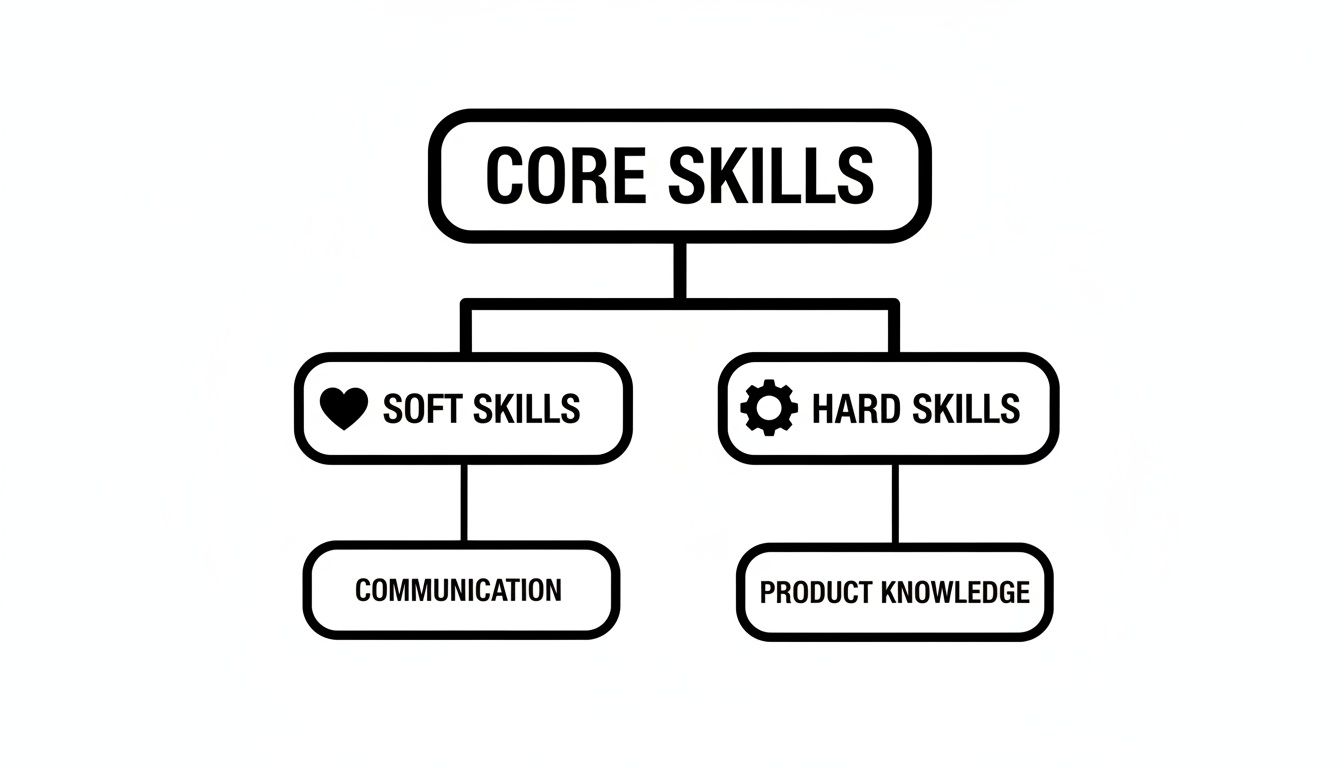
It’s a great reminder that while technical know-how is vital, advanced problem-solving is really driven by soft skills like curiosity and analytical thinking.
Building Digital and AI Literacy
Modern support is a team sport between human agents and technology. An advanced agent needs to be digitally fluent, able to jump between tools to deliver support that’s fast, personal, and accurate. This is becoming non-negotiable.
This literacy covers a few key areas:
- AI Collaboration: Agents have to know how to work with chatbots, letting them handle the easy stuff so they can focus on complex problems. They also need to know exactly when to step in if an AI assistant is out of its depth.
- Knowledge Base Mastery: Top performers don't just search the knowledge base; they use AI-powered search to find the right answer in seconds, which drastically cuts down research time and boosts First Contact Resolution.
- CRM Data Interpretation: A skilled agent uses the CRM to get the full story on a customer. They can quickly scan past purchases, previous support tickets, and other notes to provide support that feels genuinely personal and informed.
The demand for agents with these tech-forward skills is exploding, especially in global service hubs. The Middle East Call Centers market, valued at USD 6,309.68 million in 2024, is set to grow at a CAGR of 12.2% through 2026. This boom is fueled by the need for agents who can juggle digital tools and speak multiple languages—two essentials for the ecommerce and SaaS companies outsourcing to the region. You can dive into the full report on these market trends at Cognitive Market Research.
By investing in these advanced skills, you’re building a tough, future-ready team that doesn't just put out fires—it thrives on solving them.
Your Playbook for Hiring and Training Top Talent

A team with incredible customer care service skills isn't something that just happens. It's the result of a deliberate, strategic approach to both hiring and constant development. The absolute best support teams are carefully built, not just thrown together.
Think of it like coaching a pro sports team. You aren’t just looking for players who can run fast. You’re scouting for game intelligence, resilience under pressure, and a natural ability to collaborate. The same exact principle applies here. Your mission is to find candidates with the right inherent qualities and then plug them into a training framework that sharpens those raw abilities into elite skills.
This playbook is your practical guide for spotting, hiring, and nurturing top-tier customer service talent, whether your team is in-house, fully remote, or even outsourced.
Finding the Right Candidates
To find people with the potential for greatness, you have to look beyond the resume. Sure, a candidate’s past experience matters, but it’s their underlying behavioral traits that truly predict success in a customer-facing role. You need to design an interview process that digs deep and uncovers these qualities.
Behavioral interview questions are your best friend here. Instead of asking what they would do in a hypothetical scenario, ask them to share real stories from their past. This forces them to show you their skills, not just tell you about them.
Here are a few powerful questions to add to your interview script:
- "Walk me through a time you had to deliver bad news to a customer. How did you handle it?" (This tests empathy and communication)
- "Tell me about a complex problem you had to solve with limited information. What was your process?" (This gets at their problem-solving and resourcefulness)
- "Describe a situation where you received difficult feedback from a manager or customer. How did you react?" (This reveals their resilience and coachability)
The table below offers a more structured way to approach this, matching core skills to specific questions and highlighting what to listen for in a great answer.
Interview Question Matrix for Core Customer Care Skills
| Skill | Sample Interview Question | What to Look For in the Answer |
|---|---|---|
| Empathy | "Tell me about a time you dealt with a frustrated customer. How did you make them feel heard?" | Look for active listening cues, validation of the customer's feelings, and a focus on the person, not just the technical problem. |
| Problem-Solving | "Describe the most complex customer issue you've ever resolved. What steps did you take?" | A structured approach (gather info, identify root cause, explore solutions, follow up). Bonus points for creativity. |
| Communication | "How would you explain a technical concept to a non-technical customer without confusing them?" | Clarity, simple language, use of analogies, and checking for understanding. Avoids jargon and condescending tones. |
| Resilience | "Walk me through a time you made a mistake that impacted a customer. What did you do to fix it?" | Ownership of the mistake (no blaming), a clear plan to rectify it, and what they learned from the experience. |
| Technical Acumen | "Describe a time you had to quickly learn a new piece of software to do your job. How did you approach it?" | A proactive learning process, resourcefulness (using help docs, asking colleagues), and a quick ramp-up time. |
| Conflict Resolution | "Share an example of when you had to de-escalate a tense situation with an angry customer." | A calm demeanor, staying professional under pressure, and focusing on a mutually agreeable solution rather than "winning." |
A candidate's answer to these kinds of questions tells you far more than a list of past jobs ever could. You're searching for real evidence of empathy, a problem-solving mindset, and the cool-headedness to stay composed when things get tough.
Using Practical Hiring Exercises
Asking questions is only half the battle. If you really want to gauge a candidate's abilities, you have to see them in action. Practical exercises simulate the actual day-to-day challenges of the role, giving you a crystal-clear picture of their real-world skills.
These exercises don't have to be overly complicated. The goal is simply to create a realistic scenario that puts their core competencies to the test.
- Mock Ticket Resolution: Give the candidate a few sample customer emails, covering everything from simple questions to full-blown complaints. Ask them to write back as if they were the agent. This is a fantastic way to test their writing skills, tone, and problem-solving process.
- Live Role-Playing Scenario: Have a hiring manager play the part of a difficult customer on a phone or video call. This is the ultimate test of an agent's ability to think on their feet, de-escalate tension, and maintain a professional demeanor under fire.
Building a Robust Onboarding Framework
Once you’ve hired the right people, your focus has to shift immediately to training. A bulletproof onboarding program is the foundation for consistent, high-quality service. It should be a structured journey that turns a promising new hire into a confident, knowledgeable brand advocate. For a deeper look at what this involves, implementing a modern playbook for training on customer service can ensure your team is ready for anything.
Your onboarding should be built on several key pillars:
- Culture and Company Vision: Your agents are the voice of your brand. They need to truly understand your company's mission and values so they can represent them authentically in every single conversation.
- Deep Product Mastery: An agent can't help a customer effectively if they don't know the product inside and out. This requires hands-on training and real-world usage, not just reading a manual.
- Systems and Tools Fluency: Provide thorough training on your CRM, helpdesk software, and any other tools they'll use daily. The less time they spend fighting with software, the more time they have to help customers.
Fostering Continuous Growth and Development
Training doesn't stop after the first 30 days. The best support organizations cultivate a culture of continuous learning to make sure their team's skills evolve right alongside the business and its customers.
Strategies for ongoing development are critical for both retention and performance. Think about setting up peer mentorship programs where seasoned agents guide new hires, or running targeted coaching sessions based on specific performance metrics. If you’re looking for more structured ideas, our guide on how to train your team for better customer service offers additional frameworks.
Remember, investing in your team's growth is a direct investment in your customer experience.
How to Measure and Scale Skill Development
Developing top-notch customer care service skills is a great first step, but if you don't have a clear way to measure their impact, you’re just flying blind. It's a simple truth: what gets measured gets improved. This principle is exactly what can transform your support team from a cost center into a powerful engine for growth. It’s time to push past surface-level metrics and start tracking the KPIs that genuinely reflect an agent's skill and how it affects the customer experience.
Effective measurement isn’t about tracking every single click or call duration. It’s about choosing the right metrics that tell a story—a story about your team's ability to communicate with clarity, solve problems efficiently, and build real rapport with customers. When you focus on the right data, you can pinpoint exactly where to direct your coaching efforts and scale your training programs with total confidence.
Moving Beyond Average Handle Time
For years, Average Handle Time (AHT) was the undisputed king of support efficiency metrics. But an obsessive focus on speed often comes at a steep price. It pushes agents to rush conversations and offer quick, incomplete fixes just to keep their numbers looking good. Real skill isn't about speed; it's about striking the perfect balance between efficiency and effectiveness.
Instead of chasing the clock, let's zero in on three core metrics that paint a much richer, more accurate picture of your team's performance.
- First Contact Resolution (FCR): This is the percentage of issues you solve in a single interaction. A high FCR is a direct reflection of strong product knowledge, crystal-clear communication, and fantastic problem-solving abilities.
- Customer Satisfaction (CSAT): Usually measured with a quick post-interaction survey like, "How satisfied were you with your support experience?", CSAT gives you a direct line to how customers are feeling. It captures an agent's empathy, tone, and ability to make someone feel heard and valued.
- Customer Effort Score (CES): This KPI asks a simple but powerful question: "How much effort did it take to get your issue resolved?" A low CES score is a massive win. It shows your team makes getting help easy and frictionless—the true hallmark of a superior service.
When you shift the conversation from "how fast did we close the ticket?" to "how well did we solve the problem?", you empower your team to prioritize quality over raw speed. This one change is fundamental to building a truly customer-centric culture.
Creating Actionable Performance Dashboards
Collecting data is only half the job. You have to present it in a way that gives both agents and managers clear, real-time insights they can actually use. A well-designed performance dashboard should be much more than a wall of numbers; it needs to be a visual tool that celebrates wins, flags areas for improvement, and drives positive behavior.
Your dashboard should track your key metrics—FCR, CSAT, and CES—at both the individual and team levels. This lets you spot trends in a flash. Is one agent consistently struggling with FCR? That’s your cue for some targeted product training. Is the entire team’s CSAT score taking a dip? Maybe it's time for a refresher course on communication and empathy skills. For more on this, you can learn about the behaviors that define excellence in customer service.
Strategies for Scaling Training and Development
As your company grows, keeping service quality consistent becomes a huge challenge, especially if you're working with remote or outsourced teams. To scale your skill development effectively, you need a structured, repeatable system that ensures every single agent gets the same high-quality training.
A big piece of this puzzle is understanding regional customer expectations. For example, customer care service skills in the Middle East are absolutely critical for building loyalty. A recent PwC survey found that 47% of consumers in the region prefer local retailers, a choice driven by digital convenience and personalized service. This trend is fueling a loyalty program market that's projected to hit USD 3.27 billion by 2025, where skilled agents are essential for driving engagement.
To scale training without sacrificing quality, put these strategies into action:
- Develop a Centralized Knowledge Base: Create a single source of truth for all your product information, policies, and procedures. This ensures every agent, no matter where they are, has access to the same accurate information.
- Use a Learning Management System (LMS): An LMS helps you deliver standardized training modules, track who has completed them, and test comprehension with quizzes. It’s all about maintaining consistency across the board.
- Implement Peer-to-Peer Coaching: Pair your top-performing agents with newer team members. This not only reinforces best practices but also helps build a supportive, collaborative culture where everyone learns from each other.
- Conduct Regular Quality Assurance (QA) Reviews: Systematically review a sample of tickets for every agent. Use a clear scorecard based on your core skills to provide specific, actionable feedback that helps them grow and improve.
By combining insightful measurement with a scalable training framework, you can ensure your team's skills develop right alongside your business, delivering an exceptional customer experience every single time.
Frequently Asked Questions About Customer Care Skills
Even with the best strategy in place, a few common questions always pop up when you're trying to build and scale a top-tier support team. Here are some straight-to-the-point answers for CX leaders and ops managers looking to sharpen their team's customer care service skills.
Which Skills Are Most Important to Develop First ?
When you’re building a team from scratch, you have to nail the fundamentals first. That means prioritizing empathy, active listening, and crystal-clear communication. These soft skills are the bedrock of every great customer interaction and are way harder to teach than the technical stuff.
Once you’ve got a solid foundation of human-centric skills, you can start layering on the essentials like deep product knowledge and CRM fluency. A new agent can learn your software in a week, but teaching them to be genuinely patient with a frustrated customer? That’s a much taller order. Start with the human element, and the technical skills will follow.
How Can We Measure Soft Skills Like Empathy ?
Measuring something as abstract as empathy feels tricky, but it’s totally doable if you know what to look for. Instead of trying to put a number on "empathy" itself, measure the results it creates.
Here’s how you can track the impact of soft skills:
- Customer Satisfaction (CSAT) Scores: This is the most direct feedback you’ll get on how a customer felt during an interaction. High CSAT scores almost always point to an agent with strong empathy and communication skills.
- Customer Effort Score (CES): Agents who are great listeners and problem-solvers make it easy for customers to get help. The result? A lower effort score, which is exactly what you want.
- Qualitative Ticket Reviews: Go beyond the basic checklist. Your Quality Assurance (QA) scorecard should include things like, "Did the agent validate the customer's feelings?" or "Was the agent's tone positive and appropriate?"
A great trick is to scan ticket transcripts for specific phrases. When you see things like "I understand how frustrating that must be" or "Let's figure this out together," you're seeing clear proof of an agent putting themselves in the customer's shoes.
What Is the Best Way to Train an Outsourced Team ?
Training an outsourced or remote team demands a super-structured and repeatable process to keep everyone on the same page. The secret is to over-communicate and give them the exact same top-shelf resources you'd give your in-house team. This means creating a central, easy-to-access knowledge base that acts as the single source of truth for everything.
Regular video calls for training, role-playing exercises, and QA feedback are completely non-negotiable. It’s also incredibly important to immerse them in your company culture. Help them understand your brand's mission and values so they don't just feel like contractors—they feel like a true extension of your team, ready to deliver amazing service.
How Do We Keep Our Team’s Skills Sharp Over Time ?
Skill development isn’t a one-and-done training session; it’s a constant process. Complacency is the silent killer of great customer service. To make sure your team’s skills are always getting better, you need a system of regular, targeted coaching.
Use your performance dashboards to spot areas for improvement, both for individual agents and the team as a whole. If you see First Contact Resolution numbers dipping, it’s time for a workshop on advanced problem-solving. If one agent’s CSAT scores are slipping, schedule a one-on-one coaching session to review their communication style. The most effective way to maintain high standards for customer care service skills is to build a culture of continuous learning, backed by peer mentorship and consistent feedback.


