


Why Consumer Complaints Are Hidden Opportunities

It’s easy to see a rising number of complaints as a sign of failure. But with a strategic shift in mindset, you can reframe them as some of your most invaluable assets.
Think of each piece of negative feedback not as a fire to be put out, but as a diagnostic tool running a real-time 'business health check'. These unfiltered messages from your customer base pinpoint weaknesses long before they escalate into widespread issues that could seriously damage your reputation or revenue.
This proactive approach transforms your support function from a reactive cost center into a strategic intelligence unit. Complaints often signal deeper operational issues that data alone might miss. For instance, a sudden spike in calls about a new feature could point to a hidden bug, while repeated questions about billing might reveal a confusing pricing page.
The Voice of Your Customer
Every complaint is a story. It's a narrative detailing exactly where your customer's journey hit a roadblock. By actively listening and analyzing these stories, you gain a crystal-clear picture of user friction points. These aren't just anecdotes; they're qualitative data points that enrich your quantitative analytics, providing the crucial 'why' behind the numbers.
To truly tap into the hidden opportunities within complaints from consumers, you need to master a comprehensive Voice of Customer (VoC) analysis. This practice is what turns raw, emotional feedback into structured insights that can inform everything from product development to marketing messages.
A complaint is your customer's way of saying, 'I want to stay with you, but you need to fix this.' It's a sign of engagement, offering you a chance to strengthen the relationship and build lasting loyalty. Ignoring it is like ignoring a free opportunity to improve.
Turning Feedback into Actionable Data
The real key is to systematize how you handle this feedback. Simply resolving an issue and closing the ticket is a massive missed opportunity. Instead, you should be categorizing and tagging each complaint to identify trends, which helps distinguish between isolated incidents and systemic problems. By understanding https://www.customer-service.cx/features-bugs-insights-and-the-art-of-solving-customer-problems/, you can better separate one-off bugs from recurring feature gaps.
Building this framework allows your business to:
- Identify Product Flaws: Uncover the bugs or design issues that are actively frustrating users.
- Refine Service Delivery: Pinpoint training gaps in your support team or flaws in your communication protocols.
- Improve the Customer Journey: Detect friction in your checkout process, onboarding sequence, or website navigation.
When you adopt this perspective, you start building a more resilient and customer-centric operation. Each complaint becomes a stepping stone towards a better product, a stronger team, and a more loyal customer base. This is the foundation for turning a support function into a true driver of business growth.
Of course. Here is the rewritten section, crafted to sound completely human-written and natural, following all your specified requirements.
A Practical Framework for Classifying Complaints
To get a handle on customer complaints, you need a system. Simply playing whack-a-mole with every issue that pops up is a fast track to burnout and gets you nowhere. A clear framework for classifying feedback lets you step back, see the bigger picture, spot recurring patterns, and fix the root causes instead of just patching up the symptoms.
Think of it like a librarian organizing a massive collection of books. Without categories like 'fiction,' 'history,' and 'science,' finding anything would be a nightmare. In the same way, grouping complaints into logical clusters transforms a chaotic stream of feedback into an organized library of business intelligence.
This structured approach is what separates the pros from the amateurs. It’s how you train agents effectively, give your product team actionable insights, and equip outsourced partners with the knowledge they need to handle issues with precision. When you know what kind of problem you’re facing, you can deploy the right solution every single time.
Product or Service Failures
This is one of the most straightforward categories, covering any time your product or service just doesn't do what it's supposed to do. We're not talking about feature requests or minor annoyances here—these are core functional breakdowns.
For an e-commerce store, this might be a customer receiving a damaged item or a product that dies a week after they bought it. In the SaaS world, it could be a critical feature that constantly crashes or an integration that fails to sync data correctly. These failures hit right at the heart of your value proposition.
When you see a cluster of these complaints, it’s a massive red flag. It almost always points to quality control issues in manufacturing, bugs in a recent software update, or a breakdown somewhere in your supply chain. Fixing these issues fast is critical to prevent widespread frustration and serious damage to your brand’s reputation.
Billing and Pricing Friction
Money is a sensitive topic. Any confusion or hint of unfairness around billing can obliterate trust in an instant. Complaints in this bucket all revolve around payments, subscriptions, refunds, and those dreaded unexpected charges.
Common examples include:
- A SaaS customer getting hit with an annual subscription fee when they thought they had canceled their trial.
- An e-commerce shopper seeing a different price at checkout than what was on the product page.
- Disputes over refund amounts or frustrating delays in processing returns.
These problems often stem from confusing pricing pages, convoluted terms of service, or billing systems that are just too rigid. Sorting these out doesn't just resolve individual complaints; it helps plug revenue leaks and can even improve conversion rates by making the whole financial experience more transparent for everyone.
Before we dive into the next two categories, it helps to see how these issues stack up and what they can cost you if left unchecked.
Common Consumer Complaint Categories and Their Business Impact
| Complaint Category | Common Examples (SaaS/E-commerce) | Potential Business Impact |
|---|---|---|
| Product/Service Failures | SaaS: Critical feature bugs, server downtime. E-commerce: Defective items, wrong product shipped. |
High churn, negative reviews, increased return/refund costs, brand reputation damage. |
| Billing & Pricing | SaaS: Unexpected renewal charges, confusing invoices. E-commerce: Incorrect pricing, hidden fees. |
Lost customer trust, high chargeback rates, lower customer lifetime value (CLV), revenue leakage. |
| Communication Breakdowns | SaaS: Poor onboarding, lack of update notifications. E-commerce: Misleading product descriptions, no shipping updates. |
Customer frustration, increased support ticket volume, negative word-of-mouth, lost sales opportunities. |
| Digital Journey Roadblocks | SaaS: Confusing UI, broken sign-up forms. E-commerce: Clunky checkout process, slow-loading pages. |
High cart abandonment, low conversion rates, poor user engagement, customer churn due to frustration. |
As you can see, each category carries its own set of risks, turning what might seem like a small issue into a significant business problem if ignored.
Communication Breakdowns
Sometimes, the problem isn't your product or your price—it's the information, or lack thereof, surrounding it. Communication breakdowns happen when customers feel misled, uninformed, or flat-out ignored. This can happen at any point in their journey with you.
For instance, a customer might complain that a product description was wildly inaccurate, setting them up for disappointment. Another all-too-common issue is a lack of proactive updates about shipping delays, which leaves customers feeling anxious and angry.
These complaints are pure gold. They shine a spotlight on gaps in your customer service scripts, marketing copy, or automated notifications. They reveal those moments where a little extra clarity could have prevented a whole lot of frustration.
Digital Journey Roadblocks
In today's market, a clunky digital experience is a deal-breaker. This category covers all the friction a customer hits while trying to use your website, app, or online platform.
Think of a confusing checkout process that makes a shopper give up and leave, or a mobile app so poorly designed it’s basically unusable. Other classics include broken links, painfully slow-loading pages, or a sign-up form that keeps spitting back errors. Every single one of these roadblocks is a potential lost sale or a canceled subscription.
These kinds of complaints from consumers are incredibly valuable because they come from people who wanted to use your service but were stopped by a technical or design flaw. Their feedback is a direct roadmap for your UX designers and developers to improve usability and lift conversions. By sorting complaints this way, businesses can also spot wider trends, as seen in Jordan, where the services and e-commerce sectors accounted for a combined 40% of logged issues. You can read more about these consumer complaint statistics to see how different industries are affected.
Building Your Complaint Resolution Playbook
So, you've got a system to classify complaints. That’s step one. But the real game-changer is your resolution playbook—this is where your strategy gets put into action. A well-defined playbook makes sure every customer issue gets handled the same way, with the same level of care, whether it's your in-house team or an outsourced partner on the line. Think of it as your team's single source of truth, turning a potentially chaotic situation into a predictable, structured workflow.
Without a clear plan, teams often end up guessing. That leads to inconsistent resolutions, frustrated customers, and burned-out agents. A playbook gets rid of the guesswork. It gives your team the confidence to tackle even the trickiest complaints from consumers by laying out a clear path from problem to solution.
We can break this process down into four distinct stages: Triage, Investigate, Resolve, and Follow-Up. Nailing each one is key to building a complaint management system that doesn't just fix problems but actually strengthens customer loyalty.
The flowchart below shows how different types of complaints flow into this playbook, helping your team quickly get a handle on the nature of an issue.
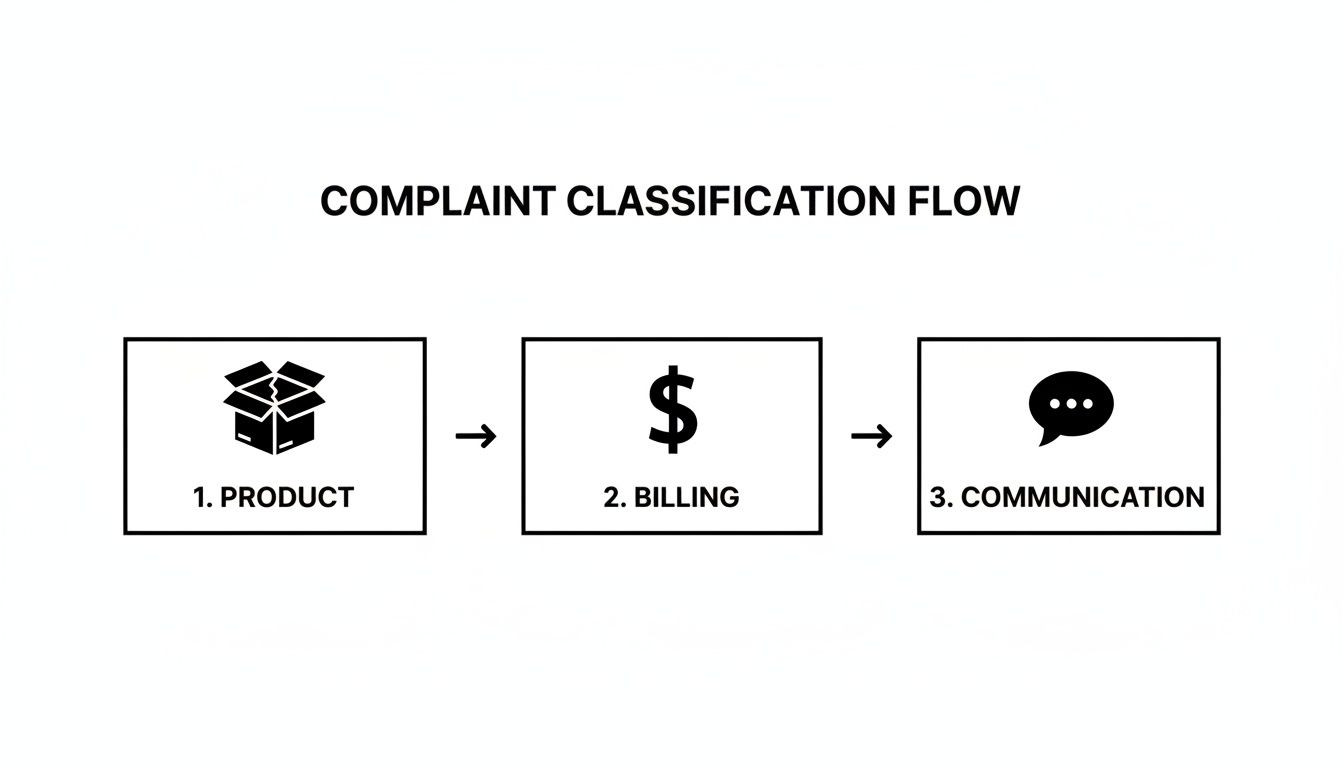
This visual shows how all sorts of issues—from product defects to billing mistakes—are funneled into a structured resolution process.
Stage 1: Triage
The second a complaint lands in your inbox, the clock starts ticking. The triage stage is all about fast, smart assessment and prioritization. Let's be honest, not all issues are created equal. A typo on your website is annoying, but a fraudulent charge on someone's credit card is a five-alarm fire that needs immediate action. Your team has to be able to quickly size up an issue's severity and potential business impact.
Think of this stage like an emergency room. A nurse doesn't just see patients in the order they arrive; they assess who needs a doctor right now. Your support agents are that nurse. They need a simple system to categorize complaints as low, medium, or high priority. This makes sure your best resources are thrown at the most critical problems first.
A high-priority issue might be a security breach, a major service outage, or something that carries legal risk. A low-priority issue could be a minor bug in the user interface or a general question. Setting clear Service Level Agreements (SLAs) for each priority level is absolutely crucial for managing customer expectations and keeping your team accountable.
Here’s a quick matrix your team can use to make those calls on the fly. It helps agents move from guessing to a structured, repeatable assessment process.
Complaint Triage and Prioritization Matrix
| Severity Level | Customer Impact | Business Impact | Recommended Response Time | Example Scenario |
|---|---|---|---|---|
| High | Widespread service disruption, data loss, security risk. | Significant revenue loss, legal exposure, brand damage. | Immediate (within 1 hour) | A customer reports a data breach affecting multiple accounts. |
| Medium | Core feature not working, significant inconvenience. | Moderate churn risk, negative social media attention. | Within 4-8 hours | A key integration for a B2B client has stopped working. |
| Low | Minor bug, usability issue, general question. | Minimal churn risk, isolated customer frustration. | Within 24 hours | A customer can't find the "contact us" link on the website. |
This matrix isn't set in stone—you should adapt it to fit your business. The goal is to give your team a clear, immediate framework for making smart decisions under pressure.
Stage 2: Investigate
Once an issue is prioritized, it's time to dig in. The goal here is simple: get all the facts without making the customer feel like they're on trial. This is where your agents need to blend technical know-how with some serious emotional intelligence. They have to listen with empathy while methodically gathering details like order numbers, account info, or screenshots.
It's a delicate dance. Ask too many questions, and it feels like an interrogation, which only adds to the customer's frustration. The key is to explain why you need certain information. For example, "To help me look into that billing error, could you please provide the invoice number?" sounds collaborative, not accusatory.
The investigation phase is where so many companies drop the ball. They get so focused on the problem that they forget about the person. A great investigator makes the customer feel like an ally in solving the issue, not the cause of it.
Your playbook should give agents a clear checklist for different types of complaints. For a shipping problem, they might need the tracking number and delivery address. For a software bug, they'll need the user's operating system and browser version. A structured approach like this makes sure no critical detail gets missed.
Stage 3: Resolve
With all the facts on the table, it's time to make it right. The resolution stage is about more than just a quick fix; it's about providing a solution that's proportional to the problem and restores the customer's faith in your brand. Given that consumers are running into more issues with things like unrecognized purchases and faulty products, getting the resolution right has never been more important.
Your resolution toolkit should be diverse, and you need to empower your agents to make decisions. Common solutions include:
- Refunds or Credits: The go-to for billing errors or defective products.
- Replacements or Reshipments: A straightforward fix for when logistics go wrong.
- Service Upgrades or Discounts: A fantastic way to make up for a service failure and encourage them to stick around.
- Personalized Apologies and Explanations: Never underestimate the power of a sincere apology and a clear explanation of what went wrong.
The best resolution is one that feels fair, maybe even a little generous, to the customer. To really turn unhappy customers into your biggest fans, you have to learn how to handle customer complaints like a pro. This often means giving your frontline team the authority to offer solutions without jumping through layers of approval, which speeds up the whole process and leaves the customer feeling great.
Stage 4: Follow-Up
Just because you’ve solved the issue doesn't mean you're done. The follow-up is where you close the loop, make sure the customer is truly happy, and collect some incredibly valuable feedback. A simple email or message a few days later asking, "Just checking in—did our solution fully resolve your issue?" shows you care beyond just closing a ticket.
This final touchpoint does two critical things. First, it confirms the problem is actually solved from the customer's point of view. Second, it gives you a chance to get feedback on your resolution process itself. You can use that data to fine-tune your playbook, improve agent training, and stop similar issues from popping up again.
Measuring What Matters in Complaint Management
You can't fix what you can't measure. When it comes to handling complaints from consumers, just counting the number of tickets you receive is like trying to gauge your health by only stepping on a scale. It tells you something, but it misses the whole story.
To really get a grip on performance, you need to look at Key Performance Indicators (KPIs) that reveal the quality and efficiency of your entire resolution process. Think of it like a car's dashboard. Your ticket volume is the speedometer—it shows how fast things are coming in. But you also need the oil pressure gauge and engine temperature to know if you're about to break down.
This is the data that helps you spot recurring problems, fine-tune your workflows, and build a rock-solid case for investing more in your support team. It’s what separates a reactive support desk from a strategic customer experience function that actively boosts retention and loyalty.
Key Metrics for Complaint Resolution
While you could track dozens of metrics, a handful truly cut through the noise and give you a clear picture of your team's effectiveness. These are the core numbers you should have on any performance dashboard, whether your team is in-house or outsourced.
- First Contact Resolution (FCR): What percentage of complaints get solved in the very first conversation? A high FCR is a fantastic sign. It means your team is well-trained and empowered, and customers aren’t getting bounced around from agent to agent.
- Customer Satisfaction (CSAT) After Resolution: So, the ticket is closed. But is the customer actually happy? Sending a quick CSAT survey—like "How satisfied were you with the resolution?"—gives you direct, unfiltered feedback on the quality of the solution, not just the speed.
- Average Resolution Time: This is the total time from the moment a complaint is logged to when it’s officially closed. A lower number is usually better, but you have to balance speed with quality. A rushed, incomplete solution only creates more frustration and guarantees the customer will be back.
Tracking a balanced set of these indicators gives you a much more holistic view of performance. For a deeper dive, you can explore some of the top customer service KPIs to track in 2025 to build out your dashboards.
Beyond the Numbers with Qualitative Analysis
The numbers tell you what is happening, but the stories behind the complaints tell you why. This is where you find the real gold. Digging into the actual words customers use gives you context that raw data can never provide.
Two of the most powerful ways to do this are through sentiment analysis and root cause analysis.
By analyzing the language and emotion within a complaint, you can gauge customer frustration levels and identify escalating issues before they become widespread. This is the difference between reading a report and hearing your customer's voice.
Modern tools can automatically scan and tag complaints based on expressed emotion (like angry, frustrated, or confused). This adds a human layer to your triage process, helping you prioritize the issues that are causing the most pain.
Finding the Root Cause
Root cause analysis is all about asking "why" until you can't ask it anymore. Instead of just logging a "billing error," you dig deeper. Why did the error happen? Was it a bug in the software? Unclear pricing on the website? An agent who needs more training?
It’s a straightforward, systematic process:
- Categorize Complaints: Start by grouping similar issues together. For example, pull all complaints related to "late deliveries."
- Identify Patterns: Look for common threads. Are all the late deliveries happening in a specific region or with a particular product?
- Ask 'Why' Repeatedly: Trace the problem back to its source. The late delivery might be due to a warehouse bottleneck, which is caused by a glitchy inventory system.
- Implement a Systemic Fix: Address the actual root of the problem. Fix the inventory system, and you prevent hundreds of future complaints, rather than just apologizing for one late package.
This approach transforms your complaint data from a list of fires to put out into a strategic roadmap for improving the entire business. You stop patching holes and start building a better ship.
Using Technology to Proactively Reduce Complaints
While getting good at handling complaints from consumers is a solid defensive play, the real win is stopping them from happening in the first place. The best way to do that? Use technology to get ahead of problems, shifting from a reactive support model to a truly proactive one. This is all about identifying and fixing issues before your customer even knows something is wrong.
Think of it as the difference between a smoke alarm and a modern fire prevention system. The smoke alarm—your reactive support—is essential, but it only goes off once there’s already a fire. A prevention system, on the other hand, monitors for things like overheating wires or gas leaks, stopping a fire before it ever starts.
Modern tools can be that early warning system for your business. By spotting friction points early, you can create a smoother customer experience that builds loyalty, cuts down on support costs, and protects your brand’s reputation.
Harnessing AI for Real-Time Insights
Artificial intelligence is an incredible ally in the mission to minimize complaints. AI-powered tools can listen in on customer conversations in real time, whether they're happening over live chat, email, or on the phone. They’re trained to pick up on specific keywords, shifts in tone, and sentiment changes that signal a customer’s frustration is building.
Imagine a customer is clearly struggling to understand a feature during a chat session. An AI tool could flag that conversation for a senior agent to jump in, or it could instantly feed the current agent the perfect help article to share. That kind of smart, immediate assistance can de-escalate a situation long before it ever becomes a formal complaint.
But these tools don't just work in the moment; they also dig through historical support data to find hidden trends.
- Predictive Analytics: AI can forecast potential issues by finding patterns in past complaints. It might notice, for example, that customers who buy a certain product almost always contact support with the same question a week later. Now you can get ahead of it.
- Automated Tagging: AI can automatically categorize incoming support tickets with way more accuracy than a human can, helping you spot emerging problems much faster.
- Sentiment Analysis: By gauging the emotional tone of customer feedback at scale, you can quickly prioritize the issues that are causing the most widespread frustration.
Using Your CRM to Map the Customer Journey
Your Customer Relationship Management (CRM) system is so much more than a contact list. It’s a detailed map of your customer’s entire journey, and by analyzing that map, you can pinpoint exactly where things get bumpy and proactively smooth them out.
For instance, an e-commerce company’s CRM might show that 25% of customers who add a specific item to their cart ditch the process when they get to the shipping page. That’s a massive red flag telling you to investigate shipping costs or delivery times for that product. Or, the system could automatically flag a product that has an unusually high return rate, alerting the operations team to a potential quality control problem.
By connecting different data points within your CRM—like purchase history, support interactions, and website behaviour—you create a complete picture of the customer experience. This allows you to identify and fix systemic problems, not just individual ones.
Economic pressures often make these friction points even worse. Across the Middle East, 49% of consumers say the cost of living is a top concern, which makes them much more sensitive when products or services don't meet expectations. This climate can easily lead to more complaints. You can get more insights on regional sensitivities from the PwC Voice of the Consumer 2025 survey. Adopting a proactive stance is key to creating a frictionless experience that keeps customers around, and our guide on how to transition from reactive to preventive customer support provides actionable steps to make that happen.
Burning Questions About Managing Complaints
Even with a great strategy, you’re bound to run into tricky situations when dealing with unhappy customers. This section tackles some of the most common questions and challenges that customer experience leaders face, giving you direct, no-nonsense answers.
What's the Single Most Important First Step in Handling a Complaint ?
Always start by acknowledging the customer’s frustration with genuine empathy. Seriously, before you jump into problem-solving mode, your team needs to listen and validate the customer's feelings.
Train them on simple but powerful phrases like, "I can see why this is so frustrating, and I'm here to help." This one move de-escalates tension almost instantly and signals that you're on their side. It completely changes the dynamic from a confrontation to a collaboration.
How Can We Make Sure Our Outsourced Team Handles Complaints to Our Standard ?
Getting an outsourced team to perform like your own comes down to three things: clear systems, deep training, and shared goals. Don't just hand them a script. Give your BPO partner your detailed complaint resolution playbook and empower them to make decisions without needing to escalate every little thing.
Run joint training sessions that focus on your brand’s specific tone of voice and service principles. Most importantly, integrate your systems so you have full visibility into their performance. Set shared KPIs that focus on customer satisfaction, not just how fast they close a ticket.
How Do We Actually Turn Complaint Data into Business Improvements ?
You need to build a formal feedback loop connecting your support, product, and operations teams. It’s not enough to just solve individual tickets. Systematically tag and analyze all complaints from consumers to spot recurring themes and see the bigger picture.
Schedule regular meetings where support leaders present data-backed findings to other departments.
When the support team can walk into a meeting and report that 20% of all complaints last month were about the confusing checkout process, that’s not just feedback—it's a clear mandate for the product team to prioritize a fix. This is how customer service becomes a strategic intelligence unit for the entire business.
What Legal Issues Should We Watch Out For When Handling Complaints ?
While specific laws can vary, most consumer rights are built on core principles like the right to quality, the right to clear information, and data privacy. Your top priority should be a complaint handling process that's transparent, well-documented, and consistently fair to everyone.
Always stick to your public policies on refunds, warranties, and returns. Proper documentation is your best friend here. It demonstrates a consistent, good-faith effort to resolve every issue and helps protect your business from unnecessary risk.


