


We've moved past the days when "being polite" was enough. Today, these skills are a core business strategy—the engine for growth and the key to earning loyalty in a crowded market.
Why Client Service Skills Are Your New Competitive Edge
In this economy, outstanding support is what sets you apart. It's the human touch that keeps customers coming back, even when a cheaper alternative pops up. Companies are finally waking up to the fact that investing in their team's client service skills isn't just an operational cost. It's a direct investment in keeping customers happy and protecting their brand reputation. The whole conversation has shifted from just closing tickets to creating memorable experiences that build genuine loyalty.
This shift is happening right alongside huge leaps in technology. The rise of automation and AI isn't making skilled people obsolete; it's making them more valuable. As routine tasks get automated, the importance of human interaction skyrockets. Your agents are now on the front lines, handling the complex, emotionally charged issues that require a sharp combination of empathy, critical thinking, and technical skill.
The Modern CX Toolkit
Think of modern client service skills as a "CX toolkit"—a collection of essential tools for every support professional. This guide is your playbook for building that exact toolkit. We’ll dig into how to spot, build, and measure the capabilities that actually move the needle for your team.
The skills landscape has changed dramatically. For instance, recent data shows that 95% of organizations using AI report significant time and cost savings, and 84% say it speeds up issue resolution. This points to a crucial trend: the most valuable service pros are the ones who can blend human empathy with technical smarts, managing both AI-assisted chats and complex, personal conversations. You can explore more about these customer service statistics and see how top teams are adapting.
Here’s what this guide will break down for you:
- Core Competencies: We'll distinguish between the soft skills that build connection and the technical skills that get the job done efficiently.
- Practical Assessment: You'll get frameworks to accurately measure where your team stands now and pinpoint specific skill gaps.
- Targeted Training: We'll provide actionable playbooks for creating high-impact training programs, whether your team is in-house or outsourced.
- Meaningful Measurement: Learn how to connect skills development to the business metrics that matter, like Customer Satisfaction (CSAT) and First Contact Resolution (FCR).
By the end, you'll have a clear roadmap to transform your client service function from a simple support center into a strategic engine for growth.
The Two Halves of Exceptional Service: Soft and Technical Skills
Exceptional client service isn’t built on a single foundation. It stands on two distinct but deeply connected pillars: the human touch of soft skills and the practical know-how of technical skills.
Think of it like building a house. Soft skills are the architectural design—the vision, empathy, and creativity that make a space feel welcoming. Technical skills are the concrete, wiring, and plumbing—the essential infrastructure that makes everything actually work.
One without the other is incomplete. A technically brilliant agent who lacks empathy comes across as cold and unhelpful, leaving a customer feeling like just another ticket number. On the flip side, a wonderfully empathetic agent who struggles with the CRM will create frustrating delays, no matter how kind their words are.
True excellence happens when these two halves merge seamlessly, empowering agents to deliver support that is both emotionally intelligent and highly effective.
This is how human and technical skills combine to form your competitive edge.
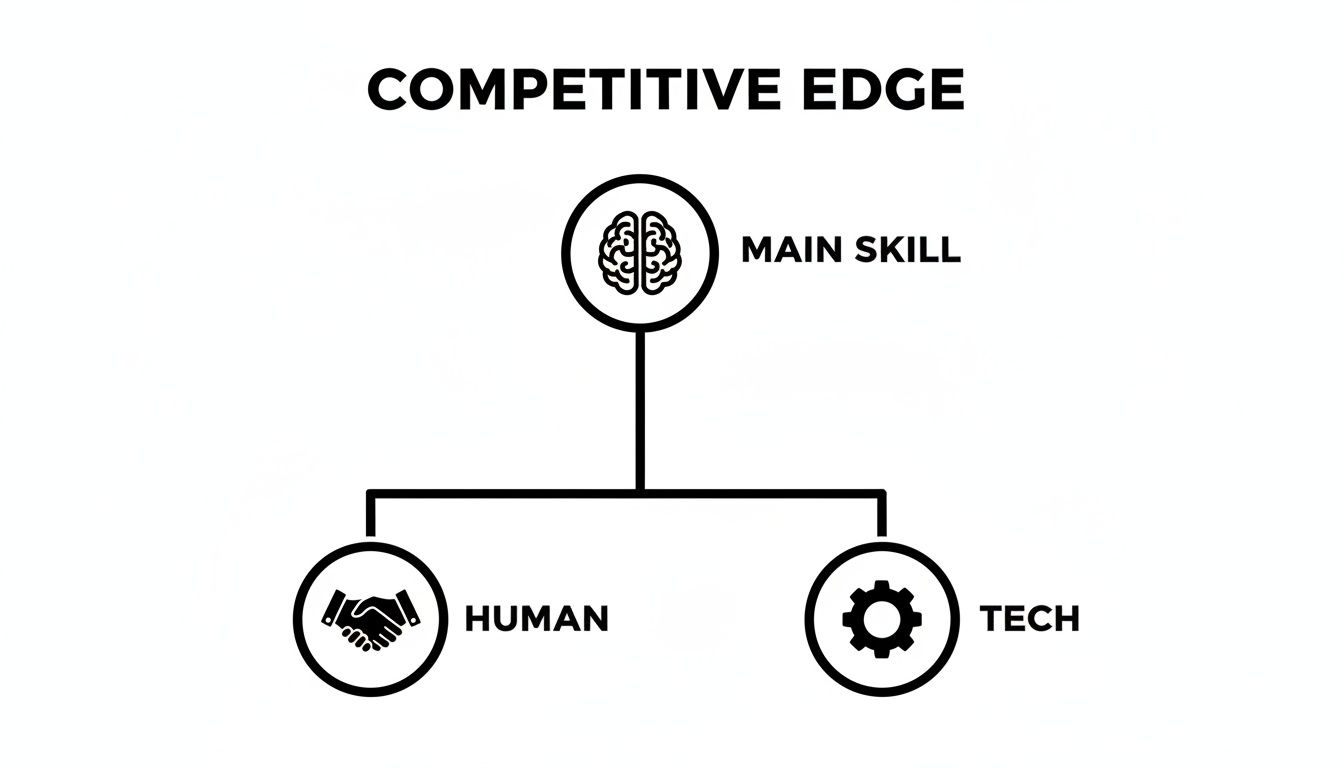
The takeaway here is simple: mastering both human-centric abilities and technological competence is non-negotiable for gaining a real advantage.
To see how these skills play out in the real world, let's break them down. The table below compares essential soft and technical skills, showing what they mean and how they look in a typical support interaction.
Essential Client Service Skills: Soft vs. Technical
| Skill Category | Core Skill | Definition | Example in Action |
|---|---|---|---|
| Soft Skills | Empathy | The ability to understand and share the feelings of another person. | "I can hear how frustrating this must be for you. Let's walk through this together and get it sorted out." |
| Soft Skills | Active Listening | Concentrating on what the customer is saying to understand their core issue, not just the surface problem. | Instead of jumping to a solution, the agent asks clarifying questions like, "So, if I'm understanding correctly, the error only happens when you try to export the report?" |
| Soft Skills | Patience | Remaining calm and reassuring when a customer is upset or struggling to explain their problem. | When a customer repeatedly fails to follow instructions, the agent calmly says, "No problem at all, let's try a different approach. We'll get there." |
| Soft Skills | Clear Communication | Conveying information simply and without jargon. | Rather than saying "You need to clear your cache," the agent guides them: "Let's try clearing your browser's temporary files. I can show you how." |
| Technical Skills | CRM Proficiency | Quickly and accurately navigating the Customer Relationship Management software. | The agent pulls up the customer's full interaction history in seconds, referencing a past conversation to provide context and personalized support. |
| Technical Skills | Product Knowledge | Having a deep, expert-level understanding of the product or service. | A customer describes a niche problem, and the agent immediately identifies a workaround involving an advanced feature the customer didn't know existed. |
| Technical Skills | Digital Literacy | Effortlessly switching between support channels like chat, email, and social media. | The agent smoothly transitions a complex chat conversation to a phone call to provide a more detailed, real-time walkthrough for the customer. |
| Technical Skills | Typing Speed & Accuracy | Typing quickly and without errors to maintain efficiency, especially in live chat. | The agent handles two live chats simultaneously, providing fast, well-written responses that keep both customers engaged and satisfied with the pace. |
As you can see, soft skills manage the emotional journey of the customer, while technical skills provide the practical resolution. Both are absolutely critical for success.
Understanding Core Soft Skills
Soft skills are the interpersonal abilities that dictate how we interact with others. They're less about what you know and more about how you apply that knowledge in a human context. These are the skills that build rapport, de-escalate tension, and make customers feel genuinely heard and valued.
Key soft skills include:
- Empathy: It’s about putting yourself in the customer’s shoes—not just to solve their problem, but to acknowledge their frustration or confusion along the way.
- Active Listening: This goes beyond simply hearing words. It involves concentrating, understanding, and remembering what the customer is saying, often uncovering the root cause of an issue they couldn't quite articulate themselves.
- Patience: When a customer is frustrated or struggling to explain an issue, patience is everything. A patient agent stays calm and reassuring, guiding the conversation toward a solution without rushing.
- Clear Communication: This means conveying information in a way that’s easy to understand, free of jargon, and tailored to the customer’s level of knowledge. It ensures solutions are understood and customers feel confident.
A truly empathetic connection can transform a negative service interaction into a loyalty-building moment. When customers feel understood on a human level, they are far more forgiving of the issue that brought them to support in the first place.
These abilities are crucial for handling emotionally charged situations where a purely technical fix isn’t enough. For a deeper look, our guide on essential customer care service skills breaks these concepts down even further.
Mastering Essential Technical Skills
While soft skills build the relationship, technical skills deliver the resolution. These are the practical, measurable abilities needed to navigate the tools and systems that power a modern contact center. Proficiency here is about using technology to create a faster, smarter, and more personalized experience.
Essential technical skills include:
- CRM Proficiency: A deep understanding of your Customer Relationship Management (CRM) software is non-negotiable. This means quickly accessing customer history, logging interactions accurately, and using its features to personalize the conversation.
- Product Knowledge: An agent must be an expert on the product or service they support. This allows them to troubleshoot effectively, offer workarounds, and explain complex features in simple terms.
- Digital Literacy: In an omnichannel world, agents have to be comfortable switching between email, live chat, social media, and phone support, understanding the unique etiquette for each channel.
- Typing Speed and Accuracy: It might seem basic, but fast and accurate typing is critical for efficiency, especially in chat and email support. It cuts down on wait times and allows agents to handle more interactions without sacrificing quality.
Ultimately, technical skills are the engine of efficiency. They give an agent with strong soft skills the power to access the right information at the right time, letting them focus on what truly matters: solving the customer's problem and strengthening their relationship with your brand.
How to Accurately Assess Your Team's Current Skills
Before you can build a high-impact training program, you need an honest picture of your team's current capabilities. Guesswork just leads to wasted resources and training that misses the mark. A solid assessment framework is what allows you to pinpoint specific strengths and weaknesses, making sure your development efforts are targeted, relevant, and actually drive improvement in your client service skills.
Measuring skills is about more than just tracking ticket closure rates or average handle times. Those metrics tell you about efficiency, but they reveal very little about the quality of the interaction. A truly accurate assessment digs deeper, analyzing the how behind the what. It examines the tone, clarity, and empathy your team shows in every customer conversation.
This process turns abstract ideas like "good communication" into measurable data points. By using a multi-layered approach, you can move past surface-level observations and build a real understanding of where your team excels and where they need support.
Employing Quality Assurance Scorecards
One of the most effective tools for systematic assessment is the Quality Assurance (QA) scorecard. This isn't just a checklist; it's a structured framework for evaluating interactions against the exact standards that define your ideal customer experience. A well-designed scorecard delivers objective, consistent feedback that’s crucial for tracking progress over time.
Your scorecard should cover both soft and technical client service skills. Instead of using vague criteria like "was friendly," break it down into specific, observable behaviors.
- Active Listening: Did the agent correctly identify the customer's core issue without needing repeat explanations?
- Empathy: Did the agent acknowledge the customer's frustration or emotional state with validating language?
- Problem-Solving: Did the agent explore multiple solutions or offer a proactive workaround?
- CRM Navigation: Was the agent able to quickly locate the customer's history and accurately log the interaction details?
A great QA scorecard acts like a diagnostic tool. It doesn't just assign a score; it reveals the root cause of service gaps, showing you whether an agent needs help with product knowledge, de-escalation techniques, or system proficiency.
By regularly reviewing a sample of interactions—calls, emails, and chats—against this scorecard, you can spot trends across the whole team. This data becomes the foundation of your training strategy, letting you create workshops or coaching sessions that address the most common skill gaps directly.
Simulating Real-World Challenges
While scorecards are great for analyzing past performance, role-playing scenarios are invaluable for assessing skills in a live, controlled environment. These simulations let you see how agents think on their feet and handle pressure without any risk to actual customer relationships. They are especially effective for evaluating complex soft skills that are tough to measure through ticket reviews alone.
Design scenarios that mirror the common but challenging situations your team faces every day. This keeps the practice relevant and directly applicable to their work.
Example Role-Playing Scenarios:
- The Angry Customer: An agent must de-escalate a situation with a customer who is extremely frustrated about a recurring technical bug. This tests patience, empathy, and conflict resolution.
- The Confused User: An agent needs to explain a complex billing change to a non-technical customer. This assesses clear communication and the ability to simplify technical jargon.
- The Upsell Opportunity: A happy customer calls with a simple query, creating an opening to introduce a premium feature. This evaluates product knowledge and persuasive communication skills.
These exercises reveal an agent's natural instincts and problem-solving process. Watching how they navigate these challenges provides deep insights into their confidence, creativity, and overall command of essential client service skills. This hands-on assessment is a powerful complement to the data-driven insights from QA scorecards, giving you a complete view of your team's readiness.
Building a High-Impact Skills Training Program
Once you've pinpointed the skills gaps in your team, it's time to build a training program that actually moves the needle. An effective program is never a one-and-done workshop. It’s about creating a culture of continuous improvement.
Think of skills development less like a mandatory lecture and more like a gym membership. It’s a place for regular, practical workouts based on real customer scenarios. This approach ensures your team's client service skills stay sharp and ready for anything.
In fact, one study found that ongoing training can lead to a 50% increase in net productivity. The goal here is to build muscle memory for everything from soft skills like de-escalation to technical skills like navigating your CRM. When training becomes a daily practice, it stops being a passive event and turns into an active, engaging part of your operations.
Blending Training Methods for Maximum Impact
No single training method is a silver bullet. The best approach is a blended one that mixes different formats to build a well-rounded team. This way, you can match the learning experience to the specific skill you're trying to teach, whether it's a nuanced soft skill or a straightforward technical process.
When it comes to soft skills, interaction is everything. These abilities are best learned through hands-on practice and feedback in a safe, supportive setting.
- Interactive Workshops: These are guided sessions zeroing in on specific challenges, like handling angry customers or communicating with empathy. They’re great for group discussions and shared learning.
- Peer Coaching and Role-Playing: Pairing up agents to practice tough conversations gives them a space to experiment and get immediate, constructive feedback from a teammate.
- Call and Ticket Reviews: These are one-on-one sessions where a manager reviews real customer interactions to highlight what went well and gently correct mistakes. It turns every customer conversation into a teachable moment.
On the flip side, technical skills often work well with self-directed learning. This allows agents to learn at their own pace and go back over complex info whenever they need to.
- Self-Paced E-Learning Modules: Perfect for teaching product knowledge or CRM software workflows, these can include quizzes to check for understanding along the way.
- Centralized Knowledge Base: This is a living, breathing internal resource with step-by-step guides, process docs, and best-practice examples that agents can pull up on demand.
The most successful training programs are dynamic. They combine structured learning with on-the-job application, ensuring that new skills are not just learned but are actively embedded into the team's daily habits.
For those looking to build out robust training programs, guidance designed for HR leaders can be a game-changer, especially when it comes to using technology for skill assessment. A comprehensive HR professionals' guide to skill development offers some deeper insights into structuring these kinds of initiatives.
Ensuring Consistency Across In-House and Outsourced Teams
One of the biggest hurdles with a hybrid workforce is keeping the quality of service consistent between your in-house and outsourced teams. A unified training strategy is the only way to get everyone aligned with your brand’s voice and standards, no matter where they’re located.
The customer shouldn't be able to tell if they're talking to a direct employee or a BPO partner. To get there, your training has to be standardized and accessible to everyone. This means creating a single source of truth for all training materials and performance expectations. For a deeper dive, our article on customer service training provides detailed strategies for putting effective programs in place.
Here are a few actionable steps to lock in that consistency:
- Develop a Universal Training Playbook: Create one core curriculum that covers your brand's mission, tone of voice, key policies, and service standards. This playbook is the foundation for all training, for every single agent.
- Share the Same Quality Scorecard: Use the exact same QA scorecard to evaluate interactions for both your in-house and outsourced agents. This guarantees everyone is being measured against the same definition of success.
- Integrate Communication Channels: Use shared platforms like Slack or Microsoft Teams to make it easy for all agents to collaborate. This breaks down silos and helps your outsourced teams feel like a true extension of your internal staff.
- Conduct Joint Calibration Sessions: Regularly bring managers from both your in-house and BPO teams together to review customer interactions. This alignment makes sure everyone is interpreting your quality standards the same way, creating a truly unified customer experience.
Measuring the ROI of Your Skills Development Efforts
Investing in your team's client service skills is a powerful move, but how do you actually prove it's paying off? To get leadership buy-in and justify your budget, you have to connect skills training directly to the business outcomes that matter. It's time to move beyond basic operational metrics like average handle time and focus on the KPIs that truly reflect skill mastery.
This means shifting your attention to numbers that tell a story about the quality of your interactions, not just the quantity. When your team's skills improve, key performance indicators should improve right alongside them. The trick is knowing which metrics to watch and how to draw a clear line from the training room to the bottom line.
Connecting Skills to Core Business KPIs
Think of your core business KPIs as the ultimate proof of your training program's success. When agents master specific skills, these are the numbers that will shift in a positive direction. This creates a clear, data-driven narrative that demonstrates the financial impact of your efforts.
You can start by tracking these three critical metrics:
- First Contact Resolution (FCR): This measures the percentage of issues resolved in a single interaction. Strong problem-solving and product knowledge skills are the primary drivers here. Skilled agents can diagnose issues and provide accurate solutions without needing to escalate or schedule a callback.
- Customer Satisfaction (CSAT): CSAT directly gauges customer happiness with a specific interaction. Skills like empathy, patience, and clear communication have a massive impact here. An agent who makes a customer feel heard and valued can dramatically boost CSAT scores, even if the issue was complex.
- Net Promoter Score (NPS): NPS measures long-term customer loyalty by asking how likely a customer is to recommend your brand. This metric is influenced by the entire customer journey, but positive service interactions driven by strong relationship-building skills are a major contributor to turning neutral customers into enthusiastic promoters.
By correlating a 15% improvement in FCR with your problem-solving workshop, you can demonstrate a direct return on investment. You're not just improving a team metric; you're reducing operational costs and improving the customer experience simultaneously.
Digging Deeper with Qualitative Analysis
Numbers tell a powerful story, but they don't always capture the full picture. To understand the why behind your KPIs, you need to dive into qualitative feedback. Customer comments, survey responses, and call transcripts are goldmines of insight that reveal the real-world impact of your team's expertise.
Look for specific keywords and themes in customer feedback. Are customers mentioning an agent's "patience" or how they "really listened"? These comments are direct evidence that your soft skills training is working. This qualitative data adds crucial context to your quantitative metrics, painting a complete picture of your ROI. This connection is essential, as understanding the profit percentage equation shows how improved satisfaction directly contributes to financial health.
To understand the true financial impact of your client service skills initiatives, delve deeper into methodologies for proving the value of your ROI on training. By combining hard data with compelling customer stories, you build an undeniable case for continued investment in your team's development.
Weave Skills Development into Your Daily Operations
Great training isn’t just a one-time workshop; it’s a cultural shift. If you want your investment in client service skills to pay off, you have to weave skill development into the very fabric of your daily work. This is how you move from an occasional training push to a sustainable, always-on process that builds a resilient, customer-obsessed team.
The idea is to get learning out of the classroom and make it part of every agent's normal routine. When skills practice is baked into their daily workflows, it stops feeling like a chore and becomes a natural habit. This fosters a mindset of continuous improvement, where every single interaction is a chance to get better.
Make Feedback a Daily Habit
The single most powerful way to embed skills is through consistent, real-time feedback. Let’s face it, annual reviews are far too slow to drive real change. Instead, skills-based coaching needs to be a core part of your regular one-on-ones, team huddles, and quality assurance cycles.
This means changing the conversation from just metrics to actual behaviors. Instead of only talking about average handle time, managers should be pointing out specific moments where an agent showed incredible empathy or came up with a creative solution to a tricky problem.
When skill-based feedback becomes a daily practice, you create a supportive environment where agents feel safe enough to experiment and fine-tune their approach. This continuous loop of action and reflection is what turns good agents into great ones.
Link Skills to Career Progression
To get your team truly motivated, you have to connect skill proficiency directly to their career growth. When agents see a clear path to a promotion or a raise based on mastering specific competencies, they become far more invested in their own development.
Build your skills framework right into your career progression model. This sends a clear message that the organization values expertise in client service skills just as much as hitting performance targets.
Practical Steps to Link Skills and Growth:
- Define Competency Levels: Spell out exactly what "good," "great," and "expert" looks like for each core skill, from active listening to knowing the CRM inside and out.
- Build a Skills Matrix: Map these competency levels to different roles or tiers on your team. For example, a senior agent role might require expert-level de-escalation skills.
- Incorporate into Performance Reviews: Make skill assessment a formal part of performance evaluations, directly linking ratings to opportunities for promotions or specialization.
Align BPO Partners with Your Standards
Consistency is everything, especially when you work with outsourced partners. Your BPO team is an extension of your brand, and they must be held to the exact same skill standards as your in-house agents. This demands deep integration and a shared commitment to quality.
Start by making your skills framework a cornerstone of your partnership agreement. Share your training materials, QA scorecards, and coaching methods so everyone is working from the same playbook. Regular calibration sessions, where your managers and the BPO’s managers review interactions together, are non-negotiable for staying aligned on what great service looks like. This unified approach guarantees every customer gets a consistent, high-quality experience, no matter who they talk to.
Frequently Asked Questions
When you're focused on building a world-class client service team, a lot of questions come up. Here are some of the most common ones I hear from CX leaders trying to navigate skill development in today's landscape.
What Are the Top 3 Most Important Client Service Skills ?
While a whole range of skills contributes to great service, a few consistently stand out. Think of these three as the foundation upon which everything else is built. Get these right, and your team can handle almost anything that comes their way.
- Active Listening : This isn't just about staying quiet while the customer talks. It's the art of truly hearing their problem, understanding the context, and picking up on the frustration without jumping to conclusions. This one skill prevents countless misunderstandings and solves the right problem the first time.
- Empathy : At the end of the day, service is a human-to-human interaction. Empathy is what allows an agent to connect with a customer, making them feel heard and valued. It can turn a frustrating experience into a moment of genuine connection that builds incredible loyalty.
- Problem-Solving : Service is all about getting to a resolution. This skill is about more than just following a script; it’s about quickly diagnosing an issue and finding the most direct path to a solution. It’s what turns a customer's headache into a sigh of relief.
How Can I Improve Skills for a Remote or Outsourced Team ?
Managing client service skills across a distributed team takes a bit more intention, but it’s entirely achievable. The key is creating a consistent, structured environment. Start by building a single, unified knowledge base—this becomes the source of truth for everyone, no matter where they’re located.
Next, implement a strong Quality Assurance (QA) program that relies on regular, constructive feedback sessions over video calls. This keeps the personal connection alive and ensures coaching is effective. Virtual meetings are also perfect for role-playing, giving agents a safe space to practice navigating tough customer conversations.
Finally, lean on e-learning platforms to deliver training that can scale. This allows you to roll out modules on everything from new software to soft skills, ensuring every single agent gets the same high-quality development opportunities. This is how you align your entire operation to one standard of excellence.
AI isn't replacing the need for skilled agents; it's elevating it. As technology handles routine queries, the value of human agents who can manage complex, emotional, and high-stakes interactions skyrockets.
How Does AI Affect the Client Service Skills My Team Needs ?
Artificial intelligence isn't making human agents obsolete—it's changing their job description. As AI and automation take over the simple, repetitive questions, your team is freed up to handle the interactions that truly require a human touch.
This shift makes skills like critical thinking, emotional intelligence, and creative problem-solving more valuable than ever. Your agents are now the specialists who step in for complex, emotionally charged situations that a bot could never handle.
It also introduces a new set of technical skills. Agents now need to know how to work alongside AI—how to interpret its suggestions, manage automated processes, and, most importantly, know when it’s time for a human to take over. The job is evolving from transactional speed to high-impact, relationship-driven support where it counts the most.


