


It's the powerful combination of communication, empathy, and technical know-how that turns simple interactions into valuable, long-term relationships that actually grow the business.
Defining the New Standard for Client Service Skills
The whole idea of client service has grown up. It's no longer about just having polite phone conversations or sending out scripted email responses. Today, it’s a core business strategy—a powerful toolkit designed not just to keep customers happy, but to actively boost retention and fuel revenue. This modern approach demands a sophisticated blend of skills that all have to work together like a well-oiled machine.
Think of it as a "CX toolkit," where each skill is a specialized instrument. Instead of just fixing problems as they pop up, today's professionals have to anticipate needs, personalize every interaction, and navigate complex digital tools without breaking a sweat. Mastering this toolkit isn't optional anymore; it's the baseline for building a resilient service operation that can keep up with new tech and rising customer expectations. A recent study drove this home, showing that 86% of customers ditched a company after just one bad experience. That highlights the massive financial risk of letting these skills slide.
The Strategic Pillars of Modern Service
This new standard for client service rests on a few interconnected pillars. Each one helps create a seamless and valuable customer journey, turning the support center from a cost department into a growth engine.
These foundational skills include:
- Proactive Communication: Going beyond just answering questions to actually anticipating what a customer might ask next, providing information before they even have to request it.
- Applied Empathy: This isn't just about understanding a customer's feelings. It's about using that insight to guide the conversation toward a positive, practical solution.
- Analytical Problem-Solving: Digging deeper than the surface issue to find the root cause, which stops the same problem from happening again to that customer—and others.
- Tech Fluency: Effortlessly using CRMs, knowledge bases, and AI-powered tools to deliver faster, more accurate, and more personalized support.
To really get a handle on modern client service, it’s crucial to understand the fundamental distinction between customer support and customer service. This difference completely shapes how these skills are applied. One is reactive and transactional, while the other is proactive and built on relationships.
The modern service professional doesn't just answer questions; they build relationships. They understand that every interaction is an opportunity to strengthen the customer's connection to the brand, directly influencing loyalty and lifetime value.
Ultimately, investing in this new standard of skills is an investment in your company's future. It equips your team to handle today's challenges and prepares them to integrate smoothly with emerging tech like AI, ensuring your service operation remains a true competitive advantage.
The Five Pillars of Exceptional Client Service
Exceptional client service skills aren't just fluffy, abstract qualities. They are practical, measurable abilities that form the very foundation of a world-class customer experience. When you develop and refine these five pillars, they work together to create a solid framework that supports every interaction, turning routine service into a powerful engine for loyalty and growth.
Think of this framework as a complete CX toolkit. Each skill has a specific job in building and keeping client relationships strong.
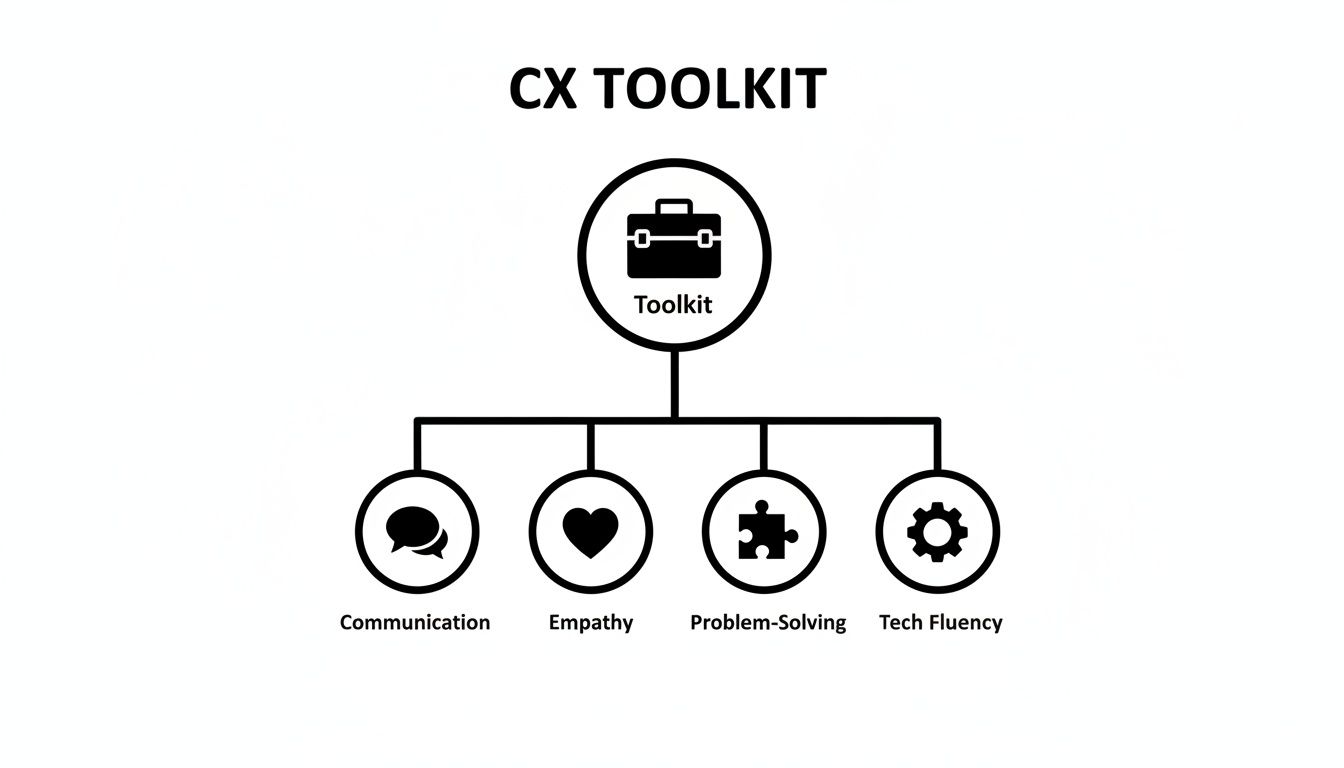
This toolkit shows how core skills like Communication, Empathy, Problem-Solving, and Tech Fluency all fit together. To truly master client service, your team needs a balanced command of both interpersonal abilities and technical know-how, all working in perfect harmony.
1. Communication That Builds Trust
Clear communication is the engine of client service. It’s about more than just speaking or writing well; it’s the ability to break down complex information into simple terms and, just as importantly, to listen actively to get to the real heart of a customer's issue.
In a digital world, this means mastering the nuances of tone in email and chat, where you can't rely on body language or a friendly voice. For instance, a skilled agent handling a chat about a billing error won't just spit out the facts. They'll use phrases like, "I can see how that would be confusing," to acknowledge the customer's frustration before clearly explaining the fix. This simple act can turn a potentially negative moment into a trust-building one.
2. Empathy That Creates Connection
Empathy is your secret weapon for making a client feel heard, respected, and valued—not just like another ticket number. It’s about genuinely understanding and sharing another person's feelings, which is especially vital in multicultural settings where a one-size-fits-all approach is doomed to fail.
An empathetic agent knows a client’s frustration isn't a personal attack. Instead of getting defensive, they align themselves with the client by saying something like, "Let's work together to get this sorted out." This small shift in language de-escalates tension and builds immediate rapport, setting the stage for a collaborative, positive outcome.
3. Problem-Solving That Delivers Solutions
Top-tier problem-solving goes way beyond offering a quick fix. It demands sharp, analytical thinking under pressure to identify the root cause of an issue, not just its symptoms. This is what separates adequate service from truly outstanding service, as it stops problems from happening again and improves the entire customer experience.
Imagine a client reporting a recurring software glitch. A reactive agent might just suggest a reboot. But an agent with strong problem-solving skills will dig deeper. They’ll ask targeted questions, try to replicate the error, and escalate it with detailed notes for the development team, making sure a permanent solution is found.
4. Technical Literacy For Seamless Support
In today's service environment, technical literacy is non-negotiable. Agents have to fly through complex CRM systems, knowledge bases, and a whole suite of support tools with speed and confidence. This fluency lets them pull up client history, find accurate information, and document everything efficiently, all while keeping the conversation flowing naturally.
Without this skill, even the most empathetic agent can cause frustration with long silences and wrong answers. It’s the behind-the-scenes competency that makes a seamless, professional experience possible. To build exceptional client service, understanding and implementing practical customer service best practices is absolutely essential.
5. Cultural And Language Proficiency For Global Reach
The final, critical pillar is cultural and language proficiency. As businesses go global, teams have to connect with a diverse client base. This skill is about more than just speaking another language; it’s about understanding cultural nuances, different communication styles, and local etiquette.
For example, in the UAE, 78% of high-performing contact centers credit their 25% higher customer retention rates to training programs that focus on skills like active listening and cultural sensitivity. Some of the top firms in Dubai even saw their First Contact Resolution (FCR) rates jump from 55% to 72% after rolling out empathy-focused workshops. This shows that investing in these core skills isn't just good practice—it's a proven strategy for measurable business success.
To help you put this into practice, we've developed a competency framework that breaks down what "good" looks like for each skill.
Core Client Service Skills Competency Framework
This table outlines each core skill, defines what it means for a CX team, lists the specific behaviors your agents should demonstrate, and shows how it directly ties back to the numbers that matter.
| Core Skill | Definition for CX Teams | Key Behavioural Indicators | Impact on KPIs |
|---|---|---|---|
| Communication | Conveying information clearly, concisely, and with the right tone across all channels (voice, chat, email). | Uses positive language, avoids jargon, confirms understanding, listens actively without interrupting. | Higher CSAT, lower Average Handle Time (AHT). |
| Empathy | Understanding and validating a client's emotional state to build rapport and de-escalate tension. | Acknowledges client's feelings, shows patience, personalizes the interaction, avoids scripted responses. | Improved Net Promoter Score (NPS), higher Customer Retention. |
| Problem-Solving | Diagnosing the root cause of an issue and finding an effective, lasting solution under pressure. | Asks clarifying questions, uses resources effectively, takes ownership, thinks critically. | Better First Contact Resolution (FCR), fewer repeat contacts. |
| Technical Literacy | Navigating support tools (CRM, knowledge base) efficiently to find information and resolve issues quickly. | Quick system navigation, accurate data entry, troubleshoots basic tool issues, follows processes correctly. | Lower AHT, increased agent productivity. |
| Cultural Proficiency | Adapting communication style to respect and align with a client's cultural background and language. | Recognizes cultural nuances, adjusts formality, uses appropriate greetings, shows patience with language barriers. | Higher CSAT in diverse markets, improved brand reputation. |
Using a framework like this gives you a clear, consistent way to assess skills, identify gaps, and build training that actually makes a difference. It moves your team from just "doing customer service" to strategically delivering exceptional experiences.
How to Accurately Assess Client Service Skills
Knowing what great client service skills look like is one thing. Actually measuring them is a completely different beast. If you want to truly understand your team's capabilities—whether they're in-house or outsourced—you have to move beyond surface-level metrics like Customer Satisfaction (CSAT) scores.
A solid assessment strategy gives you the hard data you need to target training, make smarter hires, and build a service operation that performs consistently. This whole process starts when you shift your focus from only looking at outcomes to also evaluating the behaviors and competencies that drive them. A high CSAT score is great, but it doesn’t tell you why the interaction worked. Was it the agent's empathy? Their quick problem-solving? To get those answers, you need to dig deeper.
Design a Behavior-Focused QA Scorecard
Your Quality Assurance (QA) scorecard is easily the most powerful tool you have for skill assessment. The problem is, most scorecards are obsessed with process compliance—did the agent follow the script? Did they use the right closing line? They completely miss the skills that actually shape the customer experience.
A modern QA scorecard should be built to measure specific behaviors tied to core competencies. That means dedicating sections of your scorecard to skills like:
- Empathy and Rapport: Did the agent actually listen to the customer's feelings? Did they use language that de-escalated the situation instead of just following a script?
- Problem Analysis: Did the agent ask smart questions to get to the root of the issue, or did they just slap a band-aid on the problem?
- Clarity of Communication: Was the explanation simple and jargon-free? Did they make sure the customer understood the fix before ending the conversation?
When you weight these skill-based criteria properly, you get a much clearer picture of an agent's real abilities. It helps you see who's just going through the motions versus who is strategically using their client service skills to deliver great outcomes.
Use Situational and Behavioral Assessments
Static assessments can only tell you so much. To really see how a potential hire or a current team member will act under pressure, you have to simulate the real world. This is where behavioral interviews and Situational Judgment Tests (SJTs) become incredibly valuable.
For hiring, behavioral questions are a must. Don't ask, "Do you have good problem-solving skills?" Instead, say, "Tell me about a time you handled a complex customer issue where the solution wasn't obvious. What steps did you take?" This pushes candidates to give you concrete proof of their skills in action, not just talk about them.
Situational Judgment Tests present realistic work scenarios and ask the individual to choose the most effective course of action. This method effectively gauges decision-making, empathy, and problem-solving instincts in a controlled environment, revealing how someone is likely to react before they ever interact with a live customer.
These methods are far better predictors of on-the-job success than just scanning a resume. They move past what someone claims they can do and show you what they can actually do.
Implement a Skill-Gap Analysis
Once you have all this data from your QA scorecards and other assessments, the next step is to put it all together in a skill-gap analysis. This can be as straightforward as a spreadsheet or a more sophisticated dashboard that maps individual and team skills against the benchmarks you’ve set.
This analysis lets you answer crucial questions:
- Does the team nail the technical stuff but fall short on empathy?
- Is one agent a rockstar problem-solver but struggles with clear written communication?
- Are there team-wide gaps in handling a certain type of difficult inquiry?
This visual map of strengths and weaknesses becomes your roadmap for development. It ensures your training budget is spent where it will make a real difference, targeting the specific client service skills that need work instead of rolling out generic, one-size-fits-all programs. It turns training from a box-ticking exercise into a strategic move that directly fixes business needs and boosts performance where it matters most.
Building a High-Impact Training Curriculum
Once you've pinpointed the skill gaps on your team, the real work begins: building a development program that actually closes them. A high-impact training curriculum for client service skills isn’t a one-and-done event. It's a continuous journey. The most effective programs I've seen use a blended learning approach, mixing different methods to build both head knowledge and hands-on ability.
This strategy shifts the focus from passive learning to active skill development. It's built on a simple truth: you can't learn empathy from a slideshow. An agent needs to grasp the theory, sure, but then they need to see it in action and practice it in a safe space before they ever talk to a real client.
The Blended Learning Framework
A solid training framework layers different learning styles to make skills stick. This approach ensures that knowledge isn't just memorized for a test but becomes second nature in an agent's daily workflow. This is how you create lasting behavioral change.
A powerful blended model brings together three core components:
- E-learning Modules: These are perfect for laying the groundwork. Self-paced online courses can efficiently cover product details, company policies, and the basic principles of communication. This frees up precious workshop time for the tough stuff.
- Interactive Workshops: This is where theory gets real. Live sessions, whether in-person or virtual, should be heavy on role-playing difficult scenarios. It’s the only way for agents to practice navigating emotionally charged conversations and get immediate, constructive feedback.
- Mentorship Programs: Real growth happens with ongoing support. Pairing new or developing agents with seasoned pros provides a lifeline for real-world advice and encouragement, helping solidify skills long after the formal training wraps up.
This kind of structured approach has shown remarkable results in the region. Since Abu Dhabi's free zones mandated service skills certification in 2021, organizations have seen a 35% improvement in support consistency and a drop in agent attrition from 45% to 28% annually. You can find more findings on service skill mandates on electroiq.com.
Sample Module: Complex Problem-Solving
Let's break down how this works for a single, critical skill. This isn’t just about teaching agents to find answers; it’s about giving them a structured method for investigation that builds client confidence and stops issues from coming back.
Module Title: The Root Cause Resolution Method
Objective: Equip agents to diagnose the underlying cause of a client's issue, not just the surface-level symptom, to prevent recurrence.
Key Activities:E-Learning (45 mins): Introduce the "Five Whys" technique for root cause analysis and walk through case studies of recurring support tickets.Role-Playing Workshop (90 mins): Agents work in pairs on simulated complex tickets, practicing diagnostic questioning and documenting their investigation process.Mentorship Follow-Up: For one month, mentors review one complex ticket per week with their mentee, offering guidance on their problem-solving approach.
Adapting Training for Remote Teams
Training a distributed team has its own set of challenges, but modern tools offer some fantastic solutions. Instead of gathering everyone in one room, you can use virtual simulation platforms that immerse remote agents in realistic customer scenarios.
Gamified learning is another powerful tool in the toolbox. By turning training modules into friendly competitions with leaderboards and badges, you can seriously boost engagement and knowledge retention. The goal is to make learning feel interactive and connected, even when your team is miles apart. For anyone looking to build out their programs, our guide on designing customer service training is a great place to start.
Ultimately, a winning curriculum fosters a culture of continuous learning. It transforms training from a one-time onboarding task into a core part of professional development, which pays off in both agent morale and the quality of your client service.
Integrating Skills Into Your Hiring and Outsourcing
Knowing which client service skills matter is the first step. Actually acquiring them is where your strategy comes to life.
Whether you're building a team in-house or picking an external partner, the goal is identical: find people with the right mix of emotional intelligence, technical skill, and a genuine drive to solve problems. This takes a focused approach that digs much deeper than a simple resume.
For your in-house teams, this means designing your entire hiring process to actively uncover these core skills. For those looking at outsourcing, it demands a tough evaluation of a vendor’s ability to grow and maintain the high standards your brand represents. The right questions and a clear evaluation framework are your best tools, no matter where your team is located.
Refining Your In-House Hiring Process
When hiring internally, you have to move past just asking about previous jobs. Your interview process should be built to see client service skills in action. This means using behavioral questions that force candidates to give you real-world examples of how they’ve handled specific situations.
Instead of asking, "Are you a good problem-solver?" try something more revealing, like:
"Describe a time a customer came to you with a vague or confusing issue. What specific steps did you take to figure out the real problem, and what was the final result?"
This kind of question forces candidates to walk you through their thought process and communication style. It separates the people who can talk about great service from those who can actually deliver it.
Questions That Uncover Core Competencies
To build a well-rounded team, you need to target your questions to assess the different pillars of client service. Here are a few examples you can weave into your interviews:
- To Assess Empathy: "Tell me about a time you had to deliver bad news to a frustrated client. How did you manage their emotional reaction while guiding them toward a solution?"
- To Assess Problem-Solving: "Walk me through a situation where you had to find a solution that wasn't in your training manual or knowledge base. What was your thought process?"
- To Assess Technical Literacy: "Describe how you've used CRM or support software to personalize a customer interaction. What specific information did you use?"
These questions open a window into a candidate's instincts and true capabilities, giving you a much stronger predictor of their future performance than a simple skills checklist ever could.
Evaluating Outsourcing Partners
When you choose to outsource, you're handing over your brand's reputation to a partner. Your evaluation has to go way beyond just cost and headcount. A potential BPO partner's commitment to developing and measuring client service skills should be a top priority in your due diligence.
For these kinds of complex partnerships, having the right internal team to manage the relationship is absolutely critical. This is where a dedicated partner relationship manager can be a game-changer.
To find a partner who acts as a true extension of your team—not just a contractor—you need a structured way to compare potential vendors. It’s crucial to ask sharp questions about their internal processes to see if they truly align with your standards.
The checklist below provides a solid framework for evaluating potential BPO partners on their ability to hire, train, and maintain high-quality client service teams.
BPO Partner Evaluation Checklist for Client Service Skills
| Evaluation Criteria | Key Questions to Ask | Indicators of Excellence | Red Flags to Watch For |
|---|---|---|---|
| Recruitment & Hiring | How do you screen for empathy and problem-solving skills? Can you share your interview scorecards? | Uses behavioral questions and scenario-based testing. Looks for cultural fit, not just technical ability. | Focuses solely on previous call center experience or typing speed. Vague answers about soft skill assessment. |
| Training & Onboarding | What does your new-hire training curriculum cover? How much is dedicated to soft skills vs. product knowledge? | Blended learning approach (e-learning, role-playing, live coaching). Ongoing training, not just a one-time event. | Training is 100% product-focused. No mention of communication, empathy, or de-escalation techniques. |
| Quality Assurance (QA) | Can we review your QA scorecard? What percentage of it measures soft skills and customer sentiment? | QA scorecard is balanced, weighting empathy and resolution equally with process adherence. Regular calibration sessions. | QA is purely a compliance checklist. "Did the agent follow the script?" is the only thing that matters. |
| Performance Management | How are agents coached on their performance? How do you handle underperforming team members? | Coaches use specific examples from QA scores to guide agents. Focus is on development, not just punishment. | Vague coaching processes. High agent turnover is explained away as "industry standard." |
| Cultural Alignment | How do you foster a customer-centric culture within your teams? What are your core company values? | Leadership consistently talks about customer value. Agent recognition programs reward great service moments. | Culture is centered on efficiency metrics (e.g., AHT) above all else. No clear company values. |
Using a structured approach like this ensures you dig into the things that really matter for long-term success. It helps you move past the sales pitch and see how a partner truly operates, ensuring they can protect and enhance your customer relationships.
The Synergy Between Human Skills and AI
The conversation around technology in customer service is finally shifting. It’s no longer a "humans versus machines" debate. Instead, we’re asking how they can work together, and the answer is that AI isn't here to replace the essential client service skills your team has—it's here to amplify them.
Think of AI as the ultimate assistant. It’s brilliant at handling the repetitive, predictable tasks that eat up an agent's day. We’re talking about answering basic FAQs, categorizing tickets, or gathering a customer’s initial information before a human ever steps in.
By automating these routine jobs, AI frees up your agents to focus on what people do best: managing complex, emotionally charged interactions. This is where empathy, critical thinking, and advanced problem-solving are non-negotiable. It creates a powerful partnership where technology handles the simple stuff, and your people handle the meaningful connections.
AI as a Co-Pilot for Service Agents
Modern AI tools have evolved into a real-time co-pilot for agents, feeding them information and insights during live interactions. This completely transforms an agent’s role from a simple responder into a strategic problem-solver who’s armed with data-driven guidance.
This collaboration shows up in some really practical ways:
- Intelligent Routing: AI can instantly analyze an incoming query and send it to the agent with the perfect skill set, whether that’s deep technical knowledge or a proven talent for de-escalating frustrated customers.
- Real-Time Sentiment Analysis: During a chat or call, the AI can monitor a customer’s tone and language, giving the agent subtle cues about their emotional state. This allows the agent to proactively adjust their communication style and build better rapport.
- Knowledge Suggestions: Instead of manually searching for information, an agent can rely on AI to listen to the conversation and automatically pull up relevant articles from the knowledge base. This leads to much faster, more accurate resolutions.
This human-AI partnership is already delivering impressive results. A recent ADCCI study shows that 86% of high-performing UAE teams achieve a 75% First Contact Resolution on phone channels when trained for flexibility. We’re also seeing 19% call cost reductions for firms that give their skilled agents AI tools.
Evolving Training for AI Collaboration
To build a service strategy that lasts, your training has to evolve. "AI collaboration" needs to become a core competency that you actively develop in your team. Your agents need training not just on how to use a new tool, but on how to interpret AI-driven insights and apply them effectively.
Training should focus on helping agents understand when to trust an AI suggestion and when to apply their own judgment. The goal is to create confident agents who see AI as a supportive partner, not a replacement.
This means shifting training away from process-heavy modules and toward programs focused on critical thinking and emotional intelligence. For anyone looking to upgrade their team's capabilities, exploring different customer care service skills is a great place to start. By doing this, you build a resilient service operation that uses the best of both human talent and technological innovation, ensuring your client service skills remain a powerful competitive advantage.
Frequently Asked Questions About Client Service Skills
Even with a solid strategy in place, questions always pop up when you're trying to build up your team's client service skills. This section cuts right to the chase, giving you direct, actionable answers to the questions CX leaders ask most often. Think of it as a quick reference to help you put the core ideas from this guide into practice.
What Is the Single Most Important Client Service Skill ?
If you had to pick just one, empathy is the skill that underpins everything else. It’s the foundation that makes genuine connection, sharp problem-solving, and clear communication possible.
Without the ability to actually understand and acknowledge how a client is feeling, even the most technically perfect solution can come across as cold and robotic. That kind of interaction doesn't build the long-term loyalty you're after. Empathy is what turns a transaction into a relationship. A recent study drove this home, showing that 7 out of 10 consumers have spent more money with a company just because they delivered great, empathetic service.
Empathy isn't just about being nice; it's a strategic tool. It allows an agent to de-escalate tension, accurately diagnose the true nature of a problem, and build the kind of trust that makes a customer feel valued and understood.
How Can I Measure Soft Skills Like Empathy or Patience ?
Measuring soft skills feels tricky because you can't just slap a number on them. The key is to stop trying to measure the feeling and start measuring the behaviors that demonstrate the skill. You can do this by weaving behavioral analysis right into your Quality Assurance (QA) process.
Here are a few ways to get tangible data :
- Behavior-Focused Scorecards: Ditch the generic QA forms. Design scorecards that look for specific actions, like, "Did the agent acknowledge the client's frustration?" or "Did they ask clarifying questions without interrupting?"
- Sentiment Analysis: Let AI do some of the heavy lifting. Use tools that analyze call transcripts and chat logs for shifts in client sentiment. You can then correlate positive changes directly with specific agent behaviors.
- Customer Feedback: Be direct in your post-interaction surveys. Ask questions like, "Did you feel the agent took the time to understand your issue fully?"
These methods give you real data on how well soft skills are being applied, showing you exactly where you need to focus your coaching efforts.
Which Skill Is Most Impacted by AI ?
Technical literacy is the skill being most profoundly reshaped by AI. It's not just about knowing your way around a CRM anymore. It’s evolved into what you could call "AI collaboration."
Today's best agents know how to work alongside AI to deliver faster, smarter service. This means knowing how to interpret real-time AI suggestions, pull up AI-surfaced knowledge articles in a flash, and trust AI to handle the routine stuff. When agents get this right, they free up their uniquely human skills—like complex problem-solving and emotional intelligence—for the moments where they matter most. It creates a powerful partnership between your tech and your talent.


