


From Voice Hub to Experience Engine
Think of your customer support operation as a central nervous system. For decades, the call center was its voice box. It was a physical hub where agents with headsets answered phones, solved problems, and made sales pitches. The model was simple and powerful in a world that ran on phone calls.
But the world changed. Customers now reach out through a dozen different channels, from email and web chat to social media and SMS. This shift forced the old model to evolve. A simple voice hub just wasn't enough anymore.
Today’s call center is rarely just a room full of agents taking calls. It’s now a critical piece of a much larger puzzle, one designed to manage and improve the entire customer journey. This brings us to a key distinction you need to understand.
Call Centre vs Contact Centre
The real difference comes down to the channels they handle. Let's break it down simply:
- A Call Center is a voice specialist. Its entire world revolves around managing inbound and outbound phone calls. It’s the original, optimized for telephone-based service.
- A Contact Center is an omnichannel generalist. It manages customer conversations across every channel—voice, email, live chat, social media, you name it. A call center is often just one department within a broader contact center strategy.
This isn't just about semantics; it's a strategic shift in how companies think about customer interaction. A call center is built for voice efficiency. A contact center is designed to deliver a seamless, consistent experience no matter how a customer decides to connect.
Both have their place, but knowing the difference is the first step toward building a support structure that actually works. The synergy between them is critical, especially when combining human expertise with new technologies. To explore this further, you can learn more about leveraging AI and human agents for the future of hybrid customer service.
A call center is the foundation upon which modern customer experience is built. While new channels have emerged, the importance of a clear, empathetic human voice to resolve complex issues remains a powerful tool for building brand loyalty and trust.
Ultimately, whether your operation is a dedicated call center or part of a bigger contact center, the mission is the same: to be the direct line to your customers. It's where problems get solved, feedback is heard, and relationships get stronger, one conversation at a time.
Choosing Your Call Centre Operating Model
Picking the right structure for your call center is a lot like choosing the engine for a car. Your operating model is what will power your entire customer service strategy, shaping how your team engages with customers and what goals they can realistically achieve. Not all call centers are created equal, and understanding the four foundational models is the first step toward building an operation that actually works.
These models—inbound, outbound, blended, and virtual—each serve a distinct purpose. The right choice boils down to what you need your call center to do. Are you solving technical problems? Generating sales leads? Or offering flexible support from anywhere in the world?
Inbound Call Centres: The Problem Solvers
At its core, an inbound call center is reactive. Its entire purpose is to handle incoming calls from customers. Think of it as the central hub for any customer-initiated contact, staffed by agents trained to answer questions, resolve complex issues, and provide on-the-spot support.
For instance, when a customer calls a software company for technical help or a banking client needs to query a strange transaction, they're connected to an inbound agent. The workflow is built around one thing: responding to customer needs efficiently. These teams are your front line for customer support and retention.
Outbound Call Centres: The Proactive Connectors
An outbound call center, on the other hand, is all about being proactive. In this model, agents are the ones making the calls out to customers or prospects. It’s the engine for sales, telemarketing, fundraising campaigns, and market research. The goal isn’t to wait for the phone to ring—it's to make it ring.
A sales team following up on web leads or a research firm conducting phone surveys are classic examples of outbound operations. Here, success isn't measured by how quickly a problem is solved, but by metrics like connection rates, lead conversions, and appointments set. It’s about creating opportunities from scratch.
The modern call center has moved far beyond being just a voice hub. It’s now a sophisticated experience engine, as this diagram shows.
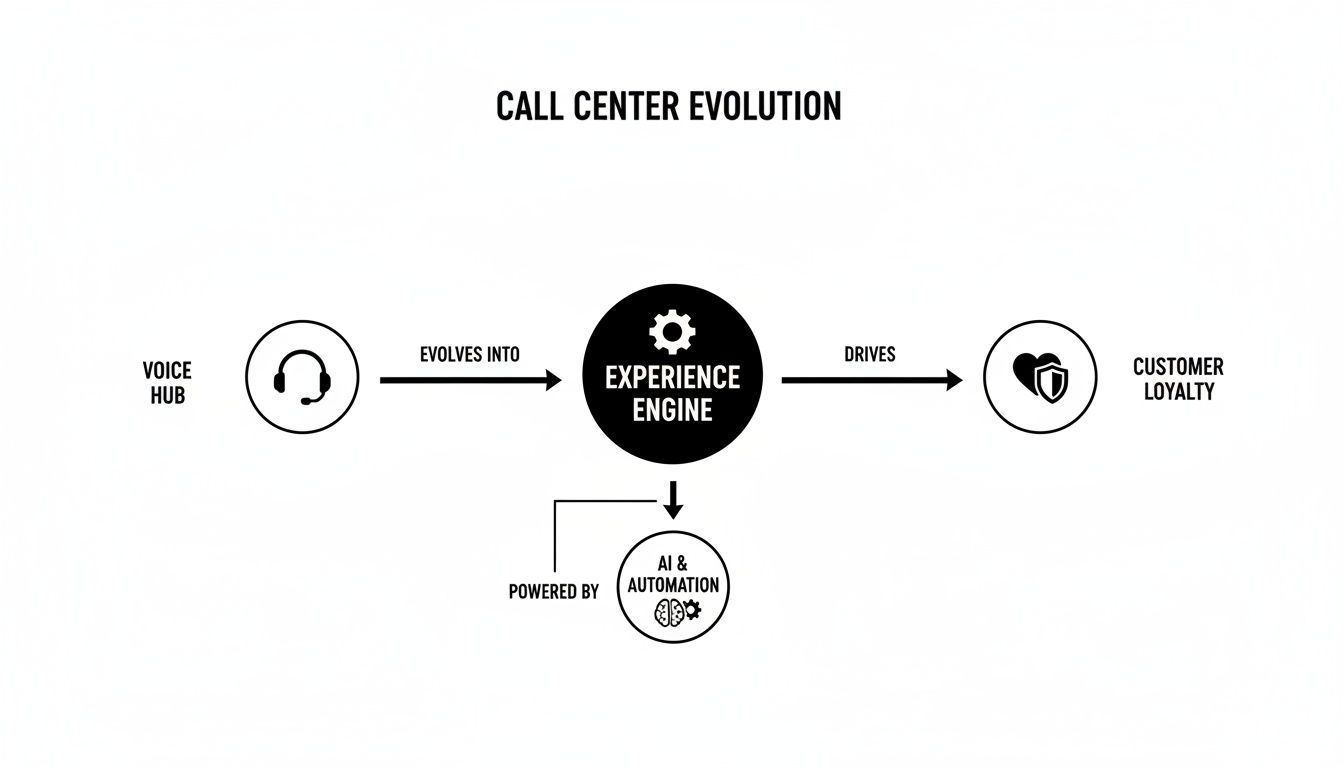
This evolution from a basic voice function to an advanced experience driver is powered by smart technology and a relentless focus on building customer loyalty.
Blended and Virtual Models: The Efficiency Experts
Many businesses quickly realize that operating purely in one mode—either inbound or outbound—is just not efficient. This is where blended and virtual models change the game.
- Blended Call Centres: These operations are the best of both worlds, combining inbound and outbound functions. An agent might handle support calls during the morning rush and then switch to making outbound sales calls when things quiet down. This model squeezes every ounce of productivity out of your team.
- Virtual Call Centres: A virtual call center isn't tied to a physical office. Agents work remotely from anywhere, using cloud-based software to connect with customers. This approach offers incredible flexibility, slashes overhead costs, and lets you hire the best talent, no matter where they live.
The most effective operating model is never a one-size-fits-all solution. It's a strategic choice that should be a direct reflection of your primary business objectives, whether that's world-class customer support, aggressive sales growth, or maximum operational flexibility.
To help you map out your options, the table below breaks down these four core models, highlighting their functions, ideal use cases, and key benefits.
Comparing Call Centre Operating Models
| Model Type | Primary Function | Example Use Case | Key Benefit |
|---|---|---|---|
| Inbound | Responding to customer-initiated calls | Technical support, order processing, and general customer service queries. | High customer satisfaction and problem resolution. |
| Outbound | Proactively contacting customers/prospects | Sales calls, telemarketing, appointment setting, and market research. | Lead generation and revenue growth. |
| Blended | Combining inbound and outbound tasks | Agents handle support tickets and then conduct customer satisfaction surveys. | Increased agent productivity and operational efficiency. |
| Virtual | Handling calls from remote locations | A global team providing 24/7 support across different time zones. | Reduced costs and access to a wider talent pool. |
By carefully weighing these models against your business needs, you can build a call center structure that not only meets customer expectations but also becomes a true engine for growth.
The Technology Stack That Powers Performance

Think of a modern call centre like a high-performance kitchen. A great chef needs more than just fresh ingredients; they rely on sharp knives, precise ovens, and a well-organized workflow. In the same way, a call centre depends on a sophisticated technology stack to deliver a five-star customer experience. Without the right tools, even the most talented agents will struggle.
This technology is the invisible framework holding everything together. It ensures every call is handled efficiently, intelligently, and with the right context. It’s what automates the repetitive tasks, arms agents with critical information on the spot, and gives managers the data they need to make smart decisions. Let’s unpack the core components that make it all click.
Core Systems for Call Management
At the heart of any call center call centre operation are the systems that manage the flow of conversations. These are the traffic controllers of the customer service world, directing calls to their destinations and making sure nothing gets lost in transit.
- Automatic Call Distribution (ACD): An ACD is the intelligent routing system that connects incoming calls to the best available agent. It uses pre-set rules—based on agent skills, availability, or language—to make sure a customer with a technical question actually reaches a tech expert, not a billing specialist.
- Interactive Voice Response (IVR): You know this one: the automated menu that greets you when you call a company. An IVR lets customers self-serve for simple tasks, like checking an account balance or tracking an order, just by pressing a few keys. This frees up human agents for the more complex issues that really need their attention.
These systems work in tandem to create an organized and efficient front door for your customer service. They handle the initial triage, so when an agent finally picks up, they’re already set up for success.
Empowering Agents with Data and Insights
Once a call reaches an agent, a whole other set of tools comes into play. These technologies provide the context and support needed to resolve issues quickly and personally, turning a simple phone call into a positive brand interaction.
The most critical tool here is the Customer Relationship Management (CRM) software. A CRM is the secret ingredient for personalized service, acting as a central hub for all customer information. When a call comes in, the agent’s screen instantly populates with the caller’s history—past purchases, previous support tickets, and any important notes.
A well-integrated CRM turns an anonymous caller into a known customer. It allows an agent to say, "I see you contacted us last week about your delivery," instead of forcing the customer to repeat their entire story from scratch.
Beyond the CRM, other key technologies support agent performance:
- Workforce Management (WFM): WFM software is a manager's best friend. It helps forecast call volumes, build agent schedules, and track adherence, ensuring you have the right number of people working at the right times to avoid both overstaffing and frustratingly long wait times.
- Artificial Intelligence (AI) and Automation: AI is quickly becoming a non-negotiable part of the call centre toolkit. It can provide real-time agent assistance by suggesting answers, transcribing calls, and even analyzing customer sentiment on the fly. These capabilities are some of the emerging technologies transforming customer service outsourcing.
This growing reliance on cloud-based technologies is fueling massive market expansion. The Middle East & Africa Contact Center as a Service (CCaaS) market, for instance, is projected to grow from USD 487.9 million to USD 1,570.8 million by 2030. This growth is driven by the adoption of tools like AI-powered IVR and advanced call distribution.
By investing in an integrated technology stack, a call center transforms from a reactive support function into a proactive engine for customer loyalty and business growth.
Measuring Success With the Right Metrics

How do you know if your call centre is actually working well? A room full of busy agents isn't a reliable sign of success. The real answer is buried in the data, and knowing which numbers tell the most important stories is what separates a cost center from a value driver.
Measuring performance is all about moving beyond guesswork and gut feelings. You need to track specific Key Performance Indicators (KPIs) that reveal the true health of your customer interactions, your agent efficiency, and your overall operation. These metrics are your diagnostic tools—they help you spot problems, make smart decisions, and continuously improve.
Without clear metrics, a call center call centre is flying blind. You’re left wondering if long wait times are killing customer loyalty or if your agents are actually resolving issues on the first try. Let's dig into the core metrics that genuinely matter.
Balancing Efficiency With Quality
The best call centers strike a delicate balance between speed and quality. If you focus too heavily on one, the other almost always suffers. That’s why you have to track metrics from both sides of the equation.
One of the most common efficiency metrics is Average Handle Time (AHT). This measures the entire duration of a customer interaction, from the second an agent picks up the phone until all the post-call admin work is done. A low AHT can signal efficiency, but it needs to be monitored closely. If it drops too low, it might be a red flag that agents are rushing through calls and leaving issues unresolved.
On the quality side of things, First Call Resolution (FCR) is king. This metric tells you the percentage of calls where the customer's problem was solved completely on the first attempt, with no need for a follow-up. A high FCR is a powerful sign of both agent competence and customer satisfaction. After all, nobody wants to call back a second time for the same issue.
Customer Satisfaction (CSAT) is the ultimate verdict on your service quality. It’s usually measured with a simple post-call survey ("How satisfied were you with your interaction today?") and gives you direct, unfiltered feedback on how customers feel about the support they just received.
Defining Performance With Service Level Agreements
When you bring an outsourced call centre into the mix, these metrics become even more critical. They become the foundation of your Service Level Agreement (SLA)—the formal contract that lays out the exact performance standards your partner must meet.
An SLA isn't just a piece of paper; it’s a promise. It translates your business goals into measurable targets that hold your BPO partner accountable. The most common metrics baked into an SLA include:
- Call Answer Time: The percentage of calls answered within a specific timeframe (e.g., 80% of calls answered in 20 seconds).
- Abandonment Rate: The percentage of callers who hang up before ever speaking to an agent. A high rate is a glaring sign that your wait times are unacceptably long.
This data-driven approach is essential for success, especially in competitive markets. The Middle East Contact Center Analytics Market, valued at over USD 125 million, shows that 70% of businesses rank customer experience as their top priority. With high internet penetration, analytics are crucial for optimizing metrics like FCR to improve customer loyalty. You can read the full research about these market findings. By embedding these KPIs into an SLA, you ensure your outsourcing partner is fully aligned with your commitment to excellent service.
The In-House vs BPO Decision Framework
One of the biggest strategic calls you'll make for your customer service is whether to build a call centre in-house or partner with a Business Process Outsourcing (BPO) provider. This choice is about way more than just cost—it defines your brand's voice, your ability to adapt, and even your potential for growth.
There’s no magic formula here. The right answer is simply the best fit for your business, right now. Making that call means weighing the control and cultural fit of an internal team against the scale, expertise, and cost advantages a BPO can bring to the table. It's the classic "build vs. buy" dilemma.
The Case for an In-House Call Centre
An in-house call centre gives you ultimate control. Your agents are your employees, living and breathing your company culture, product details, and brand values every single day. This direct oversight means the customer experience is a pure reflection of your brand promise.
Building your own team makes the most sense when:
- Brand identity is everything: If your customer service is your brand, having your own people deliver that experience is non-negotiable for consistency.
- You deal with complex or sensitive issues: For industries wrestling with tricky technical problems or private data, a highly trained internal team provides better security and deeper expertise.
- You need tight integration: When your support team has to be in constant sync with product, engineering, or sales, having everyone under one roof is a massive win.
But all that control comes with a hefty price tag. The upfront investment in tech, hiring, and office space can be huge, and you're on the hook for all the ongoing operational costs.
The BPO Advantage Scalability and Expertise
Going with a BPO flips the script completely. Instead of building from scratch, you’re buying immediate access to a ready-made infrastructure, a trained workforce, and experienced management. It's the fastest way to launch or scale a professional call center operation without the massive upfront cost and effort.
A BPO is often the smart move when:
- You need to scale fast: Outsourcers can add agents in a flash to handle seasonal rushes or explosive growth, offering a level of flexibility that’s tough to replicate internally.
- Cost efficiency is a major driver: BPOs use economies of scale to keep operational costs down, especially with offshore or nearshore models.
- You need specialized skills: Many BPOs have deep expertise in specific industries or offer multilingual support that would be a nightmare to build and pay for yourself.
The trick to making it work is finding a provider that genuinely aligns with your company’s values. It’s also vital to master the art of blending your external and internal teams. You can learn more about how to seamlessly integrate outsourced support with your in-house team in our detailed guide.
Exploring Outsourcing Models Nearshore vs Offshore
Once you decide to outsource, you have another choice to make: nearshore or offshore?
Offshoring means partnering with a BPO in a distant country, usually to get the biggest cost savings. Nearshoring involves outsourcing to a neighboring country, which often means closer time zones and cultural alignment.
Each model has its own pros and cons. An offshore call centre in a place like the Philippines can slash costs and give you access to a massive, skilled talent pool. On the other hand, a nearshore partner in a nearby country might offer better time zone overlap and cultural similarities, which can be a game-changer for certain customer bases.
The demand for these services is booming. The call centers market in the Middle East and Africa is expected to grow at a 12.2% CAGR, hitting over USD 6.3 billion. This growth is fueled by businesses outsourcing to get 24/7 coverage and multilingual agents. You can discover more insights about these regional market trends on Cognitive Market Research.
In the end, the right decision comes down to a careful balance between cost, control, and what your customers truly need.
Your Call Center Implementation Roadmap
Turning big ideas into a high-performing operation hinges on a clear, actionable plan. This step-by-step roadmap will guide you through launching a new call center or fine-tuning your current one, moving strategic decisions from the whiteboard to the real world.
Think of this as your checklist for building an operation that delivers exceptional service, confidently and consistently.
Phase 1: Foundational Strategy
Before you even think about headsets or software, you need to define what success actually looks like. This first phase is all about aligning your call center call center goals with the bigger business objectives, ensuring your investment pays real dividends.
- Define Business Objectives: Start with the most important question: what is this call center for? Is the goal to slash customer churn by 15%? Drive more sales conversions? Or simply offer faster, more effective technical support? These goals will steer every other decision you make.
- Select Your Operating Model: With your objectives in hand, it's time to pick the right structure. Will you need an inbound team for support, an outbound team for sales, a blended model to maximize efficiency, or a virtual setup for ultimate flexibility?
- Establish a Budget: Now, let's talk money. You need to map out your financial framework, covering everything from initial setup costs for tech and recruitment to ongoing expenses like agent salaries, software licenses, and training. A realistic budget is your best defense against costly surprises down the road.
Phase 2: Technology and Infrastructure
With a solid strategy, you can now build the technological backbone of your operation. The right tools don’t just support your agents; they empower them to create seamless customer journeys.
- Technology Stack Selection: This is where you choose your core systems. Think Automatic Call Distribution (ACD) for smart routing, Interactive Voice Response (IVR) for self-service options, and a CRM to give agents a 360-degree view of every customer.
- Integration Planning: Your systems have to talk to each other. A CRM that integrates smoothly with your call management platform isn't a nice-to-have; it's non-negotiable for delivering personalized, context-aware service.
- Compliance and Security Setup: Don't treat security as an afterthought. You need to establish your protocols from day one, configuring systems to protect sensitive customer data and ensuring your operations adhere to all regional regulations.
A successful call center implementation isn't just about buying software; it's about creating a cohesive ecosystem where technology, processes, and people work together seamlessly. This integration is the key to unlocking true operational efficiency and superior customer experiences.
Phase 3: People and Processes
Technology is only half the battle. A truly world-class call center is powered by talented people and guided by smart, well-defined processes. This phase is all about building your team and the workflows that set them up for success.
- Develop Staffing and Hiring Plans: Start by creating detailed agent profiles and a solid recruitment strategy. What skills are you looking for? Is it deep technical expertise or exceptional empathy? Know who you need, and build a plan to find and hire them.
- Design Training Programs: Your agents need more than a login. Build out comprehensive onboarding and continuous training modules that cover product knowledge, system navigation, customer service protocols, and critical de-escalation techniques.
- Set Metrics and SLAs: Define your Key Performance Indicators (KPIs) and Service Level Agreements (SLAs) from the outset. You need clear, measurable targets for things like First Call Resolution, Average Handle Time, and Customer Satisfaction to accurately gauge performance.
- Establish Quality Assurance (QA) Processes: Create a framework for monitoring interactions and providing regular, constructive feedback to your agents. A strong QA process is absolutely essential for maintaining high service standards and driving continuous improvement across the board.
Got Questions? We've Got Answers
When you're diving into the world of customer service operations, a lot of questions come up. We've put together some straightforward answers to the most common queries leaders have when building or managing a call center, designed to give you clarity right away.
What's the Real Difference Between a Call Center and a Contact Center?
Think of a call center as a specialist. It's built from the ground up to handle one thing exceptionally well: voice calls. Whether it's customers calling in for support or your team making outbound sales calls, the focus is entirely on the phone.
A contact center, on the other hand, is the all-rounder. It’s designed to manage customer conversations across every channel you can think of—email, live chat, social media messages, and SMS, right alongside traditional phone calls. So, while a call center can be a vital part of a contact center, a contact center does a whole lot more than just answer the phone.
How Much Should I Budget to Set Up a Call Center?
The cost can swing wildly depending on the path you take. If you build an in-house call center, you're looking at a serious upfront investment. You'll be paying for the technology, the office space, and the hiring process, which gives you total control but comes with a hefty price tag.
Outsourcing to a BPO or using a cloud-based service (CCaaS) changes the game. This approach turns that big initial expense into a predictable monthly operational cost, usually per agent, making it much easier to budget. For those looking for the leanest option, the virtual call center model often wins out by cutting physical office costs completely.
It's easy to get fixated on the initial setup cost, but the real number to watch is the total cost of ownership over time. A flexible model that can scale with you often delivers far better long-term value than one that looks cheap on day one but costs a fortune to maintain.
Which KPIs Actually Matter for Agent Performance?
To get a true picture of how your agents are doing, you need a balanced view that looks at both quality and efficiency. Don't get lost in a sea of metrics; these three are essential for understanding performance in any call center.
- First Call Resolution (FCR): This one is huge because it tells you about effectiveness and customer happiness at the same time. When an agent solves an issue on the first try, it’s a win for absolutely everyone involved.
- Average Handle Time (AHT): AHT is your go-to metric for efficiency. But you have to watch it carefully. If agents are rushing just to keep their AHT low, service quality will inevitably suffer.
- Customer Satisfaction (CSAT): At the end of the day, this is what it's all about. CSAT gives you direct, unfiltered feedback on whether the customer felt heard and helped.


